
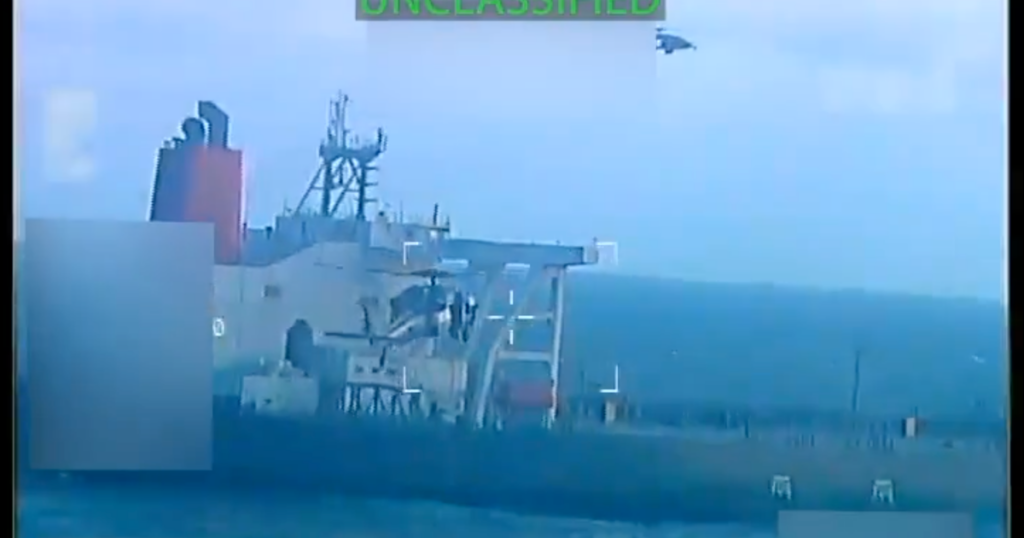
On Wednesday, the U.S. successfully seized an oil tanker named The Skipper off the Venezuelan coast amid rising tensions between the Trump administration and Venezuelan President Nicolás Maduro. The operation included advanced military tactics involving special operations forces and helicopters, marking a significant maneuver in U.S. efforts to curb oil trafficking that circumvents sanctions. The Skipper, previously sanctioned for its role in oil smuggling, is set to undergo legal proceedings as part of the seizure process.
| Article Subheadings |
|---|
| 1) Operation Details and Forces Involved |
| 2) Current Status of the Vessel and Its Cargo |
| 3) Background on Sanctions Imposed |
| 4) Reactions from U.S. Authorities |
| 5) Venezuelan Government’s Response |
Operation Details and Forces Involved
The operation to seize The Skipper commenced early Wednesday morning, shortly after the tanker departed from port in Venezuela. According to military officials, it was a well-coordinated effort involving special operations forces, the U.S. Coast Guard, and Navy personnel. The USS Gerald R. Ford, an aircraft carrier stationed in the region for several weeks, served as the launch point for the mission.
The boarding team comprised two helicopters, 10 members from the U.S. Coast Guard, and an equal number of Marines. This elite group, known as the Maritime Security and Response Team, is based in Chesapeake, Virginia and specializes in maritime interdiction operations. The authorities noted that such swift boarding tactics conducted from helicopters at sea are rare, although they align with the training activities undertaken by the boarding team in preparation for such scenarios.
In a brief video released by Attorney General Pam Bondi, armed personnel were seen descending onto the vessel’s deck via a helicopter. Bondi elaborated that the operation executed a seizure warrant, as the tanker allegedly served to transport sanctioned oil from both Venezuela and Iran, further escalating a complex geopolitical situation involving illicit oil trade.
Current Status of the Vessel and Its Cargo
Following the seizure, White House Press Secretary Karoline Leavitt informed reporters that the tanker is going through a forfeiture process. Leavitt stated, “The United States currently has a full investigative team on the ground, on the vessel, and individuals on board the vessel are being interviewed and any relevant evidence is being seized.”
Looking ahead, Leavitt confirmed that the tanker and its cargo are slated to go to a U.S. port for further evaluation. “The United States does intend to seize the oil,” she noted, emphasizing that a legal process governs the seizure of the oil. This process underscores the complexities involved in handling such international maritime operations, particularly concerning sanctioned goods.
Background on Sanctions Imposed
The U.S. Treasury Department imposed sanctions on The Skipper in 2022, impacting its operations due to its alleged involvement in oil smuggling that financially supports the Iranian Revolutionary Guard Corps and Hezbollah, a militant group supported by Iran. The ship was earlier known as The Toyo and had played a significant role in what has been described as a network facilitating illegal oil transport.
Since then, the vessel has been a component of operations designed to circumvent U.S. sanctions, drawing the attention of several governmental departments tasked with national security and economic integrity. The connection of the ship to Russian oil magnate Viktor Artemov complicates the situation, as he is known for utilizing an extensive and murky network of maritime assets to evade restrictions on Iranian petroleum exports. Thus, the sanctions aimed to disrupt these networks, creating significant geopolitical ramifications.
Reactions from U.S. Authorities
U.S. officials have voiced strong support for the actions taken during the operation. Attorney General Pam Bondi stated that the seizure was “completed safely and securely” and highlighted ongoing investigations in collaboration with the Department of Homeland Security to halt the transport of sanctioned oil. Her comments reflect a robust approach to U.S. maritime security and international law enforcement.
The Coast Guard, as the leading agency for this operation, reinforced its jurisdictional mandate in engaging such interventions at sea. The legitimacy of the authority exercised during the mission has been pivotal, given the legal complexities surrounding international shipping and the regulations controlling the seizure of sanctioned goods. The results of the operation may influence future engagements in similar situations, as the U.S. reassesses its tactical capabilities in maritime enforcement.
Venezuelan Government’s Response
In stark contrast to the U.S. actions, the Venezuelan government issued a statement denouncing the seizure as “a shameless robbery and an act of international piracy.” This declaration reflects the broader deterioration in U.S.-Venezuela relations, characterized by a series of sanctions imposed by the U.S. aimed at crippling the Venezuelan economy and its leadership.
The Venezuelan administration, echoing sentiments of capitalist exploitation, condemned the U.S. operation as an infringement on national sovereignty. Officials continue to assert that the political and economic struggles faced by Venezuela are exacerbated by external interventions and aggressive policies implemented by the Trump administration. The geopolitical landscape surrounding oil trade has become increasingly contentious, with both countries positioning themselves amid global attention.
| No. | Key Points |
|---|---|
| 1 | The U.S. seized the oil tanker The Skipper off the coast of Venezuela amid oil smuggling allegations involving sanctioned countries. |
| 2 | The operation involved elite U.S. military forces, including the Coast Guard and Navy, supported by aerial assets from the USS Gerald R. Ford. |
| 3 | The seized vessel is undergoing a legal forfeiture process, with investigations ongoing to gather evidence and interview individuals on board. |
| 4 | Sanctions against The Skipper were imposed in 2022 for involvement in supporting terrorism, complicating international maritime operations. |
| 5 | The Venezuelan government condemned the seizure as an act of piracy, reflecting rising tensions between the countries. |
Summary
The seizure of The Skipper represents a strategic operation by the U.S. to enforce sanctions and combat the illicit oil trade that supports terrorism and undermines international norms. As the tanker undergoes legal processes, the U.S. asserts its commitment to maintaining security in international waters, while Venezuela decries the action as a violation of sovereignty. This incident exemplifies the complexities of U.S.-Venezuela relations amidst an ongoing crisis in global oil markets.
Frequently Asked Questions
Question: Why was the tanker seized?
The tanker was seized due to allegations that it was involved in transporting oil that violates U.S. sanctions, specifically supporting terrorist organizations.
Question: What are the next steps for the seized tanker?
The tanker will undergo a legal forfeiture process, and the U.S. aims to seize its oil, following relevant legal protocols.
Question: How has the Venezuelan government reacted to the seizure?
The Venezuelan government has strongly condemned the seizure, calling it an act of piracy and an infringement on its sovereignty, reflecting the ongoing tensions between the two nations.