
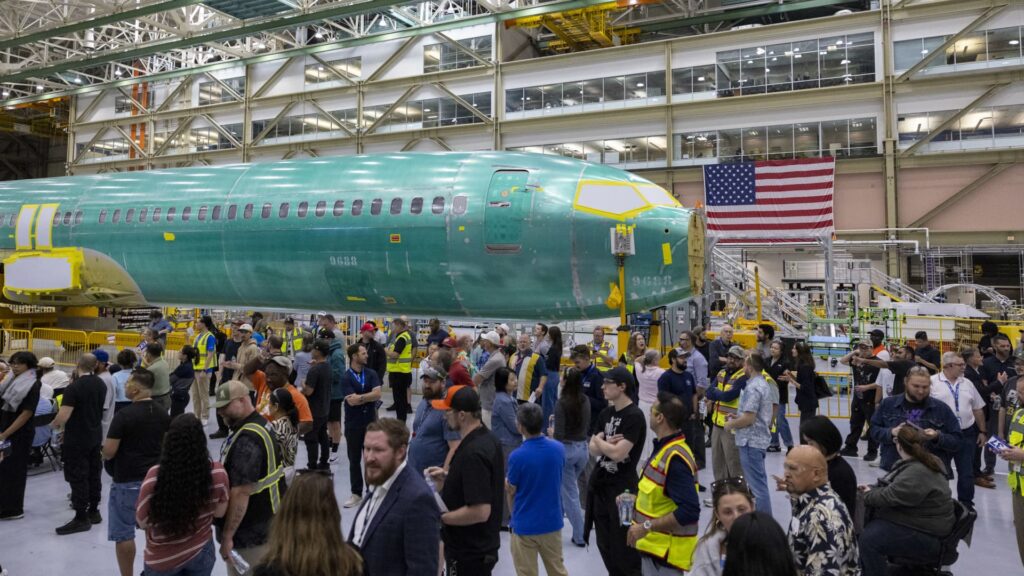
Recent developments in the aviation industry surrounding Boeing’s 737 MAX 10 aircraft have sparked significant discussions among airlines and aviation enthusiasts alike. United Airlines, in particular, is facing critical decisions regarding the seating configuration of its new planes as federal certification remains delayed. Originally slated for a 2020 debut, the MAX 10 has had its launch postponed, leaving United with an array of lie-flat seats awaiting integration.
| Article Subheadings |
|---|
| 1) Background on Boeing’s 737 MAX Family |
| 2) Delays in Certification and Its Impact on Airlines |
| 3) United Airlines’ Adaptation Strategies |
| 4) Future Prospects for the 737 MAX 10 |
| 5) Conclusion and Industry Implications |
Background on Boeing’s 737 MAX Family
The Boeing 737 MAX family, which includes various models such as the 737 MAX 7 and 737 MAX 10, has been a significant part of Boeing’s commercial aircraft lineup. First introduced in 2017, the MAX series was designed to be more fuel-efficient, with advanced engines and modern technology aimed at reducing operational costs for airlines. The 737 MAX 10 is intended to be the largest version in this family, appealing to airlines seeking to maximize passenger capacity and profitability on transcontinental routes.
However, the series faced a setback following two tragic crashes involving the MAX 8, leading to an extended grounding and a comprehensive review of its safety features. As a result, the 737 MAX has undergone numerous upgrades and regulatory scrutiny, delaying the release of subsequent models, including the MAX 10. With airlines keenly awaiting the return of the plane, the focus has remained on its anticipated capabilities, such as lie-flat seating designed for enhanced passenger comfort.
Delays in Certification and Its Impact on Airlines
Despite early projections indicating the Boeing 737 MAX 10 would commence flying in 2020, regulatory hurdles have significantly delayed its certification. Federal approvals, initially expected years ago, continue to fall behind schedule due to the need for redesigns in critical systems, notably including an anti-icing feature. In light of these issues, airlines have been left in a precarious position, needing to reassess their operational trajectories.
United Airlines, for example, has expressed concern over the significant number of lie-flat seats it had anticipated deploying on the MAX 10. During an interview at Newark Liberty International Airport, United CEO Scott Kirby highlighted the dilemma: “We got a bunch of lie-flat seats that we don’t know what to do with. They don’t fit on other airplanes.” Without federal approval in sight, these seats remain in storage, posing logistical and financial challenges for the airline.
United Airlines’ Adaptation Strategies
In response to ongoing delays, United Airlines has taken proactive steps to adapt its fleet configuration. Earlier this year, the airline decided to outfit a select group of its Airbus A321neo narrow-body aircraft with newly designed Polaris suites, premium economy options, and other seat enhancements. This fleet, branded as the “Coastliner,” is aimed at capturing high-yield passengers on transcontinental routes even before the MAX 10 enters service.
Despite these adjustments, the airline still faces uncertainty regarding the specific layout and configuration of the MAX 10. Kirby has confirmed that while United currently holds orders for 167 MAX 10 aircraft, the exact incorporation of lie-flat seats and other premium options into their service must conform to the distinctive dimensions dictated by the aircraft’s design.
Future Prospects for the 737 MAX 10
The future of the Boeing 737 MAX 10 remains a focal point of interest not only for United Airlines but for the wider aviation sector as well. With other airlines eager to explore the aircraft’s capabilities, there is optimism that federal approval will arrive soon. A recent announcement indicated that Boeing successfully obtained certification for the smaller MAX 7 model, with Southwest Airlines planning to introduce it into services by the first half of 2027, further heightened interest in the larger MAX 10 variant.
United Airlines expects to commence operations with its first MAX 10 aircraft in the summer of 2027. As airlines endeavor to enhance their networks, effective utilization of the MAX 10 may serve to bring substantial operational efficiencies to operators, catering to rising travel demand as the industry rebounds post-pandemic.
Conclusion and Industry Implications
The situation surrounding the Boeing 737 MAX 10 is a reminder of the complexities that can influence commercial aviation. As global travel expands, the need for more efficient and capable aircraft is pressing. Delays in certification can have widespread ramifications, not only for manufacturers like Boeing but also for airlines like United, who are eager to innovate their service offerings and capitalize on profitable routes.
Going forward, the industry will closely watch Boeing’s next developments, including whether it can expedite certification processes to meet the demands of both airlines and travelers. United Airlines’ strategic shifts amid these delays may serve as a potential case study for how other airlines navigate similar challenges while waiting for new aircraft to enter their fleets.
| No. | Key Points |
|---|---|
| 1 | Boeing’s 737 MAX family has faced substantial delays due to regulatory scrutiny and redesigns. |
| 2 | United Airlines has positioned itself to adapt to delays by revamping its Airbus A321neo fleet. |
| 3 | The airline faces challenges with unused lie-flat seats intended for the MAX 10 as certification timelines remain uncertain. |
| 4 | Boeing is optimistic that it will secure federal approval for the MAX 10 soon, following the successful certification of the MAX 7. |
| 5 | The aviation industry is adapting to increase operational efficiencies amidst ongoing global travel demand. |
Summary
The outlook for Boeing’s 737 MAX 10 remains uncertain as the aviation industry navigates through challenges posed by delayed certifications. United Airlines is strategically adapting to these delays by optimizing its existing fleet to serve the evolving market demand. As all parties await regulatory outcomes, the implications for both airlines and passengers suggest a future where efficiency and capacity will be indispensable in shaping air travel.
Frequently Asked Questions
Question: What is the significance of the Boeing 737 MAX 10?
The Boeing 737 MAX 10 is crucial as it represents the largest variant of the MAX family, designed to offer airlines greater capacity and operational efficiency on transcontinental routes.
Question: Why has the certification of the MAX 10 been delayed?
Certification delays for the MAX 10 stem from the need to redesign critical systems due to earlier safety concerns, leading to increased scrutiny from regulatory bodies.
Question: How is United Airlines addressing the delays in receiving the MAX 10?
United Airlines is adapting by outfitting its Airbus A321neo fleet with new premium seating options, positioning itself to retain competitive service on high-demand routes while awaiting the MAX 10.