
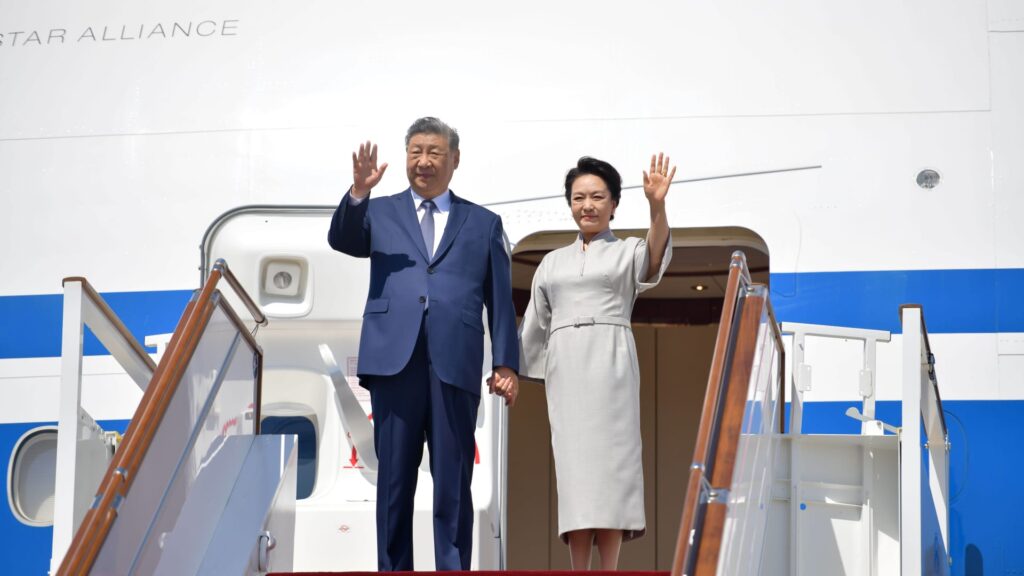
Chinese President Xi Jinping is poised for an extensive diplomatic engagement, revealing his intention to participate in multiple international summits over the coming weeks. With planned state visits to Egypt and potential engagements in India, Xi’s travel itinerary indicates a renewed commitment to global diplomatic relations following a notable decline in his foreign travels. This article explores Xi’s upcoming visits, the geopolitical dynamics at play, and the implications for U.S.-China relations.
| Article Subheadings |
|---|
| 1) Overview of Xi’s Upcoming State Visits |
| 2) The Significance of the SCO Summit |
| 3) U.S. Reaction to the Summits |
| 4) The India-China Engagement |
| 5) The Focus on Technology at the Upcoming Summit |
Overview of Xi’s Upcoming State Visits
Chinese President Xi Jinping has outlined a busy travel schedule that includes a rare state visit to Egypt and potentially presiding over discussions in India. His last significant foreign trip was in June 2026, when he visited North Korea for the first time in seven years. Experts point to this planned itinerary as a decisive shift in Xi’s foreign policy, suggesting that he is willing to engage more actively on the international stage.
The timeline for these visits is crucial. Xi is expected to start his journey with the Shanghai Cooperation Organization (SCO) summit in Kyrgyzstan, held from September 1-2, 2026. Following this event, he plans to visit Egypt, marking his first state visit there in a decade. This reflects China’s growing investment and presence in the Suez Canal region, along with its commitment to bilateral economic relations.
Moreover, Xi’s anticipated travel to India for the BRICS summit on September 12-13 is of particular interest, marking his first visit to the country since 2019 amid heightened tensions following border skirmishes. This strategic engagement suggests a possible thawing of relations between the two nations, which have been fraught with conflict but have shown signs of improvement over the past year.
The Significance of the SCO Summit
The SCO summit represents a pivotal moment for regional cooperation, particularly among non-Western nations such as India, Russia, and several Central Asian countries. Scheduled in Bishkek, Kyrgyzstan, this summit focuses on security and economic collaboration among member states. As China advocates for greater global responsibilities, the SCO provides a platform for Xi to reaffirm his vision for a multipolar world.
China’s role within the SCO is increasingly vital, especially considering the evolving geopolitical landscape influenced by conflicts like the war in Ukraine and tensions with the U.S. Experts suggest that Xi’s active participation signals not only a commitment to economic collaboration but also China’s intent to assert itself as a leader in addressing global security concerns, particularly in areas like supply chain resilience and cybersecurity.
Participation in the SCO summit allows Xi to foster deeper ties with leaders from countries that share China’s perspectives on global governance, thereby emphasizing a united front against Western hegemony. This summit is also a chance for members to engage on key issues such as counter-terrorism and the impacts of geopolitical shifts influenced by Western policies.
U.S. Reaction to the Summits
The U.S. is closely monitoring Xi’s diplomatic maneuvers, particularly as it seeks to bolster its relations with both China and India. Observers note that the events surrounding the SCO and BRICS summits will be critical for Washington, especially given the backdrop of U.S.-China trade tensions and attempts to manage relationships with Russia and India.
Experts highlight that the Biden administration’s aim is to counterbalance China’s sway in global affairs while engaging with India to solidify strategic partnerships. The recent thaw in U.S.-India relations, illustrated by the U.S. scaling back tariffs on Indian goods, reflects a mutual interest in cooperative economic engagement. This evolving diplomatic context means that reactions to the outcomes of the summits, especially concerning energy ties with Russia, will be pivotal for U.S. international strategy.
Last year’s events, where Xi, Indian Prime Minister Narendra Modi, and Russian President Vladimir Putin were seen together at the SCO summit, ignited concerns in Washington about a rising bloc that could challenge its geopolitical interests. As Xi prepares for upcoming talks, the degree to which he can foster alliances with non-Western leaders could shape the U.S.’s future policy directions.
The India-China Engagement
Despite persistent tensions, there are signs of improved relations between China and India, especially as they approach the BRICS summit. Economic cooperation has regained emphasis, with both nations indicating their intention to resolve outstanding border disputes that have characterized their relationship in recent years. Direct flights have resumed between the two countries, and trade routes established along the historic Silk Road have reopened, indicating a potential shift towards enhanced connectivity.
However, ongoing visa issues for Indian businessmen applying to travel to China suggest that significant barriers remain. The nuances of this bilateral relationship involve balancing growing economic interdependence against national security concerns. Observers assert that as India asserts itself on the global stage, the nation maintains its resolve to showcase a diversified approach in international partnerships.
For instance, India’s increasing participation in global technology manufacturing challenges China’s dominance in this sector. As India emerges as a supplier for major international tech firms such as Apple, it represents a potential reshaping of global supply chains that could limit China’s influence. The complex interplay of cooperation and competition highlights the shifting dynamics in the region.
The Focus on Technology at the Upcoming Summit
Technology is set to be a central theme during Xi’s anticipated meeting with U.S. officials in Washington, D.C., later this month. As both nations grapple with the implications of advanced technological developments, including artificial intelligence, the discussions are expected to focus on establishing regulations and frameworks to govern such innovations.
Tensions surrounding technology are notably heightened due to allegations regarding China’s influence over sectors that intersect with national security concerns, such as AI and cybersecurity. The potential for bilateral collaboration, particularly in cancer research, has emerged as a point of mutual interest, albeit amidst growing skepticism about the feasibility of cooperative engagement in other areas.
Experts have remarked on the complex reality of U.S.-China relations, where technology is often viewed through a competitive lens. The disparities in governance ideologies and military advancements contribute to a landscape where both countries perceive technological superiority as critical for global dominance. Proposals for an AI development mechanism could emerge as part of Xi’s efforts to navigate these tensions while ensuring stability in trade relations.
| No. | Key Points |
|---|---|
| 1 | Xi Jinping’s upcoming state visits signify a shift in his foreign policy approach and refer to a renewed emphasis on international diplomacy. |
| 2 | The SCO summit in Kyrgyzstan is pivotal for enhancing China’s regional influence and collaboration among non-Western nations. |
| 3 | The U.S. is closely observing the outcomes of both SCO and BRICS summits, adjusting its strategies towards China and India accordingly. |
| 4 | The budding economic cooperation between India and China may indicate a fundamental shift in their bilateral relationship amidst prior conflicts. |
| 5 | Technological competition will be a focal point in the upcoming Trump-Xi summit, with discussions expected on AI regulations and bilateral tech collaboration. |
Summary
The upcoming state visits and participation in significant summits highlight Xi Jinping’s renewed engagement in global diplomacy, particularly with Egypt and India. As tensions pivot and cooperative frameworks emerge, the outcomes of these initiatives will shape future bilateral relations for China, India, and the United States. Observers anticipate that these developments will recalibrate regional dynamics, illustrating the ongoing evolution of international alliances in a multipolar world.
Frequently Asked Questions
Question: Why has Xi Jinping curtailed his foreign travel in recent years?
Xi Jinping has reduced his foreign travel mainly due to domestic priorities and political considerations, wanting to focus on stabilizing the internal political landscape and addressing pressing domestic issues.
Question: What is the significance of the BRICS summit for China?
The BRICS summit offers China an opportunity to solidify alliances with other emerging economies and assert its leadership role in a multipolar world, particularly in contrast to Western influences.
Question: How might the U.S. respond to China’s growing influence at these summits?
The U.S. is likely to adopt a strategy of increased engagement with India and other nations to counterbalance China’s influence while maintaining vigilance over China’s actions in key geopolitical matters.