

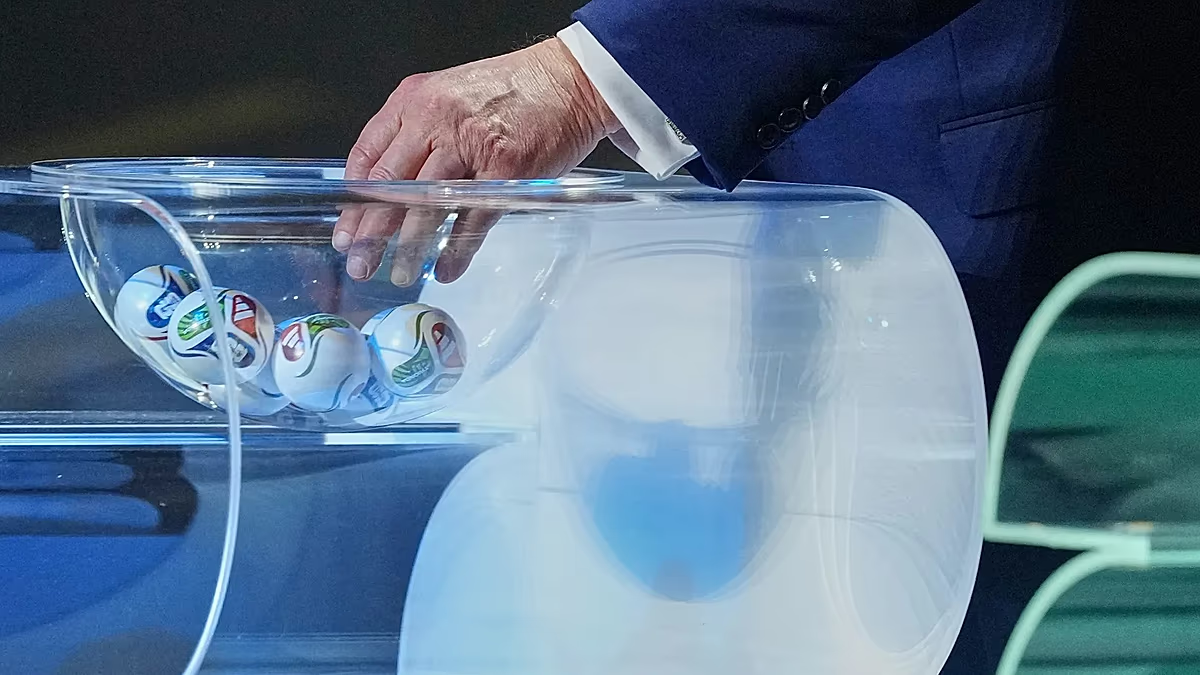

The draw ceremony for the 2026 FIFA World Cup took place at the Kennedy Centre in Washington, where officials unveiled the group allocations for the tournament set to begin in Mexico City on June 11, 2026. This upcoming tournament will see a record 48 teams competing in 12 groups, as FIFA aims to enhance the global reach of the sport. Critical matches will occur across various venues in the United States, Mexico, and Canada, with the full match calendar expected to be finalized soon.
| Article Subheadings |
|---|
| 1) Overview of the 2026 World Cup Groups |
| 2) Understanding the Qualification Process |
| 3) World Cup Newcomers and Expanding Horizons |
| 4) Ticketing and Financial Aspects |
| 5) Predictions and Expectations |
Overview of the 2026 World Cup Groups
The 2026 FIFA World Cup will feature 48 teams, distributed across 12 groups as announced during the draw ceremony. Among the notable teams, host nations and football powerhouses like Mexico, Brazil, and Germany are set to compete. The tournament will run from June 11 to July 19, 2026, with matches scheduled to be hosted in the US, Mexico, and Canada.
The groups consist of a mix of veteran teams and emerging nations. Each group includes four teams, with games played across 16 sites, mainly NFL stadiums in the US and strategic locations in Canada and Mexico. The anticipation surrounding these matchups is heightened as teams prepare to vie for the ultimate soccer title.
Here’s a brief summary of the groups:
- Group A: Mexico, South Africa, South Korea, UEFA Play-off D
- Group B: Canada, Qatar, Switzerland, UEFA Play-off A
- Group C: Brazil, Morocco, Scotland, Haiti
- Group D: USA, Paraguay, Australia, UEFA Play-off C
- Group E: Germany, Ivory Coast, Ecuador, Curaçao
- Group F: Netherlands, Japan, Tunisia, UEFA Play-off B
- Group G: Belgium, Egypt, Iran, New Zealand
- Group H: Spain, Saudi Arabia, Uruguay, Cape Verde
- Group I: France, Senegal, Norway, FIFA Play-off 2
- Group J: Argentina, Algeria, Austria, Jordan
- Group K: Portugal, Uzbekistan, Colombia, FIFA Play-off 1
- Group L: England, Croatia, Panama, Ghana
Understanding the Qualification Process
Qualification for the tournament is crucial, and as of now, six of the participating teams have yet to be determined. The groups are finalized, yet the final teams will emerge in March 2026. Four of these additional teams are to be decided through the UEFA playoffs, while two will be selected from the FIFA Play-off Tournament.
The UEFA Play-offs feature several esteemed teams with the potential to make an impact on the global stage. Teams such as Italy, Wales, and others are vying for a spot in the tournament, indicative of the fierce competition present in European football.
Moreover, the stakes are high as these final qualifiers will provide not only further representation but also increase excitement for the matches ahead.
World Cup Newcomers and Expanding Horizons
A highlight of the 2026 World Cup is the inclusion of newcomers such as Cape Verde, Jordan, Uzbekistan, and Curaçao. Their participation marks a significant expansion of the tournament, reflecting FIFA’s initiative to broaden the global footprint of football.
The tournament will take place across 16 venues, with significant preparations underway. In Canada, for instance, BMO Field is undergoing enhancements to accommodate more fans, preparing to add 17,000 temporary seats to bring its capacity to around 45,000.
In total, games will occur in 11 NFL stadiums along with three locations in Mexico and two in Canada. As FIFA aims to exceed the prior attendance record of 3.59 million set in 1994, excitement builds around both the new teams and the historic venues that will host these matches.
Ticketing and Financial Aspects
FIFA recently announced ticket prices for the 2026 World Cup, ranging from $60 to $6,370. Tickets will have a dynamic pricing model, an adjustment from previous World Cups, which has raised some eyebrows among fans. Common expectations regarding ticket transparency seem less certain with this upcoming tournament.
FIFA has also introduced parking passes priced up to $175 for a single match. Although financial discussions are ongoing, FIFA officials remain tight-lipped about specific details as they relate to ticket sales and associated costs.
“The teams are not there by coincidence,” stated former manager Arsène Wenger, indicating the high caliber of teams that are anticipated to compete.
The analysis continues to indicate that the tournament will draw immense viewership and attendance, highlighting the significance of accessibility and affordability in terms of tickets and accommodations throughout the event.
Predictions and Expectations
As anticipation grows, experts have started to formulate predictions regarding each team’s chances in the tournament. An analytical model indicates that the host country, the United States, currently has only a 0.9% chance of winning, a stark reminder of the long history since the Americans last reached the semifinals in 1930.
Meanwhile, teams like Spain lead forecasts with a 17% chance of success, followed closely by France and England. Argentina, with captain Lionel Messi seeking to make history, is another team to watch as they aim for back-to-back championships.
With such a diverse range of teams competing, expectations continue to evolve, ensuring that the upcoming 2026 World Cup promises to be a compelling event in the world of sports.
| No. | Key Points |
|---|---|
| 1 | The 2026 FIFA World Cup will feature a record 48 teams, expanding to 12 groups. |
| 2 | Group allocations were announced at the Kennedy Centre in Washington, generating excitement. |
| 3 | Six teams are yet to be determined, remaining spots to be filled by playoffs in March 2026. |
| 4 | Ticket prices range from $60 to $6,370, with a dynamic pricing model introduced. |
| 5 | Predictions suggest Spain has the best chance, while the US faces challenges in securing victory. |
Summary
The upcoming 2026 FIFA World Cup promises to be one of the most significant sporting events in history, marking a transformative period in the tournament’s expansion and accessibility. With opportunities for new nations to compete and a heightened focus on logistical preparations, excitement is building across the globe. As teams finalize their preparations and face fierce competition in the lead-up to the tournament, the world watches to see who will emerge triumphant.
Frequently Asked Questions
Question: When does the 2026 FIFA World Cup start?
The 2026 FIFA World Cup is set to kick off on June 11, 2026, in Mexico City.
Question: How many teams will participate in the tournament?
A record 48 teams will participate in the 2026 World Cup, expanding from the traditional 32-team format.
Question: What are the anticipated ticket prices for the World Cup?
Ticket prices for the 2026 World Cup will range from $60 to $6,370, with a dynamic pricing model in place.
