

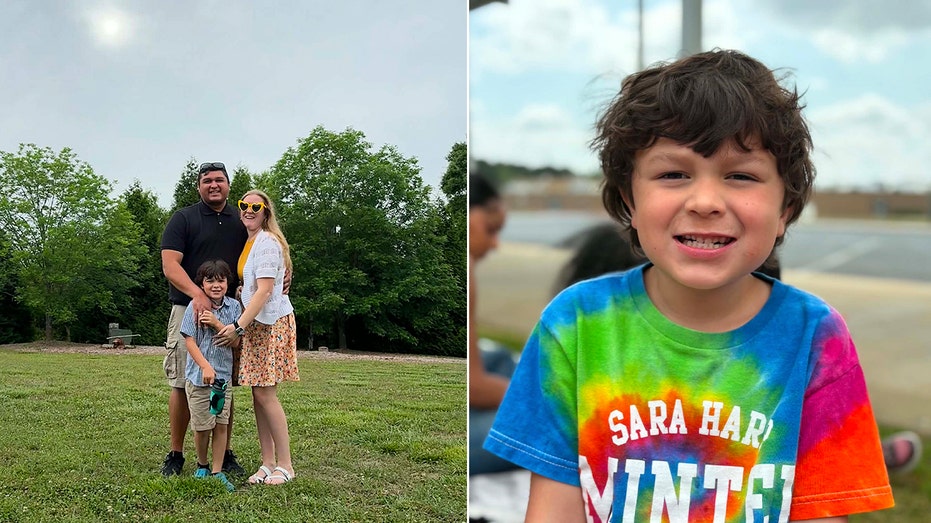

John Medina, a 6-year-old Georgia first-grader with autism and ADHD, was suspended after biting a sandwich into the shape of a gun and pointing it at a classmate during lunch. His parents, Kristin Medina and Juan “Ricky” Medina, say the punishment fails to account for his developmental disabilities. They report about 15 suspensions and more than two dozen disciplinary actions since 2023.
The family says some incidents involved physical conduct requiring intervention, while others were imaginative actions or words treated too severely. They are calling for more support and opportunities to teach appropriate behavior.
| 1) | The lunch incident and suspension |
| 2) | A wider disciplinary history |
| 3) | The family’s concerns about autism support |
| 4) | Educational accommodations and progress |
| 5) | The parents’ call for a different response |
The lunch incident and suspension
John was suspended in March while attending first grade at Sarah Harp Elementary School in Fayette County, south of Atlanta. His parents say he shaped his sandwich like a gun and pointed it at another student during lunch. They say the school applied strict weapon-related discipline even though no actual weapon was involved.
John was diagnosed with level 1 autism at age 4 and later diagnosed with ADHD. His parents say these conditions can affect his understanding of social expectations, the meaning of behavior in different settings and his ability to filter gestures or comments. They believe the lunch incident should have been addressed through explanation and correction.
A wider disciplinary history
Kristin and Juan “Ricky” Medina report approximately 15 suspensions and more than two dozen disciplinary actions since 2023. They acknowledge physical incidents, including John pushing a student during physical education and hitting a classmate with a branch.
They also cite hand-gun gestures, saying the word “gun” and drawing a pilgrim shooting a turkey for a Thanksgiving activity. The parents say weapons are not discussed at home. They believe autism can make it harder for John to regulate how he expresses imaginative ideas.
The family’s concerns about autism support
The family says repeated punishment has affected John’s confidence, relationships and willingness to attend school. His parents report that he has called himself a “bad kid” and worries that other children will laugh at him. They say he has become more isolated and eager to leave school during difficult days.
“Instead of singling him out, just make it a teachable moment for him. Teach, ‘Hey, we don’t do this in school because of this reason, it’s not appropriate.’”
Kristin Medina said traditional punishment may be ineffective and could teach John that using a word such as “gun” will result in being sent home. The parents want schools to distinguish between serious threats and behavior that can be addressed through instruction, supervision and consistent support.
Educational accommodations and progress
Kristin Medina said the school initially declined to provide John with an Individualized Education Program because he was academically advanced and officials did not recognize how autism affected him. She says it took about a year and a half, 10 to 12 suspensions and a second evaluation, which led to the ADHD diagnosis, before the school approved an IEP.
The family says John finished the previous school year strongly, reading at a third-grade level and missing the gifted and talented program by four test points. His behavioral plan includes an aide during lunch, recess and physical education. He also spends time in a smaller, calmer classroom, where his parents say he performs exceptionally well.
The parents’ call for a different response
The parents say suspensions declined after they hired Donna Reynolds, a special education advocate, to assist with school meetings. They want officials to focus on safety when necessary while using less severe discipline for conduct that can be corrected through conversation and instruction.
“What I want to see is that there’s less severe punishment like suspensions,” Juan “Ricky” Medina said. “And just continue to talk through things so you can have opportunities to learn from things and maybe focus on real serious concerns.”
The Fayette County school district declined to discuss John’s specific circumstances. It encouraged consideration of his complete disciplinary history and the full context of events rather than one isolated incident.
| Number | Key Point |
|---|---|
| 1 | John was suspended after shaping a sandwich like a gun and pointing it at a classmate. |
| 2 | His parents report about 15 suspensions and more than two dozen disciplinary actions since 2023. |
| 3 | The family says autism and ADHD affect his understanding of social norms and self-regulation. |
| 4 | John now has an IEP, a behavioral plan, aide support and access to a calmer classroom. |
Summary
The Medina family’s account highlights the challenge of balancing school safety rules with individualized responses to disability-related behavior. The parents are not disputing the need to address serious physical incidents, but argue that suspension is disproportionate when conduct can be corrected through explanation, supervision and structured support. They say John’s academic progress and accommodations show the value of a calmer, tailored approach.
Frequently Asked Questions
Why was John Medina suspended?
His parents say he was suspended after shaping a sandwich like a gun and pointing it at a classmate during lunch.
What diagnoses does John have?
He was diagnosed with level 1 autism at age 4 and later received an ADHD diagnosis.
What support does John receive at school?
His parents say he has an IEP, a behavioral plan, aide support during unstructured periods and time in a smaller classroom.
What do his parents want changed?
They want fewer suspensions for behavior they consider teachable and greater attention to John’s developmental needs, while preserving responses to serious safety concerns.
