

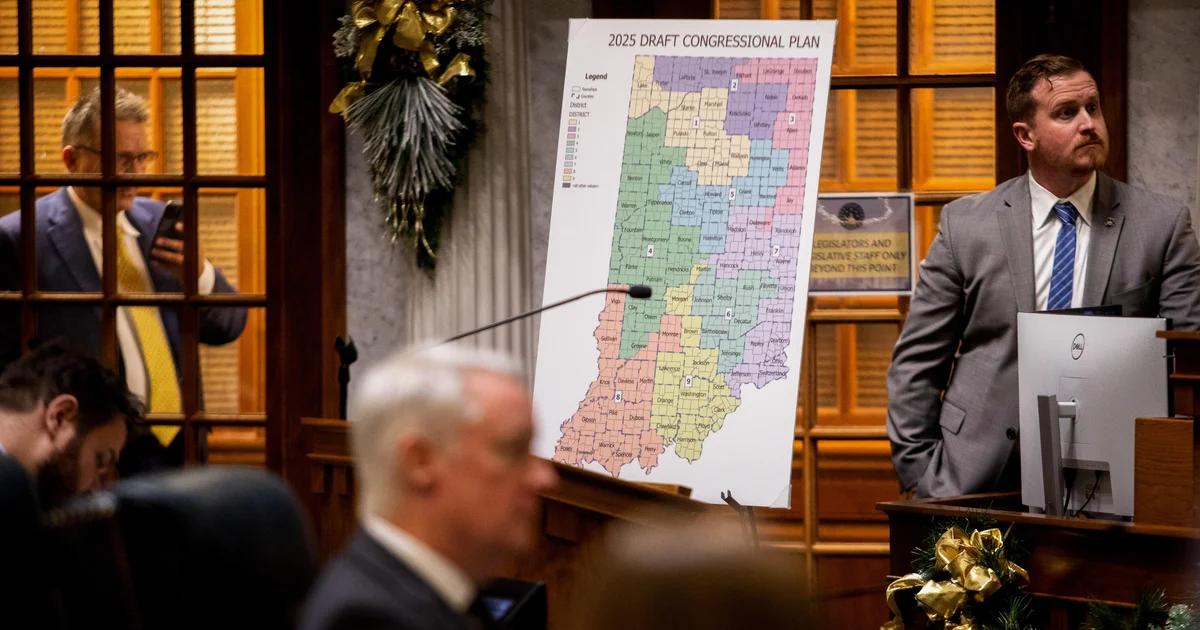

On Thursday, Indiana’s state Senate faces a crucial decision regarding a proposed congressional map that aims to shift all nine House districts toward Republican dominance. This potential redistricting has been fueled by the Trump administration, which views it as a pivotal strategy ahead of the 2026 midterm elections. However, the undercurrent of intense political rivalry has led to significant tensions, including threats against lawmakers, as the debate unfolds within the state’s legislative corridors.
| Article Subheadings |
|---|
| 1) Understanding the Proposed Congressional Map |
| 2) Political Stakes: The Redistricting Strategy |
| 3) Legislative Responses and Pushback |
| 4) The Role of External Influences |
| 5) Implications of Violence and Intimidation |
Understanding the Proposed Congressional Map
The proposed congressional map under consideration seeks to restructure Indiana’s nine U.S. House districts, effectively making them more favorable for Republicans. Currently, Republicans hold seven of these seats while Democrats occupy two, one of which encompasses Indianapolis. The redistricting aims to dilute the influence of Democratic voters in Indianapolis by significantly altering the boundaries of the district represented by Democratic Rep. André Carson.
Passage of the map requires the approval of at least 25 out of the 50 senators in the Indiana Senate, where Republicans hold a majority with 40 seats. However, there are concerns that a sufficient number of Republican senators might vote against the proposal, creating uncertainty about its future. The state House initially approved the map with a narrow 57-41 vote earlier this month, indicating a split within the party regarding the proposed changes.
Political Stakes: The Redistricting Strategy
The push for redistricting aligns with national interests among Republicans, particularly under the influence of the Trump administration. As states across the country engage in a political redistricting arms race ahead of the midterm elections, Indiana represents a crucial battleground. The desire to add GOP-friendly seats reflects broader ambitions to secure a dominant foothold in Congress.
State Republicans argue that redistricting is essential for maintaining competitive advantages, especially when contrasting their efforts with Democratic policies in states like California and Illinois.
“We’ve consistently seen the Democrats leverage these processes to expand their influence in Washington, D.C.,”
expressed Republican Sen. Andy Zay, framing the redistricting as a necessary countermeasure.
Legislative Responses and Pushback
While some Republican senators support the map, a significant contingent is opposed. Reports suggest that at least 12 senators have publicly vocalized their dissent, with more potentially keeping their views private. Marty Obst, chair of the “Fair Maps Indiana” non-profit organization, noted that approximately ten Republican senators are undecided and are seeking further input from constituents before committing their votes.
Opponents of the map express skepticism about the feasibility of securing victories in all nine districts. They cite pushback from constituents, who are unhappy with the prospect of redrawing lines mid-decade without following the usual timeline post-Census. Several lawmakers have emphasized the importance of integrity in the political process, reprising traditional values over political expediency.
The Role of External Influences
The pressure to advance the map has not only emerged from within Indiana but has also been significantly influenced by national figures and organizations. President Donald Trump has publicly criticized Republican holdouts, labeling Indiana Senate President Rodric Bray as “either a bad guy or a very stupid one.” This type of aggressive rhetoric underlines the stakes involved for lawmakers voting on the redistricting proposal.
Furthermore, Vice President JD Vance has actively participated in discussions with Indiana legislators, reinforcing the notion that redistricting is a non-negotiable priority for the party. Trump’s endorsement and threats of primary challenges for dissenting members have escalated the pressure on state lawmakers to toe the party line. Political advocacy groups have also mobilized to support pro-redistricting lawmakers, investing significant funds in campaign efforts.
Implications of Violence and Intimidation
The contentious atmosphere surrounding the redistricting debate has unfortunately led to egregious incidents of threats and harassment directed at lawmakers. Notable incidents include bomb threats targeting Republican senators opposed to the map, illustrating how deeply polarized the situation has become. Republican Sen. Jean Leising reported receiving a pipe bomb threat as a direct repercussion of the intensifying national discourse on redistricting.
Senator Greg Walker, the sole member of the state’s election committee to oppose the map, voiced his fears about the normalization of intimidation in political discussions.
“I fear for this institution. I fear for the state of Indiana, I fear for all states if we allow intimidation and threats to be the norm,”
he stated, emphasizing the necessity of protecting democratic discourse in the political arena.
| No. | Key Points |
|---|---|
| 1 | The proposed congressional map may favor Republicans in all nine Indiana districts. |
| 2 | Republicans currently hold seven of the nine congressional seats. |
| 3 | Mixed support among Republican senators makes the map’s passage uncertain. |
| 4 | External pressures from national leaders impact local legislative decision-making. |
| 5 | Threats and acts of intimidation against lawmakers raise concerns about political discourse. |
Summary
As Indiana’s Senate deliberates the contentious congressional map, the intersection of local and national politics is evident. The implications of this redistricting effort not only hold significance for the state’s political landscape but reflect broader trends across the nation. Amidst the backdrop of intense partisan rivalry, the challenges lawmakers face—including threats and public dissent—underscore the necessity for constructive dialogue and respect in the political process.
Frequently Asked Questions
Question: What is the primary goal of the proposed congressional map in Indiana?
The main objective of the proposed map is to create a congressional landscape that favors Republican candidates in all nine districts, enhancing their chances of winning elections ahead of the 2026 midterms.
Question: Why is there resistance among some Republican senators regarding the new map?
Many Republican senators express concerns regarding potential backlash from constituents and the unusual timing of the redistricting process, which typically occurs after the decennial Census.
Question: How have external influences affected the redistricting debate in Indiana?
National figures, including President Trump, have exerted significant pressure on Indiana lawmakers to support the map, threatening primary challenges for those who oppose it and underscoring the stakes involved.
