

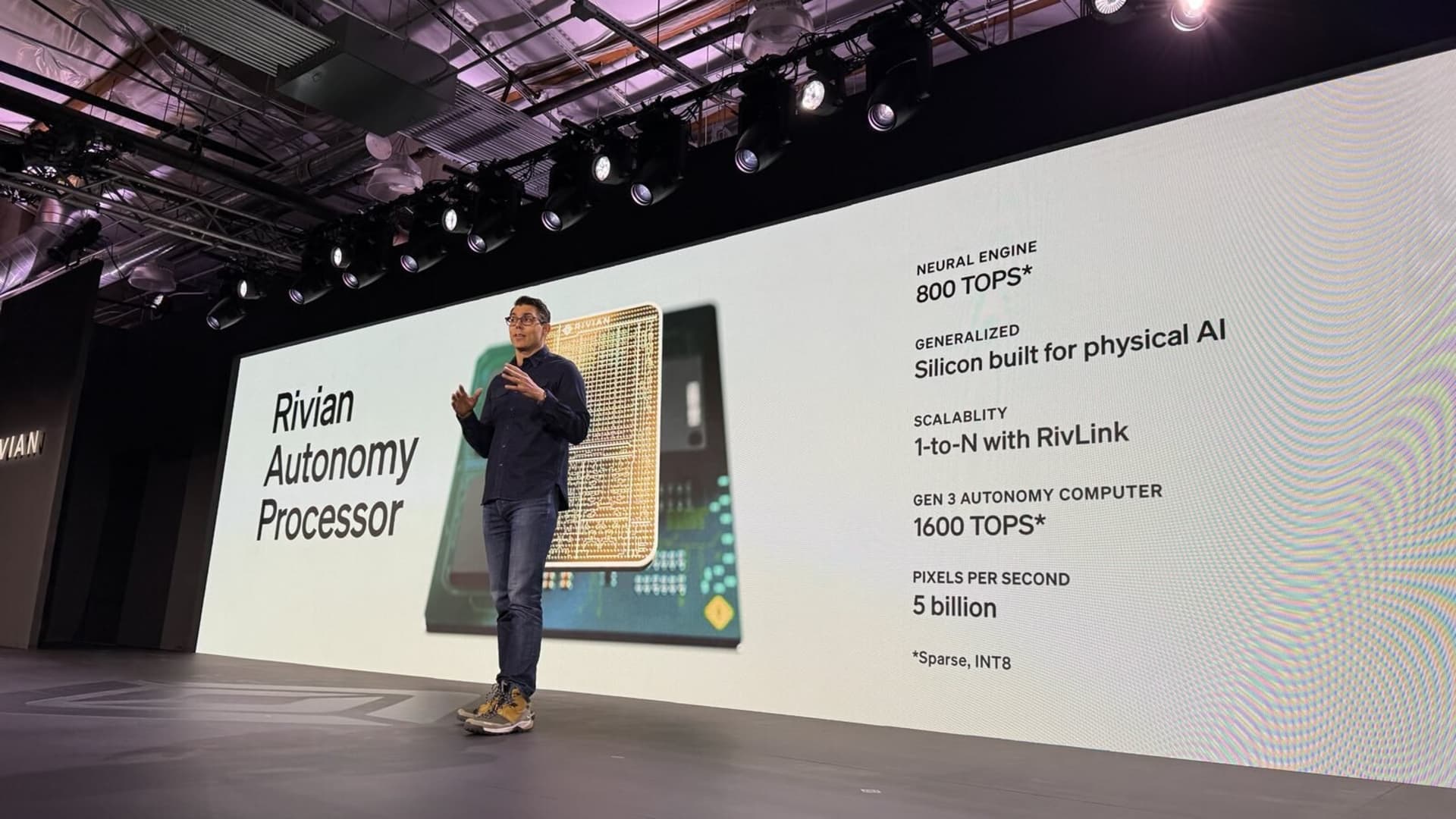

In a significant showcase of technological advancements, electric vehicle maker Rivian held its first “Autonomy and AI Day” on December 11, 2025, in Palo Alto, California. The event highlighted Rivian’s ambitions in artificial intelligence and automation, featuring a proprietary silicon chip that aims to enhance autonomous driving capabilities. However, despite the impressive announcements, the company continues to grapple with challenges related to demand and capital, which were reflected in its fluctuating stock price following the event.
| Article Subheadings |
|---|
| 1) Overview of Rivian’s AI and Autonomy Ambitions |
| 2) Market Reaction to the Company’s Announcements |
| 3) Challenges Ahead: Demand and Capital Struggles |
| 4) Future Prospects: The R2 SUV Launch |
| 5) Analysts Weigh In: Technology vs. Profitability |
Overview of Rivian’s AI and Autonomy Ambitions
Rivian’s “Autonomy and AI Day” marked a pivotal moment for the company as it unveiled major advancements aimed at enhancing its self-driving technology. The new proprietary chip, known as RAP1, was specifically developed for “physical AI,” which focuses on enabling autonomous driving capabilities. Additionally, Rivian promised to evolve its vehicle software architecture and introduce a new AI assistant capable of learning from interactions. The company projected a roadmap toward reaching “personal L4” autonomy, signifying its goal of implementing fully self-driving vehicles for individual ownership.
Rivian’s CEO, RJ Scaringe, emphasized during the event, “AI is enabling us to create technology and customer experiences at a rate that is completely different from what we’ve seen in the past.” By vertically integrating its capabilities, Rivian aims to differentiate itself from traditional automakers and position itself as a leader in the next generation of AI-infused automobiles.
Market Reaction to the Company’s Announcements
Following Rivian’s announcements, Wall Street reacted with mixed sentiment. On the one hand, Rivian’s stock initially fell by 6.1%, finishing at $16.43 per share. On the other hand, shares rebounded significantly, closing 12.1% higher at $18.42 the following day. Analysts were cautiously optimistic, with firm Needham raising its price target for Rivian from $14 to $23 per share, reflecting a 64% increase. This adjustment was attributed to the potential for future licensing deals stemming from the company’s technological innovations.
However, the overall atmosphere remained skeptical, as analysts noted that while Rivian’s tech advancements were laudable, many of the anticipated breakthroughs were already factored into the stock price ahead of the event. The enthusiasm waned further as competitor OpenAI also made significant AI-related announcements the same day.
Challenges Ahead: Demand and Capital Struggles
Despite the promising tech developments, Rivian faces formidable challenges related to demand and its financial positioning. Analysts pointed out that electric vehicle demand has receded, particularly following the expiration of tax incentives that previously buoyed sales. Added to that, Rivian’s product offerings have not gained traction as quickly as anticipated. A recent report indicated that adoption of advanced driver assistance systems across the industry remains disappointingly low, which poses a threat to Rivian’s ambitious plans.
Furthermore, constant financial losses have compounded the company’s situation. Rivian has yet to break even on vehicle sales, raising questions about its long-term viability. Despite a liquidity cushion of $7.7 billion—part of which includes nearly $7.1 billion in cash and investments—the company is under pressure to demonstrate profitability as it prepares to launch its new R2 SUV.
Future Prospects: The R2 SUV Launch
The upcoming launch of the R2 midsize SUV is viewed as pivotal for Rivian, as it signifies the company’s intention to tap into a broader customer base. Expected to start at about $45,000, the R2 aims to provide a more affordable option compared to Rivian’s current offerings, which begin at over $70,000. The R2 is crucial not only for generating revenue but also as an indicator of the company’s ability to deliver on its cost-saving promises and move toward a more sustainable business model.
As the market for mid-sized SUVs is highly competitive, analysts believe that the R2 could either enhance Rivian’s market reach or further amplify its profitability challenges. Given the significant investment in development and technology associated with the R2, the stakes are high for Rivian to ensure its successful launch and execution.
Analysts Weigh In: Technology vs. Profitability
Analysts are closely examining the balance between Rivian’s advancements in technology and its profitability. While the company’s in-house development capabilities may give it an edge, skepticism remains about Rivian’s ability to execute on its ambitious goals amidst market pressures. Dan Levy from Barclays referred to Rivian’s current situation as a “show me” story, highlighting the necessity for Rivian to not only exhibit technological prowess but also deliver tangible financial results.
Concerns about Rivian’s ongoing losses persist, with reports indicating that Rivian continues to lose billions annually despite seeing growth in its software revenue. As the company looks ahead, it is tasked with demonstrating not only that it can innovate but also that it can leverage those innovations in a way that directly contributes to its bottom line.
| No. | Key Points |
|---|---|
| 1 | Rivian’s first “Autonomy and AI Day” revealed ambitious goals in AI technology. |
| 2 | Stock prices fluctuated significantly post-event, ultimately closing higher. |
| 3 | The company faces ongoing challenges with EV demand and profitability. |
| 4 | The upcoming R2 SUV launch is a critical moment for expanding its market reach. |
| 5 | Analyst opinions highlight the need for Rivian to balance technology with financial viability. |
Summary
Overall, Rivian’s ambitious announcements at their first “Autonomy and AI Day” reflect the company’s commitment to advancing its technology in the competitive electric vehicle market. However, while its innovations hold great promise, Rivian will face significant hurdles, particularly in demand and financial sustainability, as it moves forward. The successful launch of the R2 SUV may determine its capacity to achieve profitability and secure a more substantial foothold in the market.
Frequently Asked Questions
Question: What new technology did Rivian unveil during the Autonomy and AI Day?
Rivian introduced a proprietary silicon chip called RAP1, developed for enhancing autonomous driving capabilities, alongside updates to their software architecture and a new AI assistant.
Question: Why did Rivian’s stock fluctuate after the event?
The initial optimism over the technological advancements led to a rise in stock prices. However, skepticism about demand and external market conditions caused a decrease, followed by a rebound as analysts adjusted their price targets.
Question: What challenges is Rivian facing as it prepares to launch the R2 SUV?
Rivian is contending with slumping electric vehicle demand, significant production costs, and the financial implications of launching a more affordable vehicle amid a highly competitive market.
