

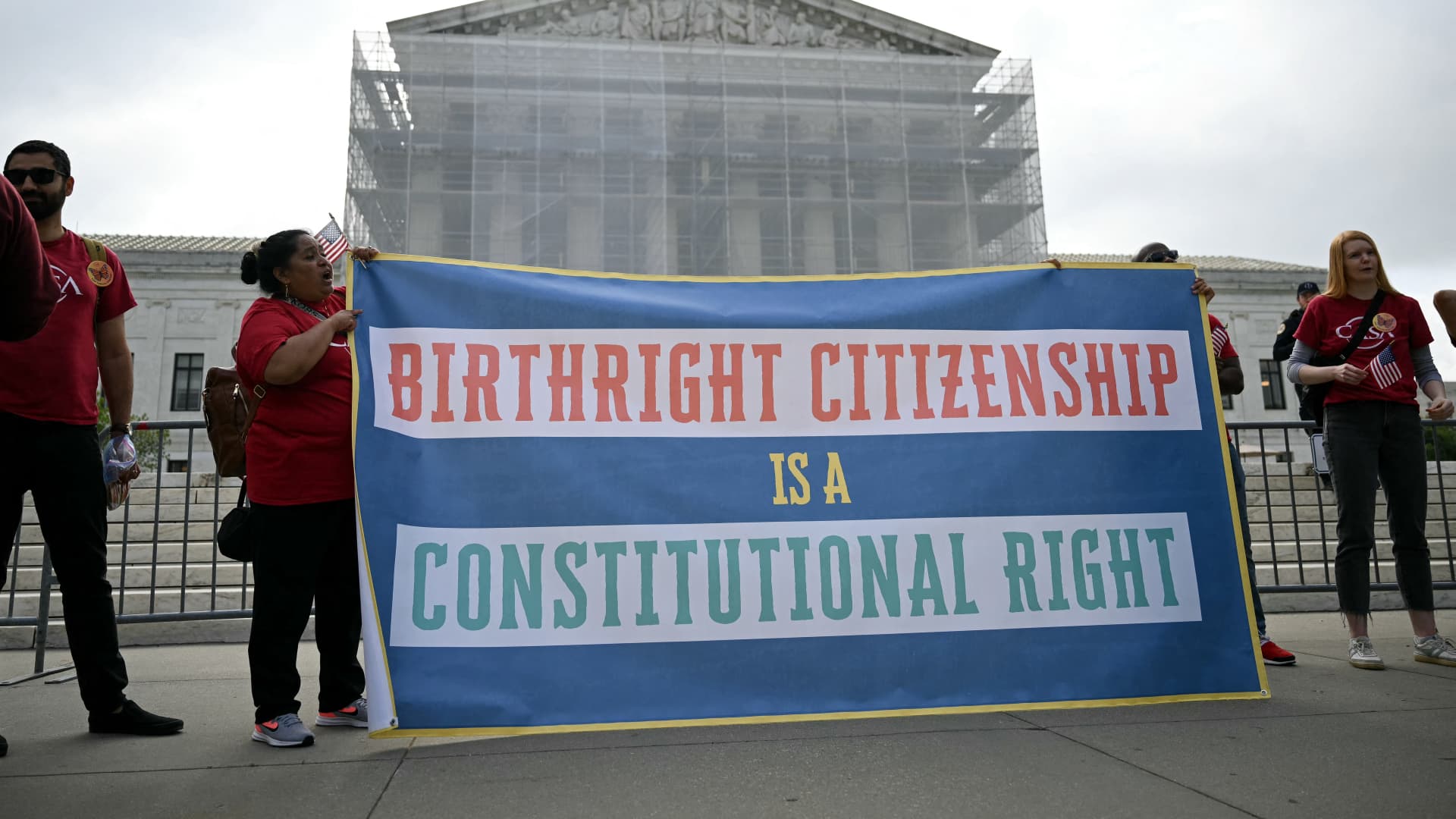

The Supreme Court is set to deliberate on the constitutionality of President Donald Trump’s controversial executive order concerning birthright citizenship. This pivotal case will examine whether the president has the authority to abolish automatic citizenship for children born in the U.S. to temporary visitors and illegal immigrants. With the constitutional implications of the 14th Amendment at stake, the Court’s decision could have far-reaching effects on immigration policy and individual rights.
| Article Subheadings |
|---|
| 1) Background of the Executive Order |
| 2) Constitutional Debate |
| 3) Court Proceedings So Far |
| 4) Implications of the Case |
| 5) Public Reaction |
Background of the Executive Order
On January 20, 2025, shortly after re-entering the White House, President Trump issued an executive order that has become a point of contention in U.S. immigration policy. This order stated that children born in the United States more than 30 days after the issuance of the order would not automatically receive citizenship if their parents were temporary visitors or illegal immigrants. This marked a significant shift in the long-standing interpretation of the 14th Amendment of the U.S. Constitution, which has traditionally granted citizenship to anyone born on American soil.
Historically, the interpretation of the Citizenship Clause of the 14th Amendment has been clear: “All persons born or naturalized in the United States, and subject to the jurisdiction thereof, are citizens of the United States.” This has meant that children of non-citizens born in the U.S. automatically acquire citizenship. However, Trump’s directive seeks to redefine this long-held principle, igniting national debate over citizenship and immigration rights.
Constitutional Debate
At the heart of this legal battle lies the question of constitutionality. Opponents of the executive order argue it directly contradicts the 14th Amendment. They posit that the amendment’s wording clearly establishes the right of citizenship by birth in the United States, regardless of parental status. Supporters of the order, on the other hand, argue that the president has the authority to determine who qualifies for citizenship under specific circumstances, particularly in the context of national security and immigration control.
The discussions within legal circles emphasize the balance of power between the executive branch and constitutional rights. Legal scholars point out that if the Supreme Court sides with the president, it could set a precedent allowing future administrations greater latitude in redefining citizenship based on evolving political landscapes. Conversely, a ruling against the order would affirm the protections afforded by the 14th Amendment, potentially reinforcing birthright citizenship as an inviolable right.
Court Proceedings So Far
The journey of this case through the judicial system has been complex. Multiple federal district court judges have ruled that Trump’s executive order violates the constitutional guarantee of citizenship. These decisions have resulted in injunctions that block the implementation of the order, emphasizing that any attempt to change fundamental citizenship rights must be carefully scrutinized and justified.
Several federal circuit courts of appeals upheld the injunctions, which indicate a judicial consensus against the order. As the Supreme Court prepares to hear the arguments, it is anticipated that the justices will thoroughly analyze the implications of legislative intent, constitutional history, and fundamental rights concerning citizenship.
Implications of the Case
The implications of the Supreme Court’s decision extend beyond the specific individuals affected by the executive order. If the Court upholds the order, millions of children born to undocumented parents in the U.S. could be left without citizenship, influencing family structures and societal dynamics. It would also create uncertainty for individuals who might be born in the future, raising questions about rights and status for generations to come.
Alternatively, if the Court rules against the executive order, it would not only restore established legal precedent but also reaffirm the constitutional principle that citizenship cannot be arbitrarily revoked based on parental status. This validation could strengthen the case for those advocating for comprehensive immigration reform and protecting civil rights.
Public Reaction
Public sentiment surrounding the case is deeply divided. Advocacy groups, immigrant rights organizations, and individuals affected by the executive order have been vocal in their opposition, organizing protests and campaigns to safeguard birthright citizenship. For them, the outcome is not only a legal matter but also a personal one that impacts families and lives throughout the country.
Proponents of the executive order claim it is a necessary measure to address “birth tourism” and safeguard national sovereignty. They argue that allowing birthright citizenship under current conditions encourages illegal immigration and undermines immigration policy. This topic has sparked significant public discourse, demonstrating the complexities of intersecting issues of immigration, identity, and national security within American society.
| No. | Key Points |
|---|---|
| 1 | The Supreme Court will hear arguments on President Trump’s executive order affecting birthright citizenship. |
| 2 | The executive order denies citizenship to children born to temporary visitors or illegal immigrants after a specific date. |
| 3 | Legal challenges argue that the order violates the 14th Amendment’s Citizenship Clause. |
| 4 | The implications of the case could affect millions of children and families in the U.S. |
| 5 | Public opinions are sharply divided, with protests and advocacy efforts surrounding the case. |
Summary
The upcoming Supreme Court ruling on President Trump’s executive order concerning birthright citizenship stands to significantly reshape the landscape of U.S. immigration policy. With core constitutional principles at stake, the decision will not only affect the lives of individuals directly involved but could also alter the interpretation of citizenship in America for years to come. Monitoring public and legal reactions will be crucial as the Court approaches this pivotal moment in its history.
Frequently Asked Questions
Question: What is the basis of President Trump’s executive order regarding citizenship?
The executive order states that children born in the U.S. to non-citizen parents after a certain date will not automatically receive citizenship, a significant departure from traditional interpretations of the 14th Amendment.
Question: What does the 14th Amendment say about citizenship?
The 14th Amendment’s Citizenship Clause states that “All persons born or naturalized in the United States, and subject to the jurisdiction thereof, are citizens of the United States,” generally granting citizenship to all individuals born on U.S. soil.
Question: How have lower courts reacted to Trump’s order?
Several federal district courts have ruled against the order, stating it violates the Constitution, and appellate courts have upheld injunctions preventing its implementation, thus allowing the Supreme Court to review the case.
