

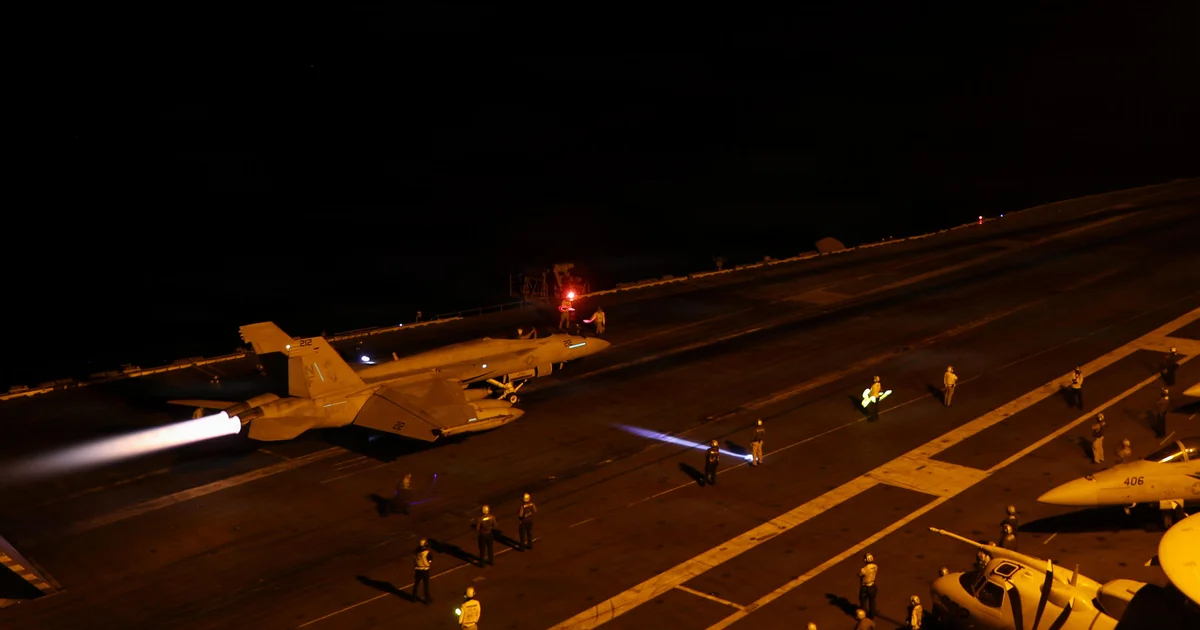

In a series of escalating tensions across the Middle East, recent events have seen military confrontations involving the United States, Iran, and other regional players. Tensions peaked as U.S. military strikes targeted Iranian installations on Larak Island, prompting swift retaliation from the Iranian Revolutionary Guard Corps (IRGC), which claimed it had attacked U.S. bases in Jordan. In parallel, President Trump shared a controversial AI-generated video suggesting an attack on Kharg Island, stirring dialogues regarding potential threats in the Persian Gulf. The situation remains fluid, with military engagements presenting risks of further confrontation in a volatile climate.
| Article Subheadings |
|---|
| 1) Trump’s AI-Generated Threat |
| 2) The Strait of Hormuz Incident |
| 3) Jordan Intercepts Incoming Missiles |
| 4) IRGC’s Response to U.S. Strikes |
| 5) The U.S. Military’s Strategic Operations |
Trump’s AI-Generated Threat
On Sunday evening, former President Donald Trump took to his social media platform, Truth Social, to share an AI-generated video that he stated depicted an attack on Kharg Island, a strategic oil hub in Iran. Trump’s post included a dramatic caption, exclaiming, “Kharg Island being blown to smithereens!!!” The share appears to imply a direct threat towards Iran, a nation that is highly sensitive to such statements given its geopolitical standing and ongoing tensions with the U.S.
Kharg Island is recognized as Iran’s primary oil export terminal, making it a critical asset in the country’s economy and its international oil trade relations. The timing and manner of Trump’s post raised questions about its intent, especially since there have been no substantiated reports of any contemporaneous attacks on the territory. The implications of sharing such a video could heighten tensions further, leading to possible military miscalculations.
As the geopolitical climate intensifies, Trump’s remarks serve as a reminder of how easily misinformation can spread and impact international relations. In light of recent events, the Iranian government has clarified through its national oil company, the National Iranian Oil Company, that operations on Kharg Island were ongoing and had not been disrupted.
The Strait of Hormuz Incident
In a related incident, a supertanker reportedly struck naval mines while navigating the Strait of Hormuz, an essential waterway for global oil shipping. According to statements from the Iranian military, the incident created a fire on board the vessel, prompting it to halt its operations. The Iranian Revolutionary Guard Corps (IRGC) claimed that the tanker had been attempting to transit this key maritime route illegally, but specific details regarding the ship or its crew have not been disclosed.
The IRGC’s response highlights persistent security challenges in the Strait of Hormuz, a region known for its strategic significance given that a significant percentage of the world’s oil passes through this narrow channel. Incidents such as this one not only pose immediate threats to vessels operating in the area but also raise concerns about the potential for broader conflict should tensions escalate between military forces active in the Persian Gulf.
The U.K. Navy’s Maritime Operations center had previously reported a similar incident involving a commercial ship in the vicinity, emphasizing the growing frequency of attacks in a region where hostilities are often intertwined with commercial interests. Thankfully, there were no casualties or significant environmental damage reported following the latest bombing.
Jordan Intercepts Incoming Missiles
Simultaneously, the Jordanian military announced on Sunday that it successfully intercepted and destroyed eight missiles that had entered its airspace. Reports from Jordan’s Al-Mamlaka TV indicated confirmation from military spokespersons that no damage resulted from the attempted attack. The incident demonstrates Jordan’s proactive defense measures and military readiness in a politically unstable region.
The interception and subsequent destruction of missiles without causing harm suggest that Jordan’s military capabilities were effectively executed. The exact origin of these missiles has not been publicly identified, but sources familiar with the situation confirmed that the intercept was a decisive action aimed at protecting Jordanian sovereignty and the safety of its citizens.
Jordan’s position at the crossroads of conflicts in the Middle East makes it a critical player in regional security dynamics. Maintaining a robust defensive posture not only ensures internal stability but also offers a layer of assurance to its allies concerning the safety of regional airspace against hostile threats.
IRGC’s Response to U.S. Strikes
In a direct reaction to the U.S. military strikes targeting Iranian military assets on Larak Island, the IRGC stated it had launched an offensive against American military bases in Jordan. Citing the attacks on Larak Island, the IRGC claimed to have targeted King Hussein and Al-Azraq air bases with ballistic missiles. The military body asserted that they successfully inflicted damage on “technical and maintenance infrastructure and the enemy’s fighter jets’ deployment sites.”
This retaliation underscores the IRGC’s commitment to responding to perceived threats against Iranian interests. Reports of U.S. forces targeting rocket launchers preparing to deploy strikes in the Strait of Hormuz have fueled tensions, framing the military exchanges in both operational and strategic contexts. The IRGC additionally claimed responsibility for downing a U.S. drone over the Strait of Hormuz, a move that has intensified scrutiny over aerial operations in this critical zone.
Statements from Iranian officials included assertions that losses were incurred on both sides as a result of these military engagements. Iran maintains that its response, including the ballistic missile assault, would bring about punishment for those involved in such “aggressive” actions.
The U.S. Military’s Strategic Operations
The ongoing military operations conducted by U.S. forces were characterized by an attack that successfully struck two rocket launchers located on Larak Island. U.S. Central Command (CENTCOM) revealed through its spokesperson that the strikes were executed to preemptively thwart Iranian forces preparing to launch attacks in the Strait of Hormuz. Observations noted that the IRGC was preparing to deploy sea mines, which posed significant threats to commercial vessels traversing this vital waterway.
Larak Island is particularly notable within the context of Iranian military strategies as it affords the opportunity to exert control over shipping lanes. The U.S. military operates under the premise of maintaining freedom of navigation in the face of Iranian posturing, thus escalating its presence in the region.
Following these strikes, Iran’s state-controlled media reported casualties among Iranian personnel, indicating the potential for heightened military tensions. The conflicts in this area routinely elevate the risks of broader international confrontations due to the interconnected nature of such military engagements.
Given the strategic importance of Larak Island as a toll point for various maritime operations, the geopolitical implications of U.S. military actions extend beyond the immediate physical damage inflicted; they signal a broader strategy of deterrence amid provocations from Iran.
| No. | Key Points |
|---|---|
| 1 | Trump’s AI-generated video conveys threats towards Iran’s oil infrastructure. |
| 2 | A supertanker experienced an incident involving naval mines in the Strait of Hormuz. |
| 3 | Jordanian military intercepts multiple incoming missiles, ensuring national security. |
| 4 | IRGC retaliates against U.S. bases, framing actions as defensive measures. |
| 5 | U.S. operations target Iranian launchers to disrupt military preparations in the region. |
Summary
The recent developments in the Middle East, particularly surrounding U.S. and Iranian military activities, illustrate an increasingly volatile landscape. Trump’s provocative AI-generated claims, coupled with actual military engagements, exacerbate tensions and may alter the strategic calculus for all involved parties. Each incident reflects broader implications for regional stability and highlights the fragile state of diplomacy amid military posturing. As nations respond to threats and assert their positions, the potential for escalation remains a significant concern for global security.
Frequently Asked Questions
Question: What is the significance of Kharg Island?
Kharg Island serves as Iran’s primary oil export terminal, playing a crucial role in the country’s oil economy and international trade relations.
Question: Why is the Strait of Hormuz strategically important?
The Strait of Hormuz is a vital waterway for global oil shipping, through which a significant percentage of the world’s oil supply is transported, making it a focal point for geopolitical tensions.
Question: What actions have the IRGC taken in response to U.S. military activity?
In response to U.S. military strikes, the IRGC has claimed to have launched attacks on U.S. military bases in Jordan and downed a U.S. drone, emphasizing a commitment to retaliate against perceived threats.
