

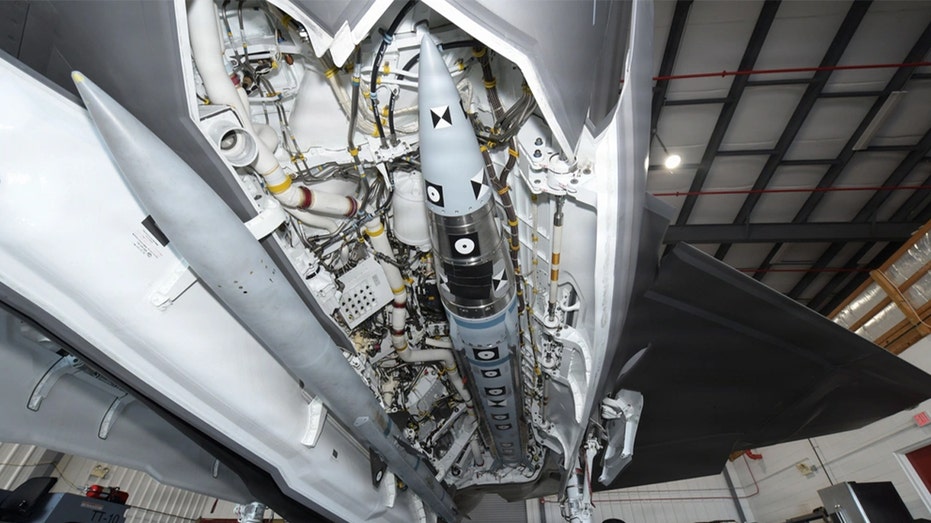

The U.S. Navy is developing the AIM-424 Long Range Air-to-Air Missile, known as MALICE, to engage enemy aircraft and drones at extreme distances. Officials announced the next-generation weapon on August 22, describing it as a system intended to give naval and Marine aviators greater reach and survivability. The missile is designed for launch from fighter aircraft and could allow pilots to attack threats before they approach carrier groups or other friendly aircraft.
The weapon’s stated range exceeds 250 nautical miles, or approximately 287 statute miles. Its large size, advanced propulsion requirements and compatibility with multiple generations of aircraft distinguish it from standard medium-range air-to-air missiles.
| 1) | A new weapon for extreme-range engagements |
|---|---|
| 2) | Range, size and destructive capability |
| 3) | Testing aboard Navy fighter aircraft |
| 4) | Compatibility across future aircraft fleets |
| 5) | The operational purpose of MALICE |
A new weapon for extreme-range engagements
The Navy’s AIM-424 LRAAM is being developed as an air-launched weapon for naval and Marine aviation. Fighter pilots would use onboard radar and other detection capabilities to identify enemy aircraft or drones, launch MALICE from a substantial distance and attempt to destroy the target before it reached a threatening position. The concept is intended to reduce the need for pilots to enter close proximity to hostile aircraft.
The Navy said the missile is intended to support a “first look, first shot, first kill” advantage by providing greater reach, survivability and tactical flexibility in air-to-air combat. The announcement was made August 22, ahead of reporting on the program at the end of August.
Range, size and destructive capability
MALICE has a listed range in excess of 250 nautical miles, equivalent to roughly 287 statute miles. That distance could allow aircraft to defend a wider area around a carrier strike force or other fleet assets, although actual engagement ranges would depend on operational conditions, detection, guidance and the target’s behavior.
The missile is approximately 13.5 feet long and weighs about 1,500 pounds. It is therefore substantially larger and heavier than the AIM-120 AMRAAM, a standard medium-range air-to-air missile that weighs about 335 pounds. MALICE also carries a blast-fragmentation warhead. Rather than requiring a direct physical impact, the warhead is designed to detonate near a target and send fragments outward to destroy or disable it.
Testing aboard Navy fighter aircraft
The Navy has tested the AIM-424 on F/A-18E Super Hornet aircraft. Images associated with the program show four missiles loaded on a Super Hornet for a test event, while another image depicts an AIM-424 mounted in the internal weapons bay of an F-35C alongside an AIM-120 AMRAAM on the weapon bay door.
These activities indicate that the Navy is examining how the unusually large missile can be carried and employed by carrier-based aircraft. The reported testing is focused on integration and operational use, but the available information does not establish a full deployment schedule or declare the system operational.
Compatibility across future aircraft fleets
Officials said the LRAAM is intended to be compatible with aircraft from multiple generations. That includes fourth-generation and fifth-generation fighters, as well as future sixth-generation aircraft. Such compatibility would allow the weapon to remain relevant as naval and Marine aviation fleets evolve.
The F/A-18E Super Hornet and F-35C are among the aircraft publicly associated with the missile’s testing. The F-35C’s internal weapons bay offers one potential carriage configuration, while the Super Hornet testing addresses the demands of integrating the weapon with an established carrier aircraft.
The operational purpose of MALICE
The program is intended to increase the range, lethality and combat effectiveness of Marine and naval aviation forces. By enabling an aircraft to launch against a distant threat, the missile could help pilots avoid closer-range engagements and provide additional protection for aircraft carriers and other fleet elements.
Raytheon, a major U.S. defense contractor, is developing the missile. The Navy has not publicly provided a complete account of the system’s final specifications, procurement plans or fielding timeline. Its stated role, however, is to extend the distance at which naval aircraft can challenge hostile air threats.
| No. | Key Point |
|---|---|
| 1 | The AIM-424 LRAAM is nicknamed MALICE. |
| 2 | Its listed range exceeds 250 nautical miles. |
| 3 | The missile weighs about 1,500 pounds and is 13.5 feet long. |
| 4 | Testing has involved F/A-18E Super Hornets and an F-35C configuration. |
| 5 | Raytheon is developing the weapon for naval and Marine aviation. |
Summary
The Navy’s MALICE program represents an effort to extend air-to-air engagement distances well beyond those associated with conventional medium-range missiles. Its reported range, large warhead and planned compatibility with current and future fighters could give naval aviation more options against aircraft and drones. The system remains under development, and further testing and official decisions will determine its eventual capabilities and deployment.
Frequently Asked Questions
What is the MALICE missile?
MALICE is the nickname for the U.S. Navy’s AIM-424 Long Range Air-to-Air Missile, a weapon designed to engage aircraft and drones at extreme distances.
How far can the AIM-424 reportedly reach?
Its listed range is in excess of 250 nautical miles, or approximately 287 statute miles.
Which aircraft have been involved in testing?
Reported testing has involved F/A-18E Super Hornets, and the missile has also been shown mounted in the internal weapons bay of an F-35C.
Who is developing MALICE?
Raytheon is developing the missile for use by naval and Marine aviation forces.
