

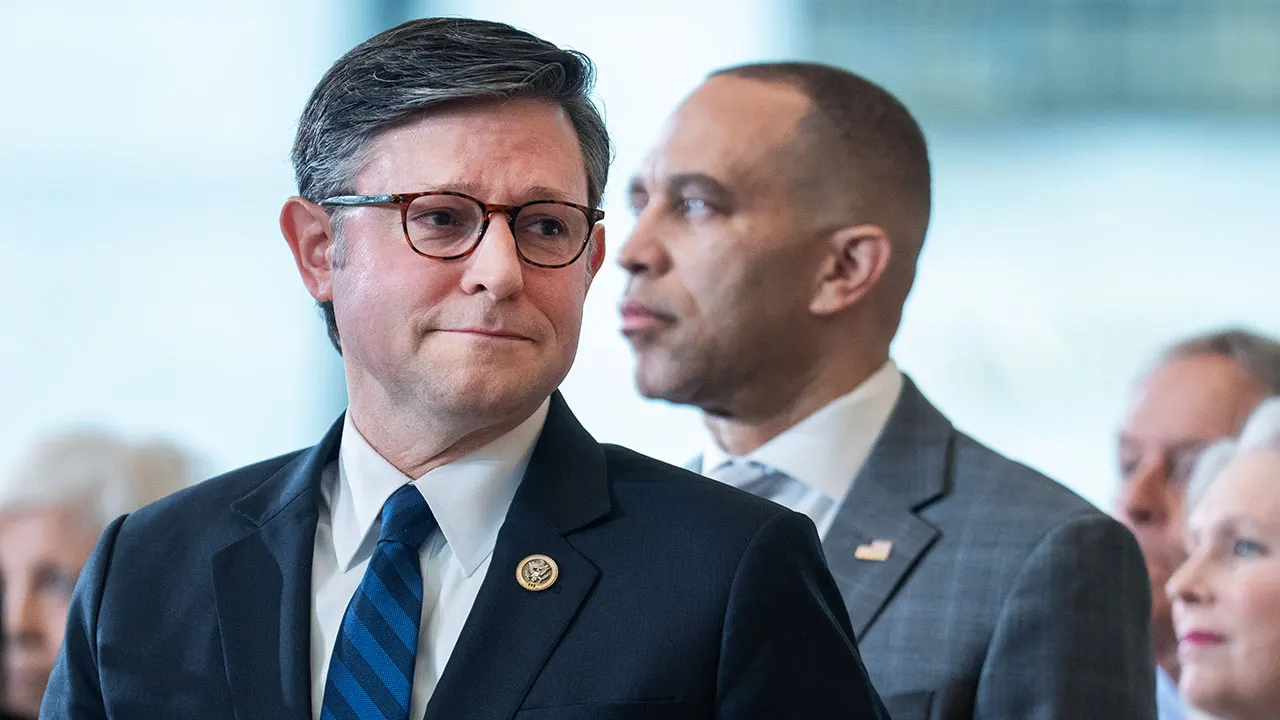

House Speaker Mike Johnson is intensifying his efforts to secure a Republican majority in the upcoming November elections, leveraging a perceived civil conflict within the Democratic Party. His recent statements highlight significant victories for socialist-aligned candidates in New York, revealing a split that many see as a potential liability for Democrats in their quest to maintain control. These developments mark a critical phase in the political landscape as both parties gear up for competitive midterm elections.
| Article Subheadings |
|---|
| 1) The Civil War Within the Democratic Party |
| 2) Key Victories for the Socialist Movement |
| 3) Implications for Hakeem Jeffries and Democratic Leadership |
| 4) Republican Strategy in Response to Democratic Turmoil |
| 5) Future of the Democratic Party Amidst Insurgency |
The Civil War Within the Democratic Party
The Democratic Party currently faces internal strife, epitomized by House Speaker Mike Johnson’s remarks regarding its leadership turmoil. During a campaign appearance in Virginia Beach, he pointedly identified House Minority Leader Hakeem Jeffries as a figurehead of a faction in crisis. Johnson claimed, “It’s a fascinating thing to see the Democrat Party, they’re in the midst of, now, an open civil war.” The backdrop of this contention is the Democratic Socialists of America (DSA), whose candidates have succeeded in recent primaries, challenging the party’s traditional establishment candidates. This divide signifies a broader ideological conflict, surpassing simple electoral competition and questioning the very essence of the party’s identity and future direction.
Key Victories for the Socialist Movement
Recent primaries across New York City have crystalized the impact of the DSA on the Democratic landscape. Candidates linked to the DSA, notably those endorsed by New York City Mayor Zohran Mamdani, have outperformed their establishment-backed counterparts in surprising fashion. Most notably, longstanding incumbents, including Adriano Espaillat, were beaten by socialist challenger Darializa Avila Chevalier in the Bronx. Another shocking upset occurred in Brooklyn, where former DSA member Brad Lander unseated Rep. Dan Goldman. According to Johnson, these victories signal a profound shift within the Democratic ranks, with socialists firmly achieving footholds in traditionally “safe” districts.
Implications for Hakeem Jeffries and Democratic Leadership
The electoral setbacks in New York could have ramifications for Hakeem Jeffries‘ tenure as the leader of House Democrats. Johnson emphasized that Jeffries “lost his slate of candidates in his own backyard,” which could undermine his authority and credibility within the party. The erosion of support from allies previously endorsed by Jeffries raises questions about his leadership approach moving forward and the ability of the Democratic establishment to respond effectively to its leftist challengers. This shift not only highlights the diverging priorities among party members but also threatens to reduce the overall cohesion necessary for a unified campaign strategy heading into the midterms.
Republican Strategy in Response to Democratic Turmoil
In light of the discord in the Democratic camp, Republicans are seizing the opportunity to strengthen their camp while criticizing their opponents. Mike Johnson has described the situation as that of a “rudderless ship” within the Democratic Party, further framing the liberal socialist candidates as representing a radical shift away from mainstream Democratic values. His strategy is to amplify these internal conflicts, positioning Republicans as the stable alternative amidst uncertainty, especially in critical districts where Democrats are vulnerable. “You have open Marxists who are winning primaries in that party,” Johnson remarked, leveraging these sentiments during his campaigns to galvanize GOP support.
Future of the Democratic Party Amidst Insurgency
The ascendance of socialist candidates poses existential questions about the future direction of the Democratic Party. As these tensions escalate, establishment Democrats may find themselves pushed to reevaluate their platform and strategies. Additional challenges stem from the fact that some newly elected candidates have not pledged support for Jeffries, suggesting a growing detachment from party leadership at the grassroots level. If the Democratic Party cannot successfully consolidate its factions, the risk of further electoral losses looms large. Nationally, the fallout from such a divide could reshape not only the Democrat agenda but also their overall platform in subsequent elections.
| No. | Key Points |
|---|---|
| 1 | Speaker Mike Johnson is leveraging Democratic internal conflicts to fortify Republican strategies for the midterm elections. |
| 2 | Candidates associated with the Democratic Socialists of America have secured significant primary victories in New York. |
| 3 | These results pose considerable challenges for Democratic leadership, particularly for Hakeem Jeffries. |
| 4 | Johnson’s narrative paints the Democrats as increasingly radicalized, appealing to moderate Republican voters. |
| 5 | The future of the Democratic Party may hinge on its ability to reconcile its establishment and insurgent factions. |
Summary
The current political scenario illustrates a critical inflection point for the Democratic Party, characterized by its internal divisions and the rise of socialist candidates. This fragmentation is being exploited by Republicans as they prepare for the November elections, suggesting a potentially transformative impact on the political dynamics both within and between the parties. As both sides navigate the complexities of evolving party ideologies, the consequences of the upcoming elections could have far-reaching implications for governance and policy formulation at the national level.
Frequently Asked Questions
Question: How are socialist candidates impacting the Democratic Party?
Socialist candidates are winning key primaries, challenging traditional leadership and altering the party’s ideological landscape, leading to internal conflicts over direction and strategy.
Question: What is the significance of the recent primaries in New York?
The New York primaries highlighted victories for candidates backed by the Democratic Socialists of America, which could signal a shift in Democratic voter preferences and threaten the incumbent establishment.
Question: How are Republicans responding to the Democratic Party’s internal strife?
Republicans are using the situation to portray Democrats as divided and radicalized, thus positioning themselves as a more stable and coherent alternative for voters in the upcoming elections.
