

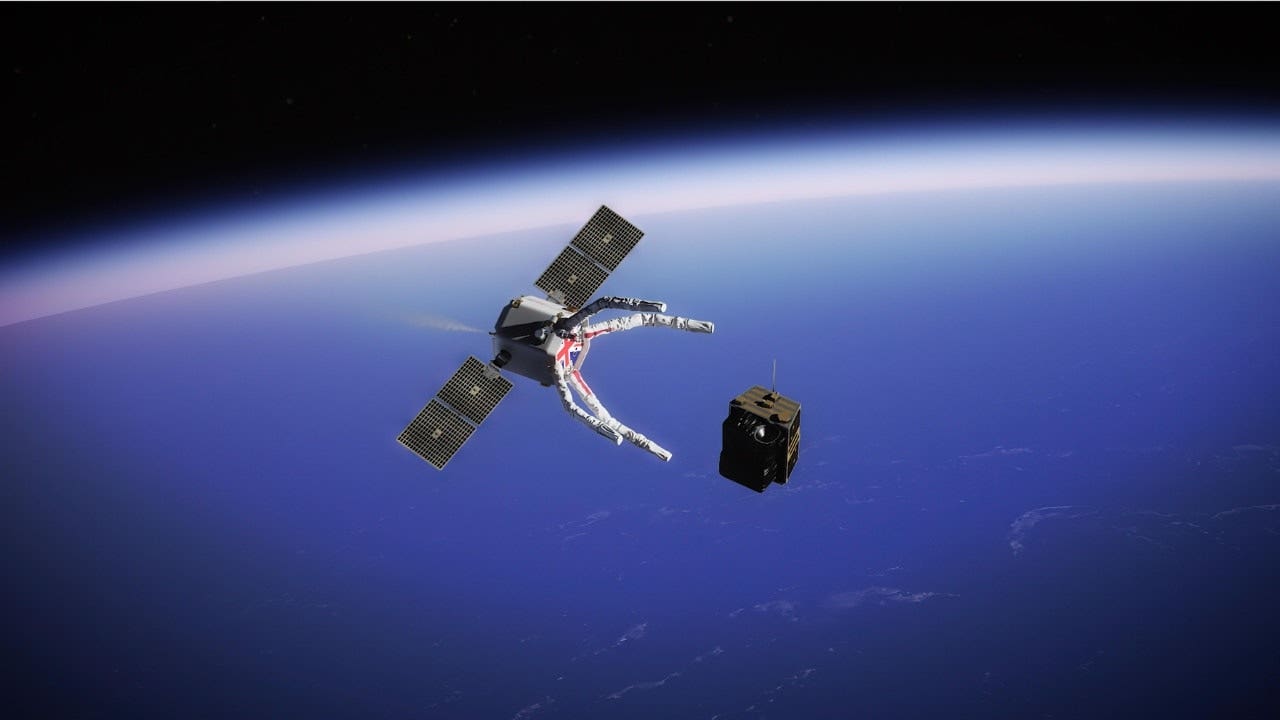

The UK has taken significant steps toward addressing the escalating issue of space debris with an ambitious project involving the development of a robotic spacecraft. This initiative, worth approximately $81 million, aims to remove defunct satellites from Earth’s orbit. The mission, which is part of Britain’s Active Debris Removal program, is expected to launch by 2029 and could provide a novel solution to the growing space junk problem that threatens both existing satellites and manned space missions.
| Article Subheadings |
|---|
| 1) Britain’s $81 million plan to clean up space |
| 2) How giant robotic claws will grab dead satellites |
| 3) Why space junk is becoming a serious problem |
| 4) Space junk also threatens astronauts |
| 5) A new space cleanup industry could be taking shape |
Britain’s $81 million plan to clean up space
The UK Space Agency has embarked on a pivotal venture to combat space debris by awarding a contract to the aerospace company ClearSpace UK. Valued at roughly $81 million, this project is central to Britain’s Active Debris Removal (ADR) mission, aimed at ensuring the long-term sustainability of space operations. The primary goal is to launch a specialized spacecraft by 2029 from the SaxaVord Spaceport located in Scotland’s Shetland Islands. The spacecraft’s inaugural mission will focus on removing two defunct satellites that are currently registered in the UK, with a target completion timeline set for 2032.
The successful execution of this mission would mark a substantial advancement in space debris management, demonstrating that a single spacecraft can efficiently capture and dispose of multiple inactive satellites without the need for immediate decommissioning. As the population of satellites in low Earth orbit continues to swell, illustrating the urgency of such operations, this project serves as a beacon of hope and innovation for future endeavors.
How giant robotic claws will grab dead satellites
The technical execution of capturing defunct satellites presents substantial challenges, particularly due to the velocities at which these objects orbit the Earth. Most satellites in low Earth orbit travel at speeds exceeding 17,000 miles per hour, complicating any potential retrieval operations. The ClearSpace spacecraft will employ advanced robotic technology specifically designed for this task. With a sophisticated capture system, the spacecraft will meticulously coordinate its movements with the target satellite, ensuring a safe and effective approach.
Once within range, its robotic mechanism will engage the satellite, securely capturing it. Subsequently, the spacecraft will maneuver the satellite into a lower orbit, where it can re-enter Earth’s atmosphere and burn up upon return. This innovative design allows for the possibility of refueling and reusing the cleanup spacecraft, effectively aiding in ongoing debris removal efforts. Engineers must validate this technology to confirm its reliability in handling such critical operations.
Why space junk is becoming a serious problem
The proliferation of space debris presents a daunting challenge for current and future space activities. The European Space Agency (ESA) reports that around 47,140 objects are tracked in Earth’s orbit, comprising both operational and inactive satellites, as well as fragments from rocket bodies. Much of this debris poses a significant risk due to the immense velocities at which it travels, with even small pieces capable of inflicting catastrophic damage to functional spacecraft.
Compounding the issue, sophisticated collision dynamics can occur when larger objects collide, generating debris clouds that could ultimately lead to further collisions, a scenario known as the Kessler syndrome. This phenomenon poses significant safety concerns for astronauts aboard the International Space Station (ISS) and operational satellites. The ESA’s recent warnings highlight the critical necessity for active debris removal initiatives to mitigate the risks posed by expanding orbital debris fields.
Space junk also threatens astronauts
Beyond the hazards posed to satellites, space debris also represents a tangible threat to astronauts stationed on the ISS. Incidents attributed to space debris have necessitated the ISS crew taking precautionary measures, such as sheltering inside their spacecraft when confronted with dangerous debris clouds. A significant event occurred in November 2021, triggered by a Russian anti-satellite weapons test that produced hazardous debris.
During this incident, both NASA and Russian space officials took immediate action to protect their crews, demonstrating how unforeseen debris hazards can disrupt critical operations in space. While the safety protocols successfully safeguarded the crew, they underscore the pressing need for strategies to actively reduce the risk of collisions by removing defunct satellites and preventing further fragmentation of the orbital environment.
A new space cleanup industry could be taking shape
Britain’s pioneering cleanup mission has broader implications for the space industry, signaling the potential emergence of a new sector dedicated to space debris management. Historically, satellites were engineered with the understanding that they would become dormant after their missions concluded, leaving them to languish in orbit. However, advanced technologies are evolving, paving the way for craft that can assist in the maintenance and repair of satellites and remove defunct ones from orbit.
The transformative potential of the ClearSpace mission lies in its ability to demonstrate that robotic spacecraft can effectively capture and retire inoperative objects. This advancement could fundamentally alter how operational satellites are managed. With plans for the cleanup spacecraft to accommodate refueling for reuse, it becomes increasingly feasible to create an economic model around debris removal wherein satellite operators may enlist specialized firms to address aging satellites or salvage those still operational before they become nonfunctional.
| No. | Key Points |
|---|---|
| 1 | The UK is investing approximately $81 million into a mission aimed at removing defunct satellites from orbit. |
| 2 | ClearSpace UK has been selected to develop a robotic spacecraft designed for debris capture and removal from space. |
| 3 | Space debris poses substantial risks to operational satellites and astronauts, necessitating active removal strategies. |
| 4 | The technological capabilities required for successful debris removal are being developed to support future missions beyond initial goals. |
| 5 | The emergence of a space cleanup industry could lead to economic opportunities as the need for safe satellite operations grows. |
Summary
The UK’s undertaking of an $81 million project to develop robotic technology for the removal of space debris marks a pivotal moment in addressing the escalating risks associated with the growing presence of defunct satellites in orbit. As satellites play an essential role in modern communication, navigation, and monitoring, ensuring their safe operation is crucial. With the potential for creating a sustainable cleanup industry, this initiative not only holds promise for enhancing safety in space but also exemplifies the collaborative efforts needed to secure the integrity of Earth’s orbital environment for future generations.
Frequently Asked Questions
Question: What is the primary objective of the UK’s space debris mission?
The mission aims to develop a robotic spacecraft capable of capturing and removing defunct satellites from Earth’s orbit, addressing the growing concern over space debris.
Question: How does space debris affect operational satellites?
Space debris poses significant risks to operational satellites by potentially causing collisions that can damage or disable them, impacting essential services they provide.
Question: What technologies are being developed for satellite removal?
The mission involves employing advanced robotic technology specifically designed to capture inactive satellites and maneuver them into lower orbits for reentry and disposal.
