

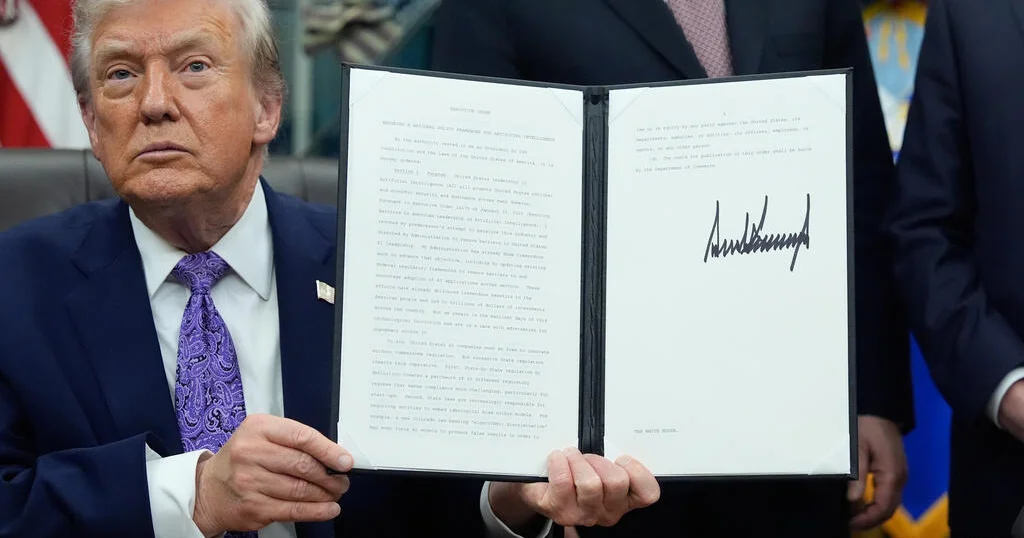

In a significant move to shape the future of artificial intelligence (AI) regulation in the United States, President Trump signed an executive order aimed at preventing states from implementing their own AI rules. The decision is driven by concerns that a fragmented regulatory environment could hinder innovation and weaken the nation’s position against competitive international forces, especially China. The executive order calls for the establishment of a task force to address state-level regulations, raising critical questions about the balance of power between state laws and federal oversight.
| Article Subheadings |
|---|
| 1) Executive Order Overview |
| 2) The State of AI Legislation |
| 3) Reactions from Industry Leaders |
| 4) Bipartisan Pushback |
| 5) Future Implications |
Executive Order Overview
On a recent Thursday, President Trump took decisive action by signing an executive order directed at states, which aims to restrict the autonomy of state governments in crafting their own regulations on artificial intelligence. His principal assertion is that a fragmented collection of state rules could create obstacles and lead to inefficiencies within the field of AI, thereby stifling innovation at a pivotal time when competition with countries like China is intensifying. The president highlighted that China’s streamlined approval processes present a significant advantage, making it essential for the United States to adopt a unified regulatory stance.
The executive order specifically instructs Attorney General Pam Bondi to form a task force that will challenge and mitigate laws implemented by states that are perceived as restrictive or counterproductive to the growth of AI technology. Additionally, it directs the Commerce Department to compile a list of problematic state regulations that may inhibit business operations in the sector. Pursuing a hardline stance, the order also threatens to strip away funding from broadband deployment programs and additional grants for any state that enacts laws perceived as unfavorable to AI advancement.
The State of AI Legislation
Multiple states, including Colorado, California, Utah, and Texas, have already implemented regulatory measures focused on AI technology, as highlighted by the International Association of Privacy Professionals. These laws primarily aim to enhance transparency and control the indiscriminate collection of personal data by companies engaging in AI operations. Advocates of these regulations argue that they are timely and crucial, as AI systems increasingly make consequential life changes for individuals, such as determining job opportunities, access to housing, loan approvals, and even medical treatments.
Concerns have been raised regarding the accuracy and fairness of AI-assisted decision-making processes. There is evidence suggesting that biases could manifest in these systems, occasionally leading to flawed judgments that unfairly prioritize individuals based on gender or race. In this regard, the existing state laws endeavor to compel companies to engage in risk assessments to identify potential sources of discrimination stemming from their AI programs. Legislators believe that ensuring ethical AI governance is imperative for both the technology’s public acceptance and its sustainable development.
Reactions from Industry Leaders
Industry stakeholders have voiced mixed sentiments concerning the president’s executive order. David Sacks, a prominent venture capitalist spearheading the administration’s policies on both cryptocurrency and AI, expressed that the administration’s objective is to alleviate excessively burdensome state regulations while not opposing essential safety measures protecting consumers, particularly children. According to Sacks, the administration aims to target the “most onerous examples of state regulation,” seeking to create a more favorable environment for innovation and investment.
However, proponents of state regulations counter that establishing a uniform federal regulatory framework could lead to complacency and substantial federal overreach. They argue that states have become essential testing grounds for AI regulations, experimenting with methodologies designed to foster responsible AI implementation while addressing public concerns around data privacy and algorithmic bias. Critics of the executive order fear that it may stifle these experimental efforts at the local level, placing the U.S. in jeopardy of losing important innovations that could arise from varied regulatory approaches.
Bipartisan Pushback
Despite the push for a centralized regulatory framework, bipartisan opposition has emerged against the executive order. Prominent figures from both parties have expressed concerns over the potential overreach of the federal government into state affairs. For instance, Florida Governor Ron DeSantis has suggested that the executive order essentially amounts to a government subsidy for large technology companies, limiting the ability of state governments to manage the burgeoning AI landscape responsibly.
Furthermore, Democratic Senator Ed Markey of Massachusetts criticized the executive order as an “early Christmas present” to wealthy company executives, suggesting that it favors corporate interests over consumer welfare. Such sentiments reflect a growing unease within parts of Congress concerning how AI regulations should be crafted and who should control the conversation surrounding their development. Lawmakers are consequent in advocating for robust discussions on how such technologies should be governed, considering the impact they have on society.
Future Implications
The executive order signed by President Trump could herald substantial shifts in how artificial intelligence is regulated across the United States. Should the administration successfully dismantle state-led initiatives that focus on safeguarding consumer rights and promoting ethical AI practices, there’s a risk that innovation may occur at the expense of public welfare. Opponents predict that the executive order could lead to a situation where companies may focus solely on profits without accountability, stunting the growth of socially responsible AI applications.
As debates over regulatory control unfold, the balance of power between state and federal governance regarding AI will be critical in shaping its future. Observers will be keenly watching for how this executive order evolves into practice and whether states continue to push back or adapt their strategies in the face of federal oversight. The long-term implications for the AI industry, societal norms, and consumer protections may ultimately hinge on the outcomes of these regulatory discussions.
| No. | Key Points |
|---|---|
| 1 | President Trump signed an executive order limiting state AI regulations. |
| 2 | The order establishes a task force to combat state laws perceived as restrictive. |
| 3 | Multiple states have implemented their own AI regulations focused on transparency. |
| 4 | Industry leaders express concerns over federal overreach and the potential for stifled innovation. |
| 5 | Bipartisan resistance arises against the executive order, questioning its implications. |
Summary
In summary, President Trump’s executive order to regulate AI at the federal level is a noteworthy development in the ongoing dialogue about technology governance in the United States. While aimed at promoting innovation, it simultaneously raises concerns about undercutting state-level protections for consumers and ethical practices in AI. As lawmakers from both political parties continue to voice their opinions, the implications of this executive order are poised to impact the landscape of artificial intelligence regulation and development for years to come, making it an essential topic for future discussion and analysis.
Frequently Asked Questions
Question: What are the key objectives of President Trump’s executive order on AI?
The executive order aims to restrict states from developing their own regulations governing artificial intelligence, proposing a unified federal approach to foster innovation and competitiveness against international rivals.
Question: Why have some states implemented AI regulations?
States have passed various AI regulations to ensure transparency, protect consumer rights, and address potential biases in AI systems, emphasizing the importance of ethical practices in technology.
Question: What has been the reaction among lawmakers regarding the executive order?
The executive order has drawn bipartisan criticism, with various lawmakers expressing concerns over federal overreach, potential harm to consumer protections, and the implications for responsible AI governance.
