

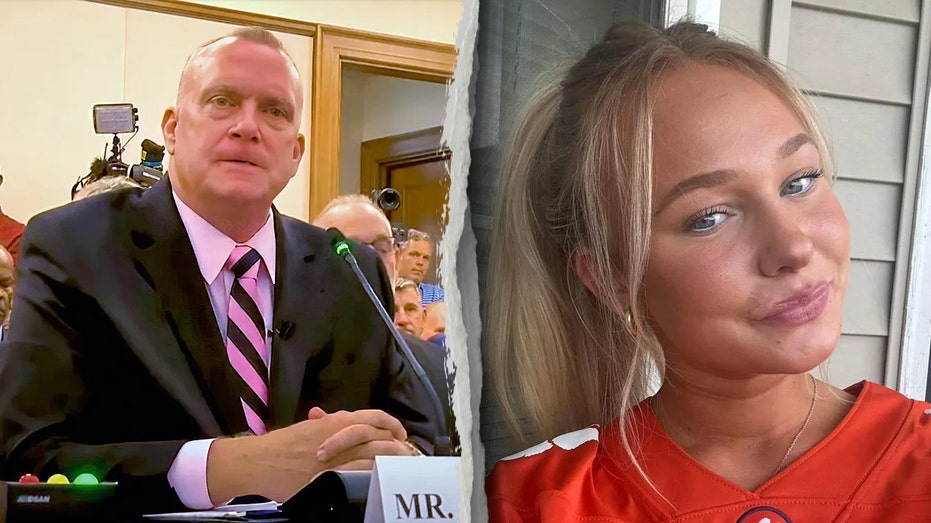

The father of 22-year-old college student Logan Federico is urging federal lawmakers to create a public registry for repeat violent offenders. Stephen Federico says legal and communication gaps allowed his daughter’s accused killer to remain free despite an extensive criminal record. The proposed Logan’s Law would also require cross-county and interstate information sharing and greater accountability for prosecutors handling habitual offenders. The legislation has been introduced but has not formally reached the floor of either chamber of Congress.
Federico made his case during a South Carolina crime-reduction roundtable attended by U.S. Attorney General Todd Blanche. He said the proposal is intended to prevent other families from experiencing similar loss and to make repeat violent offending more visible to authorities and the public.
| 1) | The proposal behind Logan’s Law |
| 2) | The killing that prompted the campaign |
| 3) | Concerns about repeat-offender gaps |
| 4) | Lawmakers and officials call for action |
| 5) | The path ahead for the legislation |
The proposal behind Logan’s Law
Logan’s Law was introduced by U.S. Rep. Russell Fry, a South Carolina Republican, and the late Sen. Lindsey Graham, also of South Carolina. The proposal would establish a publicly searchable database of people convicted of repeat violent offenses. It would also require law enforcement agencies in different counties and states to share information and would create accountability measures for prosecutors dealing with habitual criminals.
Supporters describe the proposal as similar in concept to existing public registries, but focused on violent crimes rather than sexual offenses. Its stated purpose is to reduce information gaps and help authorities identify people whose criminal histories span multiple jurisdictions.
The killing that prompted the campaign
Logan Federico, a North Carolina college student and aspiring nurse, was staying with friends at a home in Columbia, South Carolina, on May 3, 2025. Police allege that Alexander Dickey entered the property during a break-in and fatally shot Federico.
According to Columbia police, Dickey allegedly drove a stolen vehicle into the neighborhood, entered another home to take vehicle keys and a gun, and then forced his way into the residence where Federico was staying. Police say he stole credit cards inside. Federico’s father has said she was awake during the intrusion and may have been able to identify the intruder.
“He didn’t kill our daughter for a debit card. She was the only one awake who could identify him. He killed a witness.”
Concerns about repeat-offender gaps
Stephen Federico has argued that the killing exposed weaknesses in the criminal justice system. Authorities and critics of current policies point to Dickey’s criminal record, which reportedly dates to 2013 and includes convictions for breaking and entering, burglary, grand larceny, strong-arm robbery, possession of a stolen vehicle and resisting arrest.
Federico has criticized reduced sentencing and no-cash bail policies, saying they can allow people with repeated violent or serious offenses to return to communities without adequate oversight. He said the system has placed too much emphasis on the rights and circumstances of offenders while failing to protect potential victims.
“What we do as a society right now is make the criminal more important than the innocent.”
Lawmakers and officials call for action
Federico spoke at a South Carolina roundtable on crime reduction attended by Attorney General Todd Blanche. He said the legislation could prevent future deaths and urged lawmakers to address what he views as failures in communication, sentencing and supervision.
Blanche encouraged Congress to act despite the tragedy that brought the proposal national attention. He said he hoped the measure could attract bipartisan support and stated that President Donald Trump supports it. Fry has similarly presented the registry as a straightforward public-safety measure, arguing that citizens should be able to search information about repeat violent offenders.
The path ahead for the legislation
Logan’s Law has not formally come to the floor in either the House of Representatives or the Senate. Its future will depend on congressional action, including committee consideration and decisions about how a registry would define repeat violent offenses, protect accurate records and coordinate information across jurisdictions.
Federico’s campaign is focused on turning his daughter’s death into a national policy debate. The proposal’s supporters say a centralized public database and mandatory information sharing could help law enforcement identify repeat offenders before another serious crime occurs. Any final legislation would still require approval by both chambers of Congress and presidential action.
| Number | Key Point |
|---|---|
| 1 | Logan’s Law would create a public database for repeat violent offenders. |
| 2 | The proposal would require broader information sharing across counties and states. |
| 3 | Federico’s daughter was fatally shot during an alleged home break-in in Columbia, South Carolina. |
| 4 | The legislation has been introduced but has not reached the floor of Congress. |
Summary
Stephen Federico is pressing Congress to advance Logan’s Law after the 2025 killing of his daughter, Logan Federico. The proposal would establish a public registry for repeat violent offenders, improve information sharing between jurisdictions and increase accountability in cases involving habitual criminals. Supporters say the measure could address gaps that allow serious offenders to move through the justice system without consistent oversight, although the legislation still faces the congressional process before it could become law.
Frequently Asked Questions
What is Logan’s Law?
Logan’s Law is a proposed federal measure that would create a public database for repeat violent offenders and require broader communication among law enforcement agencies across jurisdictions.
Why is Stephen Federico supporting the proposal?
Federico is supporting it after his daughter, 22-year-old college student Logan Federico, was fatally shot during an alleged home break-in in Columbia, South Carolina, in May 2025.
Has Logan’s Law become law?
No. The proposal has been introduced in Congress but has not formally reached the floor of either the House or the Senate.
