

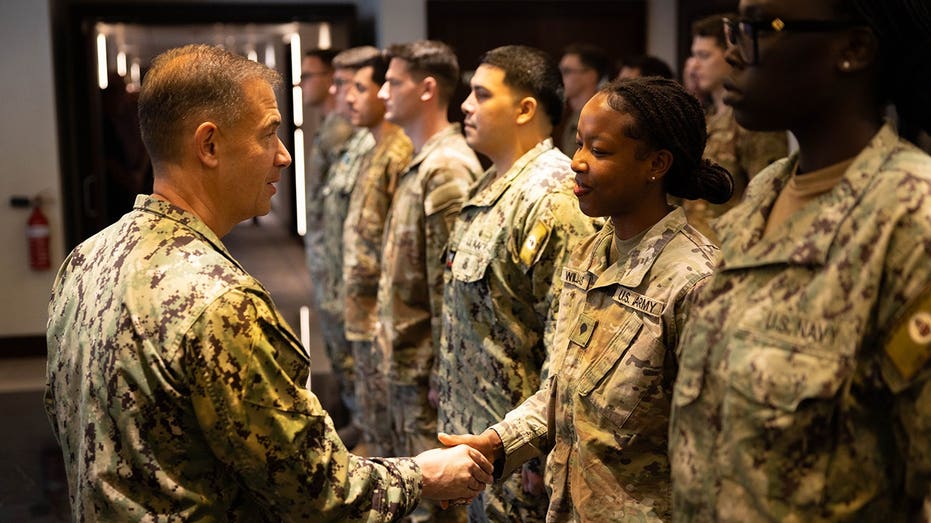

More than 50,000 U.S. service members stationed across the Middle East are spending Thanksgiving focused on missions involving maritime security, regional defense and counterterrorism. U.S. Central Command spokesperson and U.S. Navy Capt. Tim Hawkins described the command’s message to deployed troops as one of deep gratitude. He also recognized the families supporting service members from home during a difficult period. The remarks came as American forces continued operations involving Iran, shipping through the Strait of Hormuz and the effort to prevent the Islamic State from reconstituting.
| 1) | Thanksgiving recognition for deployed service members |
|---|---|
| 2) | Missions protecting shipping and regional partners |
| 3) | Families’ role during an extended deployment |
| 4) | Iran operations and the Strait of Hormuz |
| 5) | Continuing counter-ISIS operations after Iraq withdrawal |
Thanksgiving recognition for deployed service members
On Thanksgiving, U.S. Central Command highlighted the work of more than 50,000 American service members deployed across the Middle East. Speaking about the holiday message, U.S. Navy Capt. Tim Hawkins, a spokesperson for the command, said the recognition was intended for troops carrying out demanding assignments far from home.
Hawkins said the service members had demonstrated focus, commitment and dedication while handling several missions at the same time. Their duties included protecting American personnel, supporting regional security and helping safeguard international commerce. The message was directed to troops serving throughout the command’s area of responsibility during the Nov. 26, 2026, holiday.
“My message to the more than 50,000 service members stationed across the Middle East this Thanksgiving is one of deep gratitude for the exceptional work they’re doing,” Hawkins said.
Missions protecting shipping and regional partners
The troops’ responsibilities include helping protect commercial shipping moving through the Strait of Hormuz, an international waterway that is important to regional and global trade. Hawkins said American forces were also working with regional partners to defend personnel and civilians against threats.
The command said service members had stood alongside partner nations while responding to Iranian aggression and protecting U.S. forces in the region. According to Hawkins, approximately 10,000 or more projectiles had been fired at innocent civilians, Gulf neighbors and American service members. He credited the deployed force with helping keep traffic flowing through the Strait of Hormuz.
Families’ role during an extended deployment
Hawkins said the Thanksgiving message also applied to the families of deployed military personnel. Those family members remain at home while their relatives carry out assignments overseas, often managing household responsibilities and coping with uncertainty during lengthy deployments.
He described military service as involving personal sacrifice and cost not only for service members but also for spouses, children and other relatives. Families, he said, were praying for their loved ones and holding down the home front during a challenging period. The command extended its gratitude and Thanksgiving wishes to them as part of the broader recognition of the military community.
“They are in our thoughts and we are also grateful to them and we wish them a happy Thanksgiving,” Hawkins said of the families waiting at home.
Iran operations and the Strait of Hormuz
Iran has remained a primary focus of the command’s activity. The military’s Operation Epic Fury against Iran was launched on Feb. 28, and U.S. forces have continued missions connected to regional defense and maritime security since then.
Hawkins said troops were helping maintain what he described as America’s “ironclad blockade” against Iran while also protecting shipping. He characterized the effort as highly effective and said the presence of U.S. forces helped support the continued movement of traffic through the Strait of Hormuz. The mission combines maritime protection, defense against attacks and coordination with countries in the Gulf region.
Continuing counter-ISIS operations after Iraq withdrawal
Although Iran has received substantial attention, Hawkins said U.S. forces were also working to prevent the Islamic State from reconstituting. The counterterrorism mission continued after the United States completed its withdrawal of troops and equipment from Iraq following a 12-year mission.
Following the Iraq departure, Combined Joint Task Force-Operation Inherent Resolve remained operational from headquarters in Jordan. U.S. forces continued the counter-ISIS mission in Syria alongside coalition partners and the Syrian government, according to the command. The arrangement allows the campaign against the Islamic State to continue while American forces also address threats to regional stability and U.S. personnel.
| Number | Key Point |
|---|---|
| 1 | More than 50,000 U.S. service members are stationed across the Middle East. |
| 2 | Their missions include protecting shipping through the Strait of Hormuz and supporting regional partners. |
| 3 | Military families were recognized for sharing the sacrifices of deployment. |
| 4 | Counter-ISIS operations continue in Syria after the U.S. withdrawal from Iraq. |
Summary
The Thanksgiving message underscored the breadth of U.S. military responsibilities across the Middle East. Service members are supporting maritime security, responding to Iranian threats, protecting American personnel and continuing counter-ISIS operations. The recognition also emphasized that the burden of deployment is shared by families at home, whose support remains central to the military mission.
Frequently Asked Questions
How many U.S. service members are stationed across the Middle East?
More than 50,000 U.S. service members are stationed across the region, according to the report.
What missions were highlighted in the Thanksgiving message?
The missions include protecting shipping through the Strait of Hormuz, defending U.S. forces and regional partners, countering Iranian aggression and preventing the Islamic State from reconstituting.
Where is the counter-ISIS task force headquartered after the Iraq withdrawal?
Combined Joint Task Force-Operation Inherent Resolve is headquartered in Jordan and continues operations in Syria alongside coalition partners and the Syrian government.
