

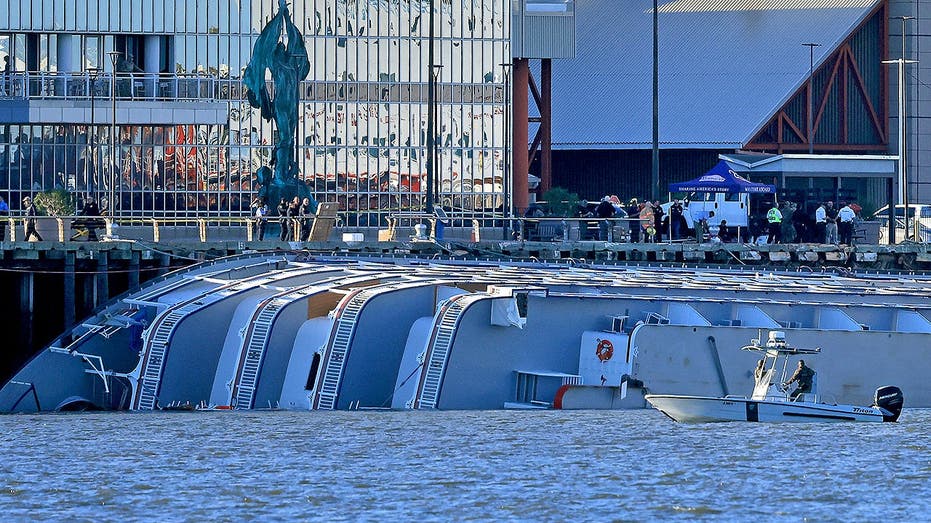

At least 100 people were pulled from the Mississippi River after a tanker struck and capsized a docked cruise ship in New Orleans on Friday, November 13, 2026. All 191 passengers and crew members aboard the American Heritage survived, although eight people remained hospitalized Saturday, including two in serious condition. The U.S. Coast Guard is preparing to remove about 16,000 gallons of fuel and begin a salvage operation expected to last weeks. Investigators, including the National Transportation Safety Board, are examining the collision and a possible steering problem involving the tanker.
| 1) | Rescue response brings all passengers and crew to safety |
|---|---|
| 2) | Capsized vessel creates a complex salvage operation |
| 3) | Collision timeline and investigation remain under review |
| 4) | River traffic resumes under a restricted safety zone |
| 5) | Passengers receive assistance as recovery work continues |
Rescue response brings all passengers and crew to safety
The American Heritage was docked near the Port of New Orleans when the Atlantic Asphalt tanker struck it at approximately 12:30 p.m. local time Friday. The cruise vessel began taking on water and later overturned. Harbor police said more than 80 people were evacuated before the vessel capsized, while roughly 100 others entered the river and were rescued by emergency responders and nearby vessels.
Officials credited the use of life jackets and the rapid response of rescuers with preventing fatalities. **Helena Moreno**, the mayor of New Orleans, said the injured captain stayed aboard until passengers and crew had been accounted for. The captain reportedly declined medical treatment initially because he wanted to confirm that everyone had left the vessel.
“Every moment of the critical time Friday, he did not want to leave his ship,” Moreno said.
Capsized vessel creates a complex salvage operation
The Coast Guard is preparing to remove approximately 16,000 gallons of fuel from the American Heritage before the wreck can be fully salvaged. Divers are expected to assess the vessel, while pollution response teams monitor the Mississippi River for leaks and other hazardous materials.
**Melanie Burnham**, a Coast Guard captain, said crews had not identified any product in the river that required removal. She warned, however, that fuel or other hazardous materials could escape as workers move or dismantle the capsized ship. The operation is expected to take weeks rather than days because officials are prioritizing safety and pollution prevention.
“We’re talking weeks, we’re not talking days, we’re talking weeks. So we’re going to do this safely and we’re going to make sure that it’s done right,” Burnham said.
Collision timeline and investigation remain under review
The collision occurred after the American Heritage had been docked for about two hours. The vessel began filling with water after the tanker hit it and capsized an estimated 30 to 45 minutes later, according to **Melanie Montro**, chief of the Port of New Orleans Harbor Police. Officials said the exact sequence remains under investigation.
Investigators are examining a possible steering issue involving the Atlantic Asphalt, but no definitive cause has been announced. The National Transportation Safety Board began sending investigators to the area Saturday after travel disruptions delayed its response. Coast Guard officials said there was no indication that terrorism was involved, while emphasizing that the investigation remains active.
River traffic resumes under a restricted safety zone
The Atlantic Asphalt was moved away from the collision site after the crash. The Coast Guard then partially reopened the Mississippi River to two-way traffic, allowing navigation to resume while recovery work continued.
A 500-foot safety zone remains around the wreck. The restriction is intended to keep commercial traffic, recreational vessels and members of the public away from divers, response crews and salvage equipment. Officials will continue monitoring river conditions as fuel removal and vessel assessment proceed.
Passengers receive assistance as recovery work continues
American Cruise Lines, which operates the American Heritage, is coordinating with local officials to assist passengers displaced by the incident. The company’s response is continuing alongside medical care, safety operations and the investigation into the crash.
Eight people remained hospitalized Saturday, with two listed in serious condition and six described as stable. The rescue effort has ended, but the longer recovery phase will involve fuel removal, underwater inspections, environmental monitoring and the eventual removal of the capsized cruise ship.
| Number | Key Point |
|---|---|
| 1 | All 191 passengers and crew survived the collision and capsizing. |
| 2 | At least 100 people entered the river and were rescued. |
| 3 | The Coast Guard plans to remove about 16,000 gallons of fuel. |
| 4 | Eight people remained hospitalized, including two in serious condition. |
| 5 | A 500-foot safety zone remains around the wreck during the investigation and salvage effort. |
Summary
The New Orleans collision produced a large-scale rescue but no fatalities, with all passengers and crew surviving after the American Heritage capsized in the Mississippi River. Authorities are now shifting from emergency response to a weeks-long recovery effort focused on fuel removal, environmental monitoring, investigation and safe wreck removal. River traffic has partially resumed, although a 500-foot safety zone remains in effect.
Frequently Asked Questions
How many people were aboard the American Heritage?
There were 191 passengers and crew members aboard the cruise ship when the Atlantic Asphalt tanker struck it.
Were there any fatalities?
No. Officials said everyone aboard survived, although eight people remained hospitalized Saturday.
How long will the salvage operation take?
Coast Guard officials said the operation could take weeks. Crews must first remove fuel, inspect the vessel and monitor for pollution before completing the salvage work.
