

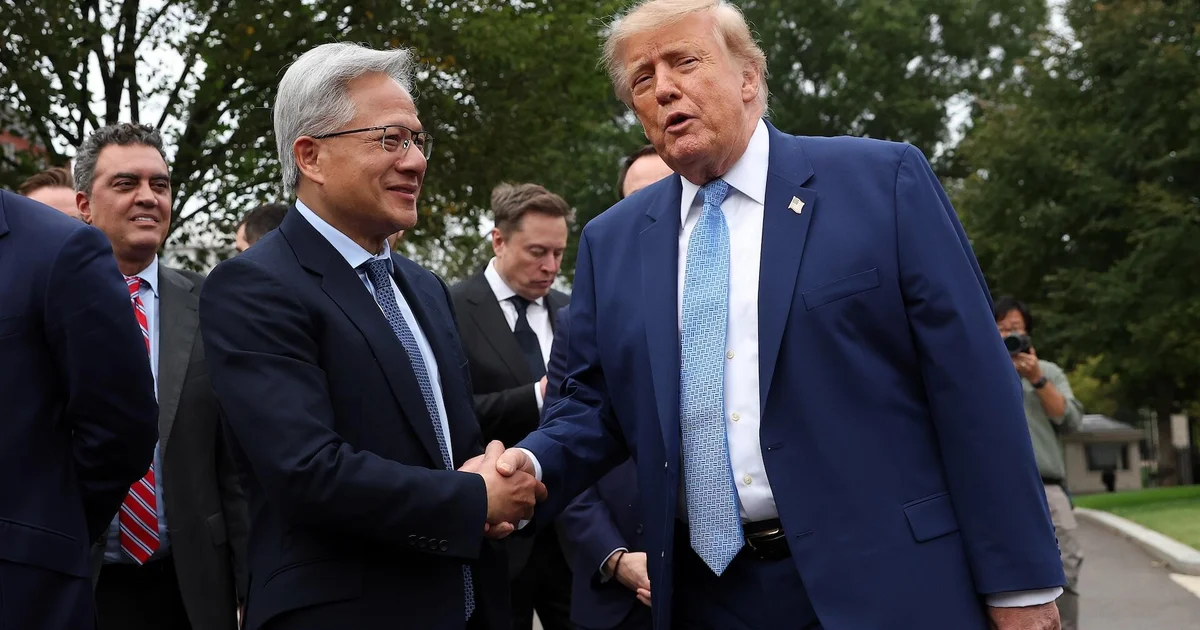

In a recent revelation, financial disclosures indicate that former President Donald Trump holds a significant investment in Nvidia, the major chip manufacturer, with stakes valued between $13 million and $58 million. This disclosure comes amidst controversy surrounding Jensen Huang‘s brief resignation as CEO over allegations of personal misconduct and subsequent return to the company, a decision that reportedly coincided with Trump’s intervention. The implications of these events raise concerns over conflicts of interest and ethical governance, especially as Trump is set to benefit financially from the company’s performance and growth.
| Article Subheadings |
|---|
| 1) Trump’s Financial Gains Linked to Nvidia’s CEO Situation |
| 2) Overview of Trump’s Nvidia Shares and Transactions |
| 3) Ethical Concerns Surrounding Presidential Investments |
| 4) Wider Implications for Trump-appointed Officials |
| 5) Future Considerations for Legislative Reforms |
Trump’s Financial Gains Linked to Nvidia’s CEO Situation
The financial entanglement of Donald Trump with Nvidia has sparked considerable public interest following the company’s CEO Jensen Huang stepping down and then being reinstated. Huang’s departure was swift, prompted by allegations of infidelity and potential national security risks linked to his relationships and business practices involving Nvidia’s chip distribution. The former President claimed he contacted Nvidia’s board and was instrumental in negotiating Huang’s return, suggesting that his intervention protected not just his financial interests, but also national priorities regarding technology and competitiveness.
On the Monday following Huang’s reinstatement, Nvidia’s stock surged by over 30%, substantially increasing Trump’s financial stake, with estimates indicating a rise in value between $1.3 million to $14.8 million. Specific details of the stock surge and its resulting profit took center stage, highlighting how a volatile corporate decision could directly influence Trump’s wealth. Critics have raised alarms about the appropriateness of a sitting president intervening in corporate governance primarily to safeguard their investments.
Overview of Trump’s Nvidia Shares and Transactions
As per the disclosures filed with the Office of Government Ethics, Trump’s investments in Nvidia range significantly, with values fluctuating based on market performance. Between January 2025 and September 2026 alone, Trump engaged in over 100 transactions concerning Nvidia shares, with the total value ranging from $27 million to nearly $98 million. Moreover, the exact number of shares he currently holds remains somewhat ambiguous due to the range of values reported.
His financial situation is further complicated by the management of these assets. A representative from the White House confirmed that Trump’s financial portfolio is independently managed, asserting that neither he nor his family has a direct hand in trading decisions. They emphasize that investment strategies align with market indexes like the Schwab 1000, which minimizes the risks of inappropriate influence or bias toward individual companies like Nvidia.
Ethical Concerns Surrounding Presidential Investments
As Trump’s financial entanglements come to light, ethics experts are voicing serious concerns about the implications of having a sitting president with substantial financial holdings in major corporations. Legal authorities have argued that on many levels, Trump’s actions represent a potential conflict of interest, whereby he could leverage his presidential powers for personal financial gain. Law professor Kathleen Clark has expressed that Trump’s intervention in corporate governance “goes beyond a conflict of interest,” essentially prioritizing his financial wellbeing over national security considerations.
Additionally, organizations such as Citizens for Responsibility and Ethics have noted that Trump’s continuous ownership of Nvidia stock raises questions about accountability and transparency in governmental operations. The overall sentiment among critics is that the line separating personal finance and public duty has been blurred, inviting calls for stricter regulations concerning financial dealings of elected officials.
Wider Implications for Trump-appointed Officials
Trump’s investment strategy is not limited to his portfolio but extends to several officials within his administration. Numerous appointees across federal departments, including State, Commerce, and Treasury, have reported holding Nvidia shares. Many have opted to sell their stocks post-appointment, indicating an awareness of ethical considerations enveloping government service and personal investments. For instance, Secretary of Homeland Security Markwayne Mullin disclosed a range of his holdings before selling, underlining the pressure on public servants to comply with ethics standards.
Scrutiny has also been directed toward the Commerce Department and other federal offices as financial disclosures indicate various senior advisers disposing of large shares in Nvidia. The growing wave of ethical inquiry reinforces the need for greater oversight on how personal investments intersect with governmental responsibilities.
Future Considerations for Legislative Reforms
In light of these controversies, numerous experts and lawmakers are advocating for substantial reforms to limit stock trading by elected officials, particularly the president. This call for reform is based on existing regulations that confer immunity from direct conflict of interest rules on the presidential office. Currently, there are discussions about updated laws that would prohibit the buying and selling of stocks while in office.
Former ethics attorney Richard Painter has been a vocal supporter of such change, emphasizing that the existing laws do not adequately address the risks posed by elected officials profiting from their positions. The anticipated shift in legislative actions will be closely monitored as new Congress sessions commence, addressing potential legal loopholes that allow for personal enrichment amidst public service.
| No. | Key Points |
|---|---|
| 1 | Trump holds between $13 million and $58 million in Nvidia stock, raising ethical concerns. |
| 2 | Nvidia’s stock value surged by over 30% following Huang’s reinstatement, directly benefiting Trump’s investment. |
| 3 | Critics argue that Trump’s involvement with Nvidia presents a conflict of interest undermining public trust. |
| 4 | Multiple Trump-appointed officials are also involved in Nvidia, either holding shares or managing related investments. |
| 5 | Calls for reforms aim to prohibit elected officials from owning stocks while in office to prevent potential conflicts. |
Summary
The intersection of Trump’s substantial financial holdings in Nvidia and his role as the former president reveals significant ethical dilemmas regarding conflicts of interest and governance principles. Growing scrutiny into these investments, compounded by the potential for future policy changes, creates an imperative for accountability among elected officials. The upcoming political activities will likely pave the way for discussions surrounding the regulation of executive stock ownership within the complex dynamics of public service.
Frequently Asked Questions
Question: What does Trump’s stock ownership in Nvidia imply for his presidency?
Trump’s ownership in Nvidia raises ethical questions about the potential use of presidential influence for personal financial gain, merging private interests with public responsibilities.
Question: How has Nvidia’s stock performance affected Trump’s financial situation?
The surge in Nvidia’s stock after Huang’s reinstatement directly enhances Trump’s financial stake, indicating a potential conflict between his duties as president and his investments.
Question: What reforms are being considered regarding stock ownership by elected officials?
Conversations are underway to implement legislation that would prohibit elected officials from owning stocks while in office, aimed at eliminating conflicts of interest that may arise from personal financial investments.
