

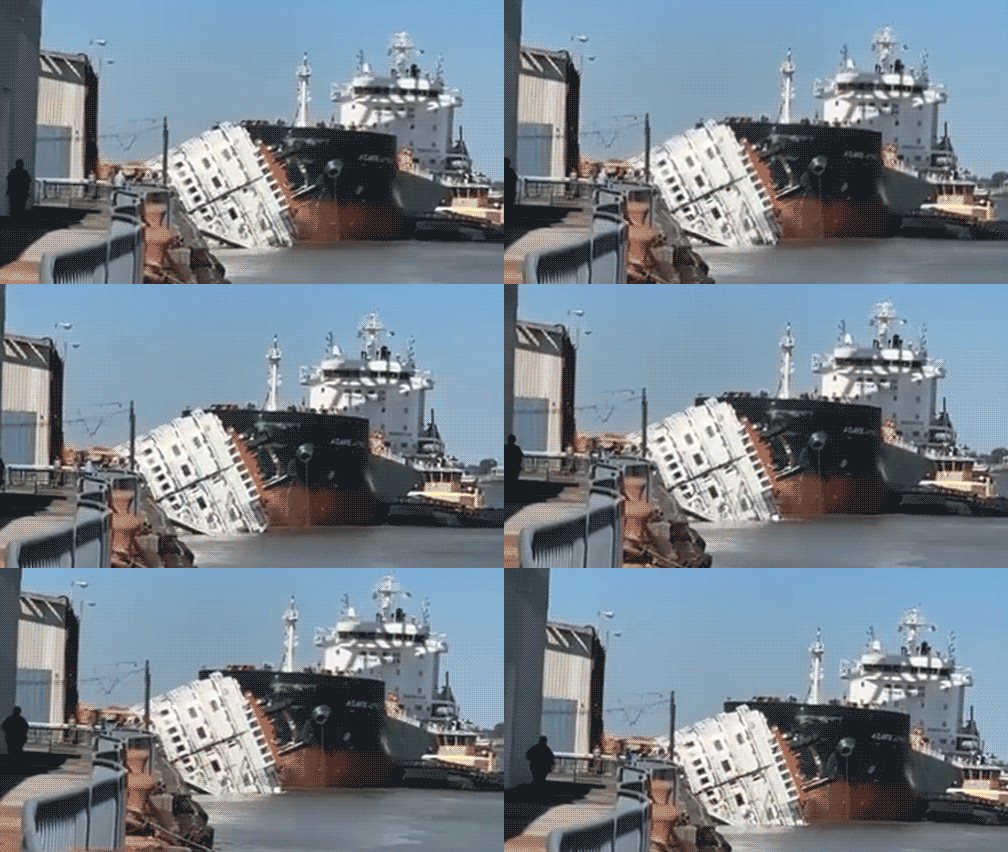

A tanker collided with the docked river cruise ship American Heritage near the Port of New Orleans on Friday, sending the passenger vessel into the Mississippi River. The cruise ship began taking on water shortly after impact and capsized 22 minutes later as roughly 200 passengers and crew evacuated. All passengers and crew were accounted for, while 32 people were taken to hospitals with non-critical injuries. Federal investigators are examining a steering failure and the tanker’s previous safety violations.
The following timeline uses Central Time and outlines the vessel movements, emergency response and known inspection history.
| 1) | Cruise ship arrives and prepares for passengers to disembark |
| 2) | Tanker begins its upriver voyage |
| 3) | Steering failure triggers emergency warnings |
| 4) | Collision leads to evacuation and capsizing |
| 5) | Earlier inspections raise questions about tanker safety |
Cruise ship arrives and prepares for passengers to disembark
At about 10:30 a.m., the American Heritage arrived near the Port of New Orleans after completing a Mississippi River cruise that had lasted several days. The vessel remained docked for approximately two hours and was beginning the process of letting passengers leave. About 200 passengers and crew were aboard when the collision occurred.
The ship was stationary at the time of the impact, making the approaching tanker the moving vessel in the sequence under investigation. Officials have not reported any deaths from the crash.
Tanker begins its upriver voyage
At 11 a.m., the tanker Atlantic Asphalt departed from Lower 9 Mile Anchorage near Mississippi River mile marker 83. It carried 19 crew members and a local river pilot and was traveling upriver toward an oil facility in Reserve, Louisiana.
The voyage proceeded for more than an hour before the steering problem was reported. Investigators are reviewing the vessel’s operations and equipment to determine how the later loss of control developed.
Steering failure triggers emergency warnings
At 12:26 p.m., the Atlantic Asphalt experienced what the National Transportation Safety Board described as a steering casualty. The tanker’s rudder became fixed in the starboard position, causing the vessel to turn toward the east bank of the Mississippi River. The cause of the malfunction remains undetermined.
Between 12:26 and 12:28 p.m., the tanker crew issued a series of emergency commands and warnings. These included a whistle, requests for assistance, orders to deploy anchors, emergency maneuvering instructions and radio warnings. Despite those efforts, the tanker continued toward the docked cruise ship.
Collision leads to evacuation and capsizing
At approximately 12:28 p.m., the Atlantic Asphalt struck the American Heritage near the Port of New Orleans. The cruise ship began taking on water shortly afterward and tilted toward the middle of the river as passengers and crew tried to evacuate.
The response brought together Coast Guard personnel, police, firefighters and other first responders. Tugboats and commercial vessels also assisted with the rescue. At about 12:50 p.m., 22 minutes after the initial impact, the American Heritage rolled onto its side and became partially submerged.
By Friday afternoon, all passengers and crew from the cruise ship had been accounted for. Thirty-two people were transported to local hospitals for non-critical injuries, and no fatalities were reported.
Earlier inspections raise questions about tanker safety
The collision was not the first time the Atlantic Asphalt had drawn scrutiny over safety conditions. Inspection records indicate that the tanker was cited in June for faulty electrical wiring in its pump room.
Inspectors who boarded the vessel in 2024 also found that its rescue boats were not prepared to launch effectively during an emergency. The same year, inspectors logged two breakdowns involving the tanker’s navigation systems.
The vessel “experienced loss of communication between the bridge and main engine,” according to Coast Guard officials.
That communication loss was reported in September 2024. Two months earlier, the tanker’s automatic pilot system malfunctioned as it approached Baltimore. These earlier incidents do not establish the cause of the New Orleans crash, but they form part of the vessel’s documented safety history as investigators examine the steering failure.
| Number | Key Point |
|---|---|
| 1 | The tanker lost steering control at about 12:26 p.m. |
| 2 | The collision occurred near the Port of New Orleans at about 12:28 p.m. |
| 3 | The American Heritage capsized 22 minutes after impact. |
| 4 | All passengers and crew were accounted for, with 32 hospitalizations. |
| 5 | The tanker had previous inspection findings involving wiring, rescue boats, navigation and communications. |
Summary
The New Orleans collision unfolded within minutes after the Atlantic Asphalt lost steering control while traveling upriver. Emergency warnings preceded the impact, but the American Heritage was struck while docked, took on water and capsized shortly afterward. The successful accounting of everyone aboard and the absence of reported deaths marked the immediate outcome, while investigators continue to assess the mechanical failure and the tanker’s prior safety record.
Frequently Asked Questions
When did the collision occur?
The Atlantic Asphalt collided with the American Heritage at approximately 12:28 p.m. Central Time near the Port of New Orleans.
How long after the impact did the cruise ship capsize?
The American Heritage capsized about 22 minutes after the tanker struck it, at approximately 12:50 p.m.
Were there fatalities?
No deaths were reported. All passengers and crew were accounted for, and 32 people were taken to hospitals with non-critical injuries.
What caused the tanker to lose control?
Investigators have said the tanker’s rudder became fixed in the starboard position, but the underlying cause of the steering malfunction has not been determined.
