

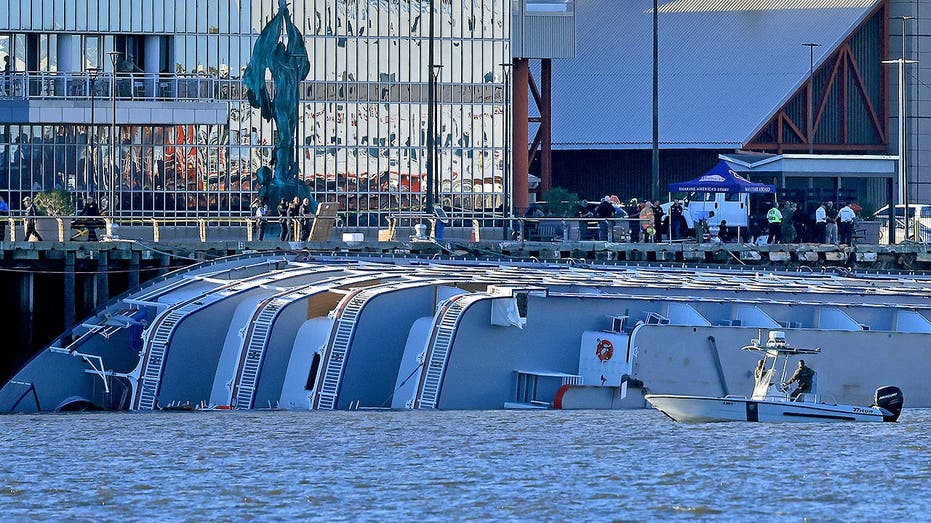

Federal investigators are examining a steering problem that preceded a tanker’s collision with the docked American Heritage in New Orleans on November 13, 2026. The riverboat overturned in about 22 minutes after the Atlantic Asphalt struck it near the Crescent City Connection Bridge. Officials said roughly 100 people were pulled from the Mississippi River, while more than 80 others were evacuated before the vessel capsized. All 190 people aboard the riverboat were accounted for, although eight remained hospitalized the following day.
The National Transportation Safety Board said recordings captured warning whistles, radio requests for assistance, anchor commands and emergency shiphandling orders during the incident. Investigators have downloaded more than nine hours of data from the tanker’s voyage data recorder and are continuing interviews with the crews of both vessels.
| 1) | Tanker steering problem preceded the collision |
| 2) | Recorded warnings and emergency actions under review |
| 3) | Riverboat overturned during a rapid evacuation |
| 4) | Salvage planning and crew interviews continue |
| 5) | Investigators expect a preliminary report within 30 days |
Tanker steering problem preceded the collision
The Atlantic Asphalt was traveling upriver near the Crescent City Connection Bridge at approximately 12:26 p.m. on Friday when its rudder remained turned to the right, according to NTSB senior marine accident investigator Bart Barnum. The condition sent the tanker toward the east bank of the Mississippi River. About two minutes later, at approximately 12:28 p.m., the tanker struck the docked American Heritage in New Orleans.
Investigators have described the event as a “steering casualty,” but officials emphasized that the term identifies a loss of steering control rather than its cause. Bart Barnum said the problem could have resulted from several different factors and remains under investigation. The NTSB is reviewing the tanker’s speed, course, rudder position and engine performance to establish how the collision developed.
Recorded warnings and emergency actions under review
Investigators downloaded more than nine hours of information from the Atlantic Asphalt’s voyage data recorder. The material includes bridge audio, rudder angle, engine revolutions per minute, course and speed. The recordings also contain sounds consistent with whistle warnings, marine-radio calls for help, commands to deploy anchors and emergency orders intended to control the vessel.
NTSB board member John DeLeeuw said investigators have data on the tanker’s speed but are still analyzing it before making the information public. Video showed that anchors were down, although investigators have not determined which anchors were deployed or how far they traveled. The sequence and effectiveness of those actions will form part of the continuing investigation.
“It could be many different things. That is something that we are investigating very closely,” Bart Barnum said.
Riverboat overturned during a rapid evacuation
The American Heritage overturned approximately 22 minutes after the collision. The NTSB said 140 passengers and 50 crew members were aboard, for a total of 190 people. Port of New Orleans Harbor Police Chief Melanie Montroll said Saturday that responders evacuated more than 80 people before the vessel overturned and pulled roughly 100 people from the river.
Eight people were hospitalized Saturday, including two in serious condition. The remaining six were described as stable. New Orleans Mayor Helena Moreno said the riverboat’s injured captain stayed aboard until passengers and crew had been accounted for and was the last person to leave the vessel.
“Every moment of the critical time [Friday], he did not want to leave his ship,” Helena Moreno said.
Salvage planning and crew interviews continue
The Coast Guard and salvage companies are overseeing work at the wreck site. Coast Guard Capt. Melanie Burnham said crews were preparing to remove approximately 16,000 gallons of fuel before salvage operations began. Officials warned that removing the capsized riverboat from the Mississippi River could take weeks.
Divers had entered the water by Sunday, while interviews with American Heritage crew members were underway. Interviews with the Atlantic Asphalt crew were scheduled to begin Monday and continue throughout the week. The investigation is being conducted in New Orleans and focuses on the actions and conditions aboard both vessels before and during the collision.
Investigators expect a preliminary report within 30 days
The NTSB expects to issue a preliminary report within approximately 30 days. The agency said the Sunday briefing was its last planned on-site news conference, with later updates to be posted online. The preliminary findings are expected to summarize known facts, while a complete explanation of the steering failure and any contributing factors will require additional analysis.
Louisiana Gov. Jeff Landry described the survival of everyone aboard the riverboat as “a miracle.” Officials continue to focus on medical care, pollution prevention, vessel removal and evidence collection as the formal investigation proceeds.
| Number | Key Point |
|---|---|
| 1 | The tanker’s rudder remained turned right before the collision. |
| 2 | Voyage recorder data captured warnings, radio calls and emergency orders. |
| 3 | All 190 people aboard the riverboat were accounted for. |
| 4 | Fuel removal and salvage work could take weeks. |
Summary
The NTSB’s early account identifies a steering problem aboard the Atlantic Asphalt as the central event preceding the New Orleans riverboat collision. Investigators are using recorded vessel data, video, physical evidence and crew interviews to determine why the tanker could not avoid the docked American Heritage. The rescue accounted for everyone aboard, but the investigation and salvage operation are expected to continue for weeks.
Frequently Asked Questions
What caused the tanker to hit the riverboat?
Investigators said the tanker experienced a steering problem in which its rudder remained turned to the right. The precise mechanical or operational cause has not been established.
How many people were aboard the American Heritage?
The riverboat carried 140 passengers and 50 crew members, for a total of 190 people.
When will more investigative findings be released?
The NTSB expects to issue a preliminary report within about 30 days. Further updates will follow as data analysis, interviews and salvage work continue.
