

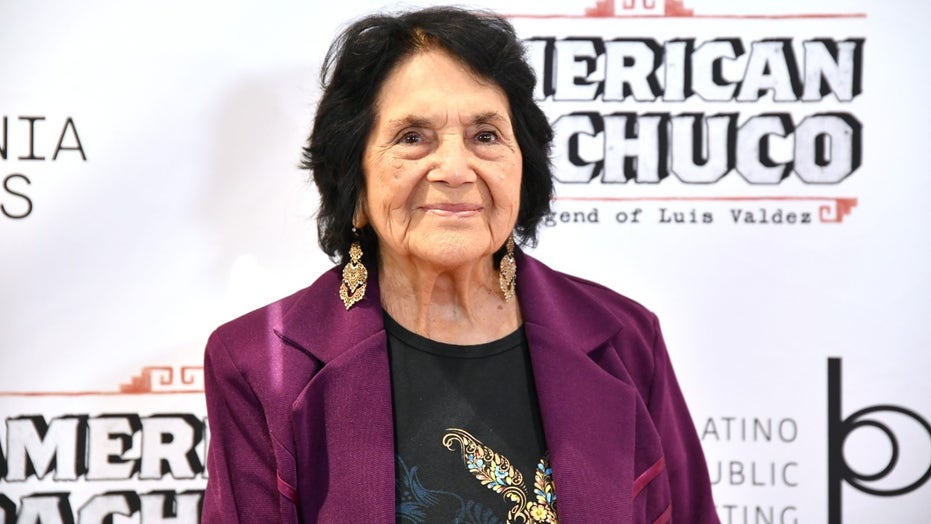

Dolores Huerta, the pioneering labor organizer who co-founded the United Farm Workers, has died at age 96. She died Wednesday, October 28, 2026, at her home in Bakersfield, California, surrounded by close family, according to her foundation. Huerta spent more than six decades advocating for agricultural workers, immigrants, civil rights and gender equality. Her legacy also includes her account accusing fellow union founder César Chávez of sexual abuse.
Born in New Mexico and raised by a single mother in California’s San Joaquin Valley, Huerta began as a schoolteacher before turning to community and labor organizing. She helped establish the National Farm Workers Association with César Chávez in 1962, and the organization later merged with another group to create the United Farm Workers union.
Huerta became one of the most influential labor leaders in the United States, particularly among agricultural workers, many of whom were immigrants. She also challenged discrimination and the exclusion of women from leadership roles in the labor movement.
| 1) | Huerta’s death and final years |
| 2) | From teaching to community organizing |
| 3) | Building the United Farm Workers |
| 4) | A broader fight for equality |
| 5) | The continuing impact of her work |
Huerta’s death and final years
Dolores Huerta died on October 28, 2026, at her home in Bakersfield, a California city in the San Joaquin Valley. She was 96. Her foundation said she was surrounded by close family at the time of her death. No further details about the cause of death were provided in the announcement.
Huerta remained publicly engaged late in life. In 2026, she attended a film premiere in Los Angeles and appeared at Dodger Stadium during Mexican Heritage Night. Her public presence reflected the continuing interest in a career that connected labor rights with broader movements for social and political change.
From teaching to community organizing
Huerta was born in New Mexico and raised by her mother in California’s San Joaquin Valley. She first worked as a schoolteacher, but became increasingly focused on the challenges facing working families and communities affected by discrimination.
Before concentrating on labor organizing, she helped establish a local chapter of a grassroots organization that challenged segregation and police brutality. That experience gave her a foundation in grassroots campaigning and helped direct her toward organizing agricultural workers, whose working conditions and economic security were central to her later career.
Building the United Farm Workers
Dolores Huerta and César Chávez established the National Farm Workers Association in 1962. The organization sought to improve conditions for people working in the nation’s fruit and vegetable fields, including many immigrant workers. In 1966, it merged with another organization to form the United Farm Workers.
The union became a major vehicle for agricultural labor organizing and remains the nation’s longest-standing labor union representing farmworkers, six decades after its founding. Huerta was known for mobilizing workers and supporters around the idea that collective action could produce political and workplace change.
“Sí, se puede!”
The phrase, which means “Yes, it can be done,” became closely associated with Huerta and expressed her belief that ordinary people could influence public policy and improve their circumstances through organized action.
A broader fight for equality
Huerta’s work extended beyond agricultural labor. She became a prominent civil rights and women’s rights advocate, opposing discrimination and campaigning for gender equality. Her activism was especially notable in a labor movement that was dominated by men when she began organizing.
Her partnership with César Chávez was central to the creation of the farmworker movement, but Huerta later accused him of sexual abuse. That allegation forms part of the complicated history surrounding the movement and its most prominent leaders.
The continuing impact of her work
Huerta’s influence is reflected in the continued existence of the United Farm Workers and in the wider connection she helped establish between labor rights, civil rights and women’s equality. Her organizing focused on workers who had often lacked political power and public visibility.
By combining workplace campaigns with community and political advocacy, Huerta helped make agricultural labor conditions a national issue. Her slogan and organizing methods continued to represent the potential of coordinated grassroots action long after the union’s formation.
| 1 | Dolores Huerta died at 96 at her home in Bakersfield, California, on October 28, 2026. |
|---|---|
| 2 | She co-founded the National Farm Workers Association with César Chávez in 1962. |
| 3 | The association merged with another organization in 1966 to form the United Farm Workers. |
| 4 | Huerta also advocated for civil rights, immigrant workers and gender equality. |
Summary
Dolores Huerta leaves a legacy rooted in farmworker organizing and expanded through civil rights and women’s rights advocacy. Her role in creating the United Farm Workers helped bring national attention to agricultural labor conditions. Her death also renews attention to the complex history of the movement, including her accusation against César Chávez.
Frequently Asked Questions
How old was Dolores Huerta when she died?
Huerta was 96 years old when she died on October 28, 2026.
Where did Dolores Huerta die?
She died at her home in Bakersfield, California, surrounded by close family, according to her foundation.
What organization did Dolores Huerta help establish?
She helped establish the National Farm Workers Association with César Chávez in 1962. The organization merged with another group in 1966 to form the United Farm Workers.
