

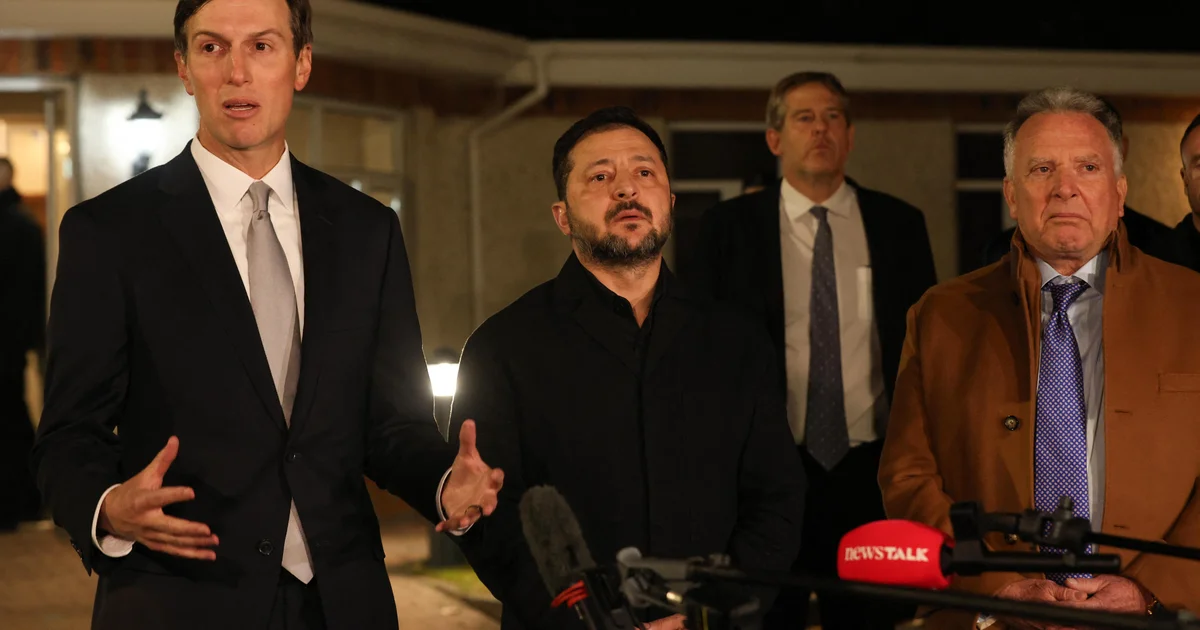

In a striking development regarding Ukraine’s relationship with NATO, Ukrainian President Volodymyr Zelenskyy announced that U.S. negotiators have broached the idea of Ukraine potentially relinquishing control over the eastern region of Donbas in exchange for NATO membership. This proposition was presented to Zelenskyy during recent discussions about a comprehensive security package aimed at enhancing Ukraine’s defense capabilities amid ongoing conflict. While Zelenskyy did not commit to any decision, he indicated that any major move would require consultation with the Ukrainian people.
| Article Subheadings |
|---|
| 1) Discussion of NATO Membership |
| 2) Security Guarantees and Military Support |
| 3) Historical Context of Donbas Conflict |
| 4) Ukraine’s Position on Territorial Integrity |
| 5) Implications for International Relations |
Discussion of NATO Membership
The request for Ukraine to consider the possibility of relinquishing part of its territory in exchange for NATO membership marks a significant turn in diplomatic discussions. During a recent press briefing, President Zelenskyy revealed how U.S. officials posed the question: “What if Ukraine joins NATO? Would Ukraine withdraw from Donbas?” This is the first instance where such a conditional dialogue has surfaced. The conversations highlight the escalating urgency for Ukraine to secure military alliances as it continues to confront ongoing threats.
This inquiry comes at a time when Ukraine faces intense challenges due to heightened tensions with Russia, which has occupied parts of Donbas since the onset of the ongoing war. The prospect of NATO membership could indeed offer Ukraine not only military support but also a sense of collective security in the face of Russian aggression. Yet, the notion of exchanging land for membership raises complex ethical and national identity questions, particularly for a nation that has experienced profound losses due to territorial invasion.
Security Guarantees and Military Support
In the context of discussions surrounding NATO membership, President Zelenskyy emphasized the necessity for robust security guarantees. He expressed that Ukraine requires assurances equivalent to NATO’s Article 5, which states that an attack on one member is an attack on all. These discussions are critical not only for Ukraine’s defense but also signify a larger recalibration of security frameworks in Europe.
Furthermore, Zelenskyy mentioned the necessity of a comprehensive security package that would incorporate an adequate troop presence, military weaponry, and financial aid. This package is envisioned as an immediate response to bolster Ukraine’s defenses while also preparing for any further military actions from Russia. The proposition demonstrates Ukraine’s proactive stance in solidifying international support, reflecting a broader narrative that has emerged among nations targeted by hybrid warfare tactics.
Historical Context of Donbas Conflict
The ongoing conflict in Donbas is not just a recent development; it has a deeply rooted history tied to geopolitical tensions between Ukraine and Russia. Control over Donbas has been one of the primary issues in the discourse surrounding peace negotiations. Since 2014, significant portions of Donbas have been under Russian influence, significantly complicating Ukraine’s aspirations for territorial integrity and national security. Russian President Vladimir Putin‘s demands for Ukraine to vacate the region as a precondition for peace have perpetuated a cycle of hostilities and political strife.
The imposition of Russian governance in the region escalated following controversial elections that garnered widespread international condemnation. Putin formally declared the annexation of four regions in eastern Ukraine in 2022, a move denounced by the U.S. and the United Nations as illegal. Understanding this historical backdrop is essential for evaluating current discussions on NATO membership and territorial concessions.
Ukraine’s Position on Territorial Integrity
During his interactions with U.S. negotiators, President Zelenskyy reinforced Ukraine’s steadfast commitment to territorial integrity. He stated that he would require comprehensive security guarantees modeled on NATO’s Article 5 as a baseline required for the country’s consideration of any compromises regarding its territory. “I have no right to make that decision on my own,” he asserted, highlighting the importance of involving the Ukrainian populace in such monumental decisions.
By framing the discussions within the broader context of national sovereignty and democratic values, Zelenskyy aims not only to remain aligned with NATO standards but also to reassure his citizens that their rights and freedoms are a priority during negotiations. Such clarity is vital at a juncture marked by uncertainty and potential compromises that could affect the nation’s future.
Implications for International Relations
The dialogues surrounding Ukraine’s NATO membership and the consideration of ceding territory have ramifications far beyond the immediate conflict. Should Ukraine pursue NATO membership, it would fundamentally reshape the strategic landscape in Eastern Europe and challenge the dynamics of international relations. Allies and adversaries alike are poised to respond based on how these negotiations unfold.
The potential for Ukraine to become a NATO member while still facing territorial disputes may also create a complex scenario for international diplomacy. NATO’s role, especially regarding Article 5, could lead to a recalibration of military strategies among member states. As diplomatic conversations advance, the outcomes will likely influence alliances, military readiness, and commitments across Europe and beyond.
| No. | Key Points |
|---|---|
| 1 | U.S. officials suggested the possibility of Ukraine relinquishing control over Donbas for NATO membership. |
| 2 | Zelenskyy emphasized the need for comprehensive security guarantees equivalent to NATO’s Article 5. |
| 3 | Historical context shows that the conflict over Donbas has deep roots dating back to 2014. |
| 4 | Ukraine remains committed to territorial integrity and will not make unilateral decisions regarding its territory. |
| 5 | The outcome of these negotiations will have significant implications for international relations and security dynamics in Europe. |
Summary
The discussions between Ukrainian leadership and U.S. officials regarding NATO membership underscore a pivotal moment for Ukraine as it navigates the difficult waters of conflict and national integrity. The proposition of territorial concessions introduces a complex and often contentious aspect to ongoing negotiations. Ultimately, the approach taken by Ukraine reflects a broader struggle for national sovereignty amid external pressures and realpolitik. Ensuring that these decisions align with the will of the Ukrainian people is essential as the country moves forward in search of security and stability.
Frequently Asked Questions
Question: What does NATO membership entail for Ukraine?
NATO membership would provide Ukraine with military support, including collective defense guarantees outlined in Article 5, where an attack on one member is viewed as an attack on all, thereby enhancing Ukraine’s security.
Question: What is the significance of the Donbas region in the conflict?
The Donbas region has been the focal point of conflict since 2014, with significant portions occupied by Russian-backed forces, making it a critical area in negotiations to end hostilities and restore Ukraine’s territorial integrity.
Question: How does Ukraine intend to involve its citizens in potential territorial concessions?
President Zelenskyy indicated that major decisions regarding any territorial concessions would require consultation with the Ukrainian populace to ensure their voices are heard and prioritized within the decision-making process.
