

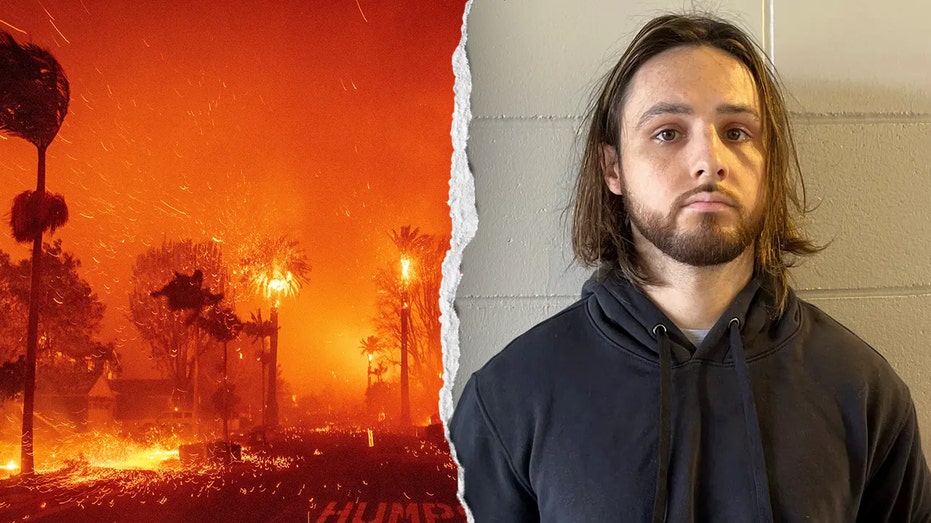

A federal jury in Los Angeles convicted Jonathan Rinderknecht on all remaining counts in the retrial over the 2025 Pacific Palisades wildfire. Prosecutors said the former Uber driver started an initial brush fire that smoldered and later grew into the blaze, which killed 12 people and destroyed nearly 7,000 homes. The verdict followed a mistrial in Rinderknecht’s first trial, which ended when jurors deadlocked in June.
| 1) | Jury reaches a guilty verdict after retrial |
| 2) | Prosecutors describe the alleged chain of events |
| 3) | Defense challenges the investigation and fire theory |
| 4) | Officials address the lasting damage |
| 5) | The case’s place in Los Angeles wildfire history |
Jury reaches a guilty verdict after retrial
The federal jury returned guilty verdicts Friday, Nov. 20, in U.S. District Court in Los Angeles. Rinderknecht, 30, faced two federal arson counts in the retrial after prosecutors dropped one of three original charges and revised the remaining counts. The changes reduced his maximum possible prison sentence from 45 years to 40 years.
The first trial lasted about three weeks and ended in June when jurors failed to reach a unanimous decision. Cameron, who served as Juror No. 3 in the retrial, said deliberations lasted roughly two days and included a review of testimony and video evidence. He said Rinderknecht’s testimony about being alone on a hill while smoking and carrying a lighter supported the conclusion that he started the first fire.
Prosecutors describe the alleged chain of events
Federal prosecutors alleged that Rinderknecht maliciously started a brush fire on Jan. 1, 2025, in the area later associated with the Palisades Fire. Although the initial incident was quickly extinguished, prosecutors argued that it continued burning underground in brush roots.
According to that theory, strong winds later fanned the smoldering fire into a much larger blaze on Jan. 7. The fire moved through Pacific Palisades, a coastal Los Angeles community, killing 12 people, destroying nearly 7,000 homes and causing property damage estimated at between $35 billion and $150 billion. Prosecutors also presented allegations about Rinderknecht’s online searches involving Luigi Mangione and resentment toward wealthy people.
Defense challenges the investigation and fire theory
Rinderknecht pleaded not guilty and maintained that he was innocent. He said he went up a hill to watch New Year’s fireworks, witnessed the Jan. 1 fire and promptly called 911.
Defense attorney Steve Haney argued that prosecutors lacked physical evidence connecting Rinderknecht to arson. The defense also contended that the major Jan. 7 fire was started separately by another person rather than developing from the earlier incident. After the first mistrial, one juror said the prosecution’s theory of a lingering fire did not establish guilt. The new jury accepted that theory and convicted Rinderknecht on every remaining count.
Officials address the lasting damage
Los Angeles Mayor Karen Bass said the verdict could not restore the lives lost or eliminate families’ pain. She noted that many people were still struggling to rebuild and that the disaster continued to affect residents nearly two years later.
Los Angeles City Councilwoman Traci Park, whose district includes Pacific Palisades, said the conviction closed one part of the disaster but did not resolve continuing problems. Thousands of residents remained displaced and involved in disputes with insurance companies. Park also cited questions about infrastructure, evacuation routes, water systems and public safety staffing.
The case’s place in Los Angeles wildfire history
The Pacific Palisades Fire occurred around the same time as the Eaton Canyon Fire in Altadena, about 30 miles east of Pacific Palisades. The Eaton fire killed 19 people and was later attributed to sparks from an electrical transmission tower. Together, the fires were described as the deadliest wildfire disaster in Los Angeles County history.
The conviction resolves the criminal case’s central question for the jury, but broader issues involving disaster response, infrastructure, insurance and recovery remain. Residents continue to face displacement, rebuilding challenges and debates over how authorities handled the emergency.
| Number | Key Point |
|---|---|
| 1 | Rinderknecht was convicted on all remaining counts in the federal retrial. |
| 2 | Prosecutors linked a Jan. 1 brush fire to the larger Jan. 7 disaster. |
| 3 | The first trial ended in a mistrial after jurors deadlocked. |
| 4 | The fire killed 12 people and destroyed nearly 7,000 homes. |
| 5 | Officials said rebuilding and accountability concerns remain. |
Summary
Jurors accepted the prosecution’s account that Rinderknecht started the initial fire that later became the deadly Pacific Palisades Fire. The conviction provides criminal accountability for the alleged ignition, while questions about disaster response, infrastructure and recovery remain unresolved.
Frequently Asked Questions
Who was convicted in the retrial?
Jonathan Rinderknecht, a 30-year-old former Uber driver, was convicted on all remaining federal arson counts.
What was Rinderknecht accused of doing?
Prosecutors alleged that he started a brush fire on Jan. 1, 2025, which smoldered underground before winds helped it grow into the Jan. 7 Pacific Palisades Fire.
How did the first trial end?
The first trial ended in a mistrial in June after jurors were unable to reach a unanimous verdict.
What was the impact of the fire?
The fire killed 12 people, destroyed nearly 7,000 homes and caused property damage estimated between $35 billion and $150 billion.
