

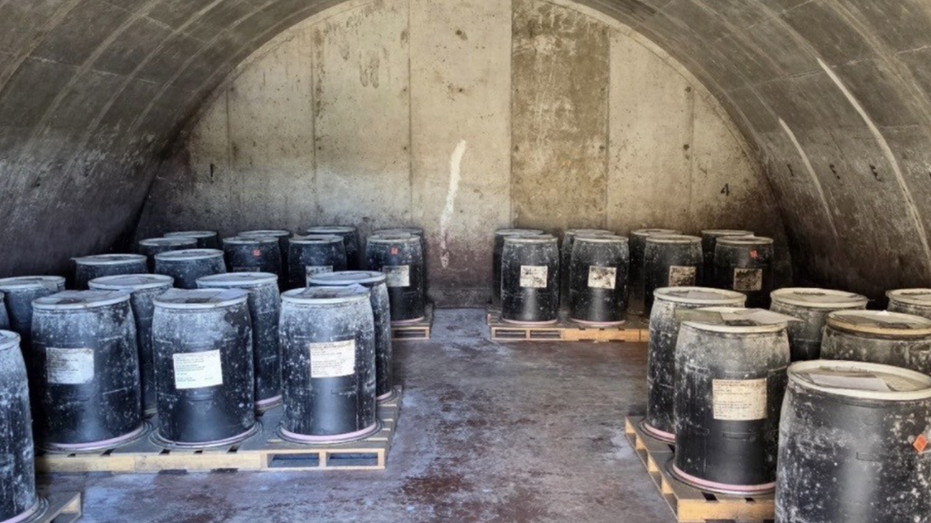

Federal officials say a controlled detonation of unstable lead azide at the Iowa Army Ammunition Plant is safer than allowing the material to explode without warning. The operation is scheduled for 9 a.m. local time on Wednesday, Nov. 25, after a federal appeals court allowed the plan to proceed. Officials have established evacuation and shelter guidance for nearby communities while preparing to monitor lead particles in air, soil and water.
The material is stored in 68 deteriorating barrels containing more than 9,700 pounds of net explosive weight. Authorities say changing weather forecasts could affect the projected dust plume, prompting hourly updates before the blast.
| 1) | Why the Army selected a controlled detonation |
| 2) | How officials plan to limit the blast |
| 3) | Evacuations, sheltering and public health guidance |
| 4) | Weather monitoring and environmental testing |
| 5) | State response and plans for future storage safety |
Why the Army selected a controlled detonation
The Iowa Army Ammunition Plant in Middletown holds lead azide, a highly sensitive initiating explosive used in detonators and blasting caps. Army officials say the barrels deteriorated significantly over the past eight months, with crystallized material appearing on their exteriors and lids. That condition made moving or opening the containers too dangerous, and officials ruled out chemical neutralization.
Adam Telle, the acting secretary of the Army, said federal and outside experts reviewed the options before recommending a controlled operation.
A controlled, mitigated detonation is far preferable to an uncontrolled spontaneous detonation of that substance.
How officials plan to limit the blast
The Army plans to use two-story-high sand-filled barriers, water walls formed from eight 16,000-gallon tanks and gel blocks to absorb blast effects. Misters and specialized PFAS-free foams will be deployed to help capture lead dust. The operation is expected to produce two rapid detonations, ground vibrations and a dust plume that should last no more than an hour.
The detonation was scheduled for the morning before snow is forecast later in the day. Officials said cold temperatures and fluctuations could encourage additional unstable crystals to form, increasing the risk of a spontaneous event triggered by heat, shock or friction. The operation has already been postponed three times.
Evacuations, sheltering and public health guidance
The Army has defined an evacuation zone as a five-mile cone extending southwest from the plant. Officials are urging residents in that area to leave, with particular emphasis on pregnant women, children and people with chronic illnesses. Residents who relocate can receive temporary lodging through Nov. 27, with extensions available on request, along with food, water and emergency transportation.
People outside the evacuation zone but within the projected impact area have been told to remain indoors during the blast. Health officials recommend closing windows and doors, sealing gaps and setting heating systems to recirculate air through filters rated MERV 11 or higher. Residents should wash their hands and clothing and remove or wash shoes that may have contacted lead dust.
Weather monitoring and environmental testing
Weather models indicate that the plume could affect approximately 350 farms, although its path may change. Beginning six hours before the detonation, the Army plans to issue updated impact maps every hour using the latest forecasts. State officials have also issued guidance for livestock producers within 20 miles southwest of the plant.
The Environmental Protection Agency has mobilized more than 100 personnel and contractors, along with other federal agencies. It has deployed three mobile laboratories and an air toxics laboratory and collected more than 1,001 air, land and water samples before the operation. Sampling will continue during and after the blast to determine whether lead remediation is needed.
State response and plans for future storage safety
Kim Reynolds, Iowa’s governor, issued a disaster emergency proclamation for Des Moines, Lee and Van Buren counties. The declaration allows state resources to support the response and authorizes up to 100 federally activated Iowa National Guard soldiers to assist about 150 households with evacuation outreach.
Federal officials said residential properties testing above the EPA-approved standard of 200 parts per million will receive government-funded soil removal and surface cleaning. The Army will also process claims for damage caused by blast vibrations. Separately, Adam Telle ordered a review of Army weapons storage facilities to identify similar risks elsewhere.
| No. | Key Point |
|---|---|
| 1 | The controlled detonation is scheduled for 9 a.m. on Nov. 25. |
| 2 | The materials include 68 barrels containing more than 9,700 pounds of lead azide. |
| 3 | Residents southwest of the plant face evacuation or sheltering instructions. |
| 4 | Federal agencies are testing air, soil and water before and after the blast. |
Summary
Officials say the controlled detonation is intended to reduce the danger posed by deteriorating lead azide while limiting blast and contamination risks. Evacuation support, indoor shelter measures, changing weather maps and environmental testing are designed to protect nearby residents and guide any cleanup that follows.
Frequently Asked Questions
When is the detonation scheduled?
The Army has scheduled the operation for 9 a.m. local time on Wednesday, Nov. 25, at the Iowa Army Ammunition Plant in Middletown.
Who should evacuate?
Residents inside the Army-defined five-mile evacuation cone southwest of the plant are being urged to leave. Vulnerable residents have received particular emphasis from health officials.
What should people outside the evacuation zone do?
Residents should follow official updates, remain indoors during the blast, close windows and doors, seal gaps and recirculate indoor air through suitable filters.
Will affected properties receive cleanup assistance?
Officials said properties testing above 200 parts per million will receive government-funded soil removal and surface cleaning, while claims for vibration damage will be processed by the Army.
