

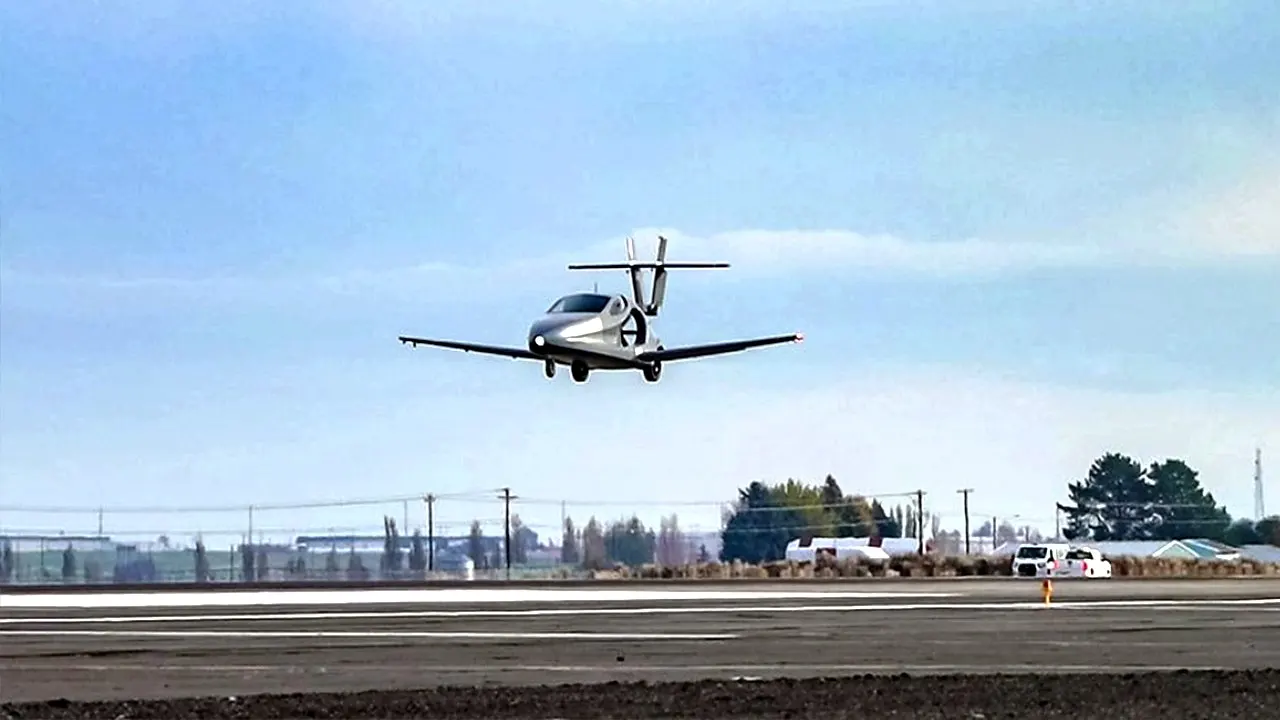

Samson Sky is making significant strides towards the production of its innovative Switchblade flying car, recently announcing an $80 million investment from the Dubai-based Matin Group. The Switchblade can transition from a car to an airplane, allowing for seamless travel from garage to sky. This investment is aimed at establishing a U.S. production facility, though an additional $20 million is still needed to complete the funding. With high-performance aspirations, the Switchblade promises a maximum airspeed of 190 mph and a unique marketplace proposition where buyers will contribute to assembling their own vehicles.
| Article Subheadings |
|---|
| 1) The Transformation of the Switchblade |
| 2) Enhancements Since the First Flight |
| 3) Performance Goals and Specifications |
| 4) Investment and Production Plans |
| 5) Buyer Participation and Requirements |
The Transformation of the Switchblade
The latest design of the Switchblade has made substantial improvements, making it more user-friendly in driving mode while still retaining its flying capabilities. When operated on the road, the vehicle appears to be a conventional car, with the wings, tail, and propeller completely enclosed within its structure. This development is a significant shift from previous prototypes, making it suitable for parking in a standard garage. Upon reaching the airport, the vehicle’s wings extend, and the tail adapts for flight, with the entire transformation process taking approximately three minutes. This ability to transition from land to air makes the Switchblade an appealing option for those who have long imagined a flying vehicle that is still a practical automobile.
Enhancements Since the First Flight
The Switchblade made its first official flight on November 5, 2023, at Grant County International Airport in Moses Lake, Washington. Since that initial test, the design has undergone notable changes, including the introduction of a larger engine and various improvements aimed at enhancing its performance. Samson Sky aims to conduct further testing with three production prototypes anticipated to be available toward the end of 2026 or early 2027. This progressive focus on development reflects the company’s commitment to refining the craft’s capabilities before delivering it to customers.
Performance Goals and Specifications
Samson Sky has ambitious performance targets for the Switchblade, claiming a maximum airspeed of 190 mph and a flying range of 450 miles. Additionally, the vehicle is expected to reach 100 mph on the ground. It operates using a hybrid-electric drivetrain, where a gasoline engine generates power for the electric motors driving both the wheels and flying propellers. The design includes a 44-gallon fuel tank that requires 91-octane gasoline. Accuracy in these performance figures needs confirmation through future testing of production prototypes, which will validate Samson’s claims.
Investment and Production Plans
The recent $80 million investment from Matin Group is crucial for Samson Sky’s plans to establish a state-of-the-art, 180,000-square-foot production facility in the U.S. This collaboration will not only aid in development but also catalyze the production process, essential for commercializing the Switchblade. CEO and founder of Samson Sky, Sam Bousfield, has indicated that while they plan to maintain their research and development facility in Prineville, Oregon, negotiations for the new production site are underway, narrowing down to three potential locations across the country. Nevertheless, the funding is not complete; an additional $20 million will be required to fully realize the current production plan.
Buyer Participation and Requirements
Acquiring a Switchblade involves a unique set of requirements distinct from traditional car purchases. Since it falls under the Experimental Amateur-Built category in U.S. FAA regulations, buyers will be tasked with assisting in the assembly of the vehicle. This process is guided by Samson’s Builder Assist program, which stipulates that potential owners complete a significant portion of the construction process to adhere to FAA rules, referred to as the “51% rule.” While much of the assembly will be automated, buyers should expect to dedicate at least a week to fully complete their contribution towards building their Switchblade. This requirement may appeal to those with a passion for hands-on projects.
| No. | Key Points |
|---|---|
| 1 | Samson Sky’s Switchblade flying car can operate both as an automobile and an airplane. |
| 2 | Recent funding of $80 million aims to facilitate production and establish a manufacturing plant in the U.S. |
| 3 | Switchblade’s design evolution allows it to hide its wings and propellers while driving, enhancing usability. |
| 4 | Potential buyers must participate in the assembly process, following FAA regulations on amateur-built aircraft. |
| 5 | The vehicle is projected to have performance stats that include a max airspeed of 190 mph and a flight range of 450 miles. |
Summary
The developments surrounding the Switchblade flying car signify a pivotal moment for personal aviation. As the project moves into the next stages of funding and testing, it emphasizes not only innovation in vehicle functionality but also a unique approach to consumer involvement in the manufacturing process. Should the vehicle meet its performance and production goals, the Switchblade has the potential to redefine personal transportation, combining the convenience of a car with the freedom of flight.
Frequently Asked Questions
Question: What is the estimated cost of the Switchblade flying car?
The estimated starting price for the Switchblade VFR kit is around $200,000, while the IFR version is estimated to be $235,000. These prices may vary as the project progresses.
Question: How does the Switchblade transition from driving to flying mode?
The transformation from driving to flying mode takes about three minutes, allowing users to extend the wings and adjust the tail before taking off from the runway.
Question: Will buyers need any special certifications to fly the Switchblade?
Yes, to operate the Switchblade as an aircraft, users must obtain a private pilot certificate, as it is classified as an airplane once in flight mode.
