

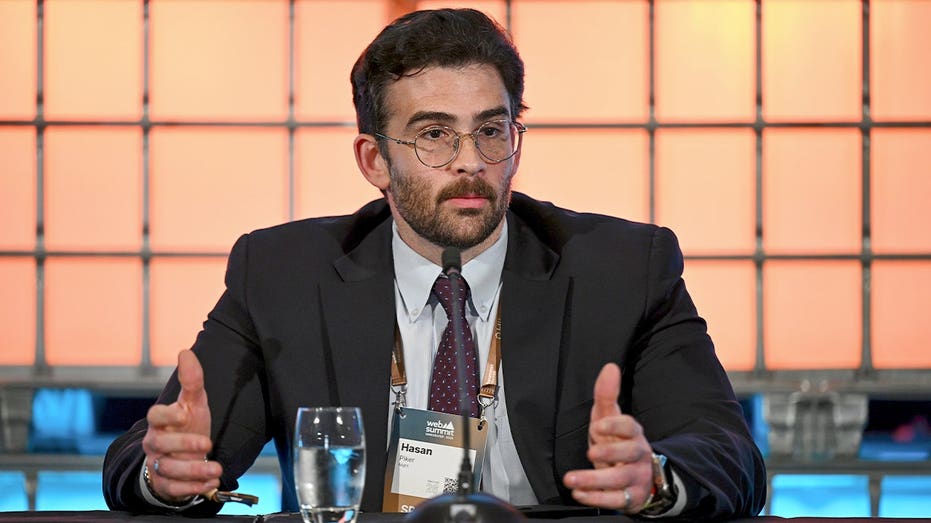

Hasan Piker called Osama bin Laden a “spoiled brat” in an interview discussing the motives behind the Sept. 11, 2001, terrorist attacks. The progressive streamer described the attacks as “blowback” for earlier U.S. actions in the Middle East, while saying that explanation did not morally justify the violence. He also discussed U.S. support for Israel, oil policy, military bases and its former support for Afghan mujahideen during the Soviet-Afghan War. Piker’s comments have drawn renewed scrutiny because of his broader criticism of U.S. foreign policy and a separate comparison involving al Qaeda.
| Article Subheadings | |
|---|---|
| 1) | Piker’s description of bin Laden |
| 2) | How he characterized 9/11 |
| 3) | His account of U.S. policy and blowback |
| 4) | Backlash over broader comparisons |
| 5) | Context of the interview and public response |
Piker’s description of bin Laden
During the interview, Hasan Piker addressed statements attributed to Osama bin Laden about why al Qaeda targeted the United States. Piker cited bin Laden’s opposition to U.S. support for Israel, American oil policies and U.S. military bases in the Middle East. He also noted that the United States had previously trained, funded and armed Afghan mujahideen during the Soviet-Afghan War.
Piker said bin Laden’s former relationship with the United States shaped his view of the al Qaeda founder’s motives. He described bin Laden as a “spoiled brat” who was not getting his way, while also condemning the violence associated with the attacks.
“The action was so heinous and so violent that … given his position as formerly an American ally , I think that he came across a little bit more as a spoiled brat that wasn’t getting his way.”
How he characterized 9/11
Piker called the Sept. 11 attacks a “horrifying tragedy” and said they represented “blowback” from U.S. actions in the Middle East. His comments distinguished between explaining a consequence of foreign policy and approving the conduct that produced it.
He explicitly rejected any moral acceptance of the attacks. In his formulation, the term “blowback” described what happened rather than offering a defense of the hijackings, mass killings and destruction in New York, Washington and Pennsylvania.
“Blowback is not a justification. Blowback is just what it is. A justification offers either a moral condemnation or a moral acceptance of the act. I do not accept the act of 9/11 morally.”
His account of U.S. policy and blowback
The discussion focused on the relationship between U.S. foreign policy and the emergence of violent opposition. Piker argued that reducing intervention in overseas affairs could lessen the conditions that encourage people to seek revenge and could reduce risks to Americans.
He said the United States should not continue to dominate or interfere in ways that create an environment where retaliatory violence becomes more likely. Piker also said he wanted fewer figures like bin Laden to exist, making clear that his stated preference was to prevent such actors and the violence they pursue.
“The other path of least resistance is to not interfere in these affairs in general and not continue to dominate and create an environment where people are going to seek out revenge and put us in a position of danger.”
Backlash over broader comparisons
The interview generated renewed scrutiny of Piker’s political commentary. In another portion of the discussion, he compared the United States with al Qaeda when discussing the number of deaths and the scale of terror caused around the world.
Piker said the comparison applied “pound for pound” to the number of deaths and asserted that the United States had caused tremendous terror worldwide. Those remarks, together with his characterization of the Sept. 11 attacks as blowback, became central to the backlash surrounding the interview.
Context of the interview and public response
The comments were made during an interview published on Sept. 18, 2026, as Piker discussed U.S. policy, terrorism and instability in the Middle East. The conversation also included his view that the Middle East would be more stable if Iran had nuclear weapons, adding to the attention surrounding his foreign-policy positions.
The remarks have also entered a wider political debate after criticism from opponents of Piker’s views. The response has focused on whether describing 9/11 as blowback, even while rejecting its moral legitimacy, places too much emphasis on U.S. policy and too little on the responsibility of the terrorists who carried out the attacks.
| Number | Key Point |
|---|---|
| 1 | Piker called bin Laden a “spoiled brat” while discussing his former relationship with the United States. |
| 2 | He described 9/11 as “blowback” but explicitly rejected the attacks as morally justified. |
| 3 | His broader comparison between the United States and al Qaeda contributed to renewed criticism. |
Summary
The interview reflected Hasan Piker’s argument that U.S. intervention and alliances in the Middle East helped create conditions for retaliation. He condemned the Sept. 11 attacks but used “blowback” to describe their relationship to earlier American policies. His wording, along with a separate comparison between the United States and al Qaeda, has prompted renewed public criticism.
Frequently Asked Questions
What did Hasan Piker call Osama bin Laden?
Piker called bin Laden a “spoiled brat” while discussing his former status as a U.S. ally and his stated reasons for targeting the United States.
How did Piker describe the Sept. 11 attacks?
He called the attacks a “horrifying tragedy” and described them as “blowback” from earlier U.S. actions, while explicitly rejecting any moral justification for the attacks.
Why did the interview draw backlash?
The interview drew criticism because of Piker’s description of 9/11 as blowback and his separate statement comparing the United States with al Qaeda in terms of deaths and terror.
