

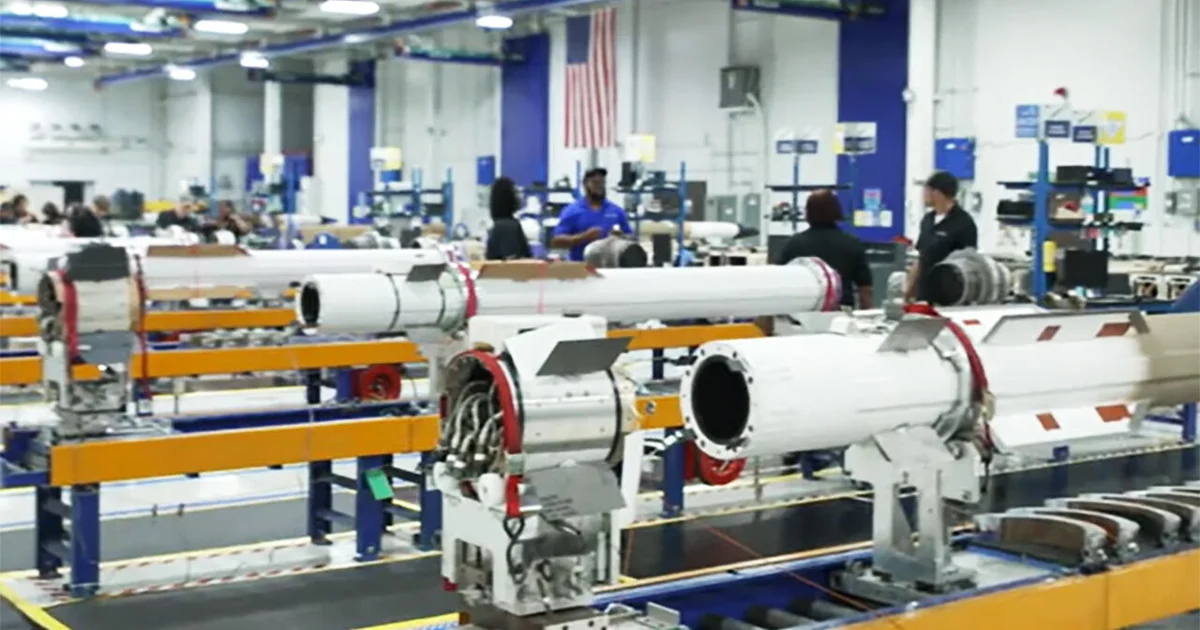

As the conflict with Iran enters its seventh month, the United States is grappling with a critical challenge: a significant shortage of advanced missile systems. Lockheed Martin, a key player in the defense industry, is ramping up production of the Patriot air defense missile in response to this urgent need. However, the current output of 750 missiles annually falls short against the escalating demand owing to the ongoing military actions. With defense officials stressing the importance of increasing the production rate to ensure national security, strategies are being developed to enhance manufacturing capabilities amidst supply chain challenges.
| Article Subheadings |
|---|
| 1) Overview of the Patriot Missile Capabilities |
| 2) Current Production Challenges Faced by Lockheed Martin |
| 3) The Implications of Military Operations on Munitions |
| 4) Strategies to Increase Weapons Production |
| 5) Perspectives on the Future of U.S. Defense Supplies |
Overview of the Patriot Missile Capabilities
In a visit to Lockheed Martin’s production facility in Camden, Arkansas, Tim Cahill, head of the company’s missile division, showcased the advanced capabilities of the Patriot air defense missile. This state-of-the-art weapon is engineered to intercept and neutralize incoming threats, particularly ballistic missiles. The operational principle of the Patriot is akin to “a bullet hitting a bullet,” signifying its high accuracy and efficiency. The missiles are designed to obliterate threats on impact, an assertion that Cahill emphasized:
“It’s going to vaporize pretty much whatever it hits.”
Each Patriot missile comes with a hefty price tag of approximately $4 million. Currently, Lockheed Martin’s production runs at an output of 750 missiles per year — a figure deemed insufficient given the estimated 1,500 missiles already expended against hostile forces in Iran. Officials and military strategists express growing concern over this shortfall, making it imperative to find ways to enhance production capacity and meet national security demands.
Current Production Challenges Faced by Lockheed Martin
The urgency of the current military situation has surfaced pressing challenges in the production of high-tech munitions. According to Mark Cancian from the Center for Strategic and International Studies, the expenditure on weapons deployed against Iran has already reached around $25 billion, indicating significant depletion of U.S. military stockpiles. These facts expose a troubling deficiency in America’s capabilities to sustain prolonged military operations, a gap that has been largely overlooked by previous administrations until recently heightened military engagements.
As the U.S. military escalated its operations, initiating attacks on Iranian targets as early as February, it became evident that inventory levels were drastically declining. As reported by Chairman of the Joint Chiefs of Staff Dan Caine, over 13,000 targets were struck within weeks, substantially depleting existing resources. While Cancian has asserted that the U.S. may have enough weaponry to continue its campaign in Iran, he warns that logistical challenges would arise if such efforts were to extend to a possible conflict with China.
The urgency echoed in Pentagon’s statements denying claims of munition shortages, emphasizing that such assertions could embolden adversaries. However, Defense Secretary Pete Hegseth has been vocal about the need for a “wartime footing,” advocating for the defense industry to scale up production immediately. The inherent complexity of the manufacturing process adds another layer of difficulty, as illustrated by the extensive supply chains needed for missile production, which rely on hundreds of suppliers, presenting potential bottlenecks in crucial components.
The Implications of Military Operations on Munitions
With a clear strategy now needed to restore weapon inventories, the implications of the ongoing military operations have become apparent. The war against Iran has revealed the critical need for advancing missile production rates not just for current engagements, but in anticipation of future threats. The significant expenditure on munitions against Iran calls into question America’s long-term defense strategies, especially regarding its responsiveness to emerging global threats.
Thus far, the response has included ramping up production schedules alongside innovations in automation. Lockheed Martin is evaluating methods to increase its production rate from 750 to 2,000 missiles per year. Cahill reported that this will involve “controlled chaos” in the production processes, maximizing efficiencies through advanced automation techniques. However, the assembly of a single Patriot missile can take up to six weeks, due to the intricate nature of manufacturing its 4,000 component parts, indicative of the magnitude of this task.
Strategies to Increase Weapons Production
To address the concerns over supply chain vulnerabilities, Lockheed Martin is looking to optimize operations by leveraging automation and increasing shift patterns at its facilities. The potential to increase the number of shifts operating within the production lines indicates a commitment to scaling up production rapidly. More importantly, Cahill pointed out that they are constantly examining measures to drive efficiencies across the assembly process.
Strategies will likely also extend to fielding redundant suppliers and enhancing procurement processes to ensure availability of critical components. For instance, rocket motors are supplied by L3Harris, a facility merely five miles away, but the dependence on single-source supplies can create challenges, as noted by President Ken Bedingfield. They are implementing measures to diversify their supplier base to enhance production reliability and mitigate delays.
Further, the U.S. Department of Defense has been exploring partnerships with emerging defense contractors that focus on cost-effective solutions. This includes companies such as CoAspire, which is developing a low-cost cruise missile designed for mass production. The intent here is to deliver high quantities of more affordable munitions to bolster America’s arsenals and can accommodate high-demand scenarios.
Perspectives on the Future of U.S. Defense Supplies
In the grand scope of U.S. military strategy, the response initiated by current military engagements could lead to a renaissance of the military-industrial complex. The adaptation of operational strategies to address the demands of conflicts demonstrates a shifting landscape in defense contracting. As new producers like CoAspire gain traction in creating more affordable options, it provides opportunities for the Pentagon to restock military resources without the exorbitant costs associated with traditional production models.
While Lockheed Martin plans to deliver 10,000 low-cost cruise missiles, companies like CoAspire continue to innovate with cost-efficient missile technology that blends advanced capabilities with affordability. A pioneering approach in resources could help bridge the gap between current production limitations and future military readiness, addressing the gradual buildup of stockpiles that defense analysts deem crucial for a potential confrontation with a peer adversary such as China.
In reflecting upon replenishing stock, estimates suggest it might take between one to five years, depending on the type of munition required. This timeframe is significant in the context of shifting global power dynamics and threats facing U.S. interests, underscoring the importance of not only stockpiling but also modernizing military capabilities to maintain strategic deterrence over the long term.
| No. | Key Points |
|---|---|
| 1 | The U.S. faces a severe shortage of advanced munitions amid ongoing military operations. |
| 2 | Lockheed Martin is increasing its annual production of Patriot missiles from 750 to 2,000 to address demand. |
| 3 | Production bottlenecks and single-source suppliers pose significant challenges to missile manufacturing. |
| 4 | New defense contracts aim to source affordable munitions while maintaining high-performing capabilities. |
| 5 | Replenishing the U.S. armory to pre-war levels may take between one to five years. |
Summary
As the war with Iran continues, the United States has recognized the imperative need to bolster its missile production capabilities to maintain operational effectiveness. Efforts led by Lockheed Martin and other defense contractors aim to expedite the production timeline while addressing supply chain vulnerabilities. This reinforces a broader strategic perspective to modernize the U.S. arsenal amidst evolving global threats and geopolitical tensions that necessitate preparedness for current and future military engagements. The path to rebuild and enhance munitions inventory highlights the critical intersection of adaptability and technological innovation in defense logistics and procurement.
Frequently Asked Questions
Question: Why is the production of the Patriot missile ramping up?
The production is increasing due to a significant demand caused by the ongoing conflict with Iran, which has depleted U.S. munitions stockpiles.
Question: How much does each Patriot missile cost?
Each Patriot missile costs approximately $4 million, which contributes to the overall expense of military operations.
Question: What challenges does Lockheed Martin face in ramping up production?
Lockheed Martin faces challenges such as supply chain bottlenecks, reliance on single-source suppliers, and the complexities of manufacturing that involve 4,000 individual components for each missile.
