

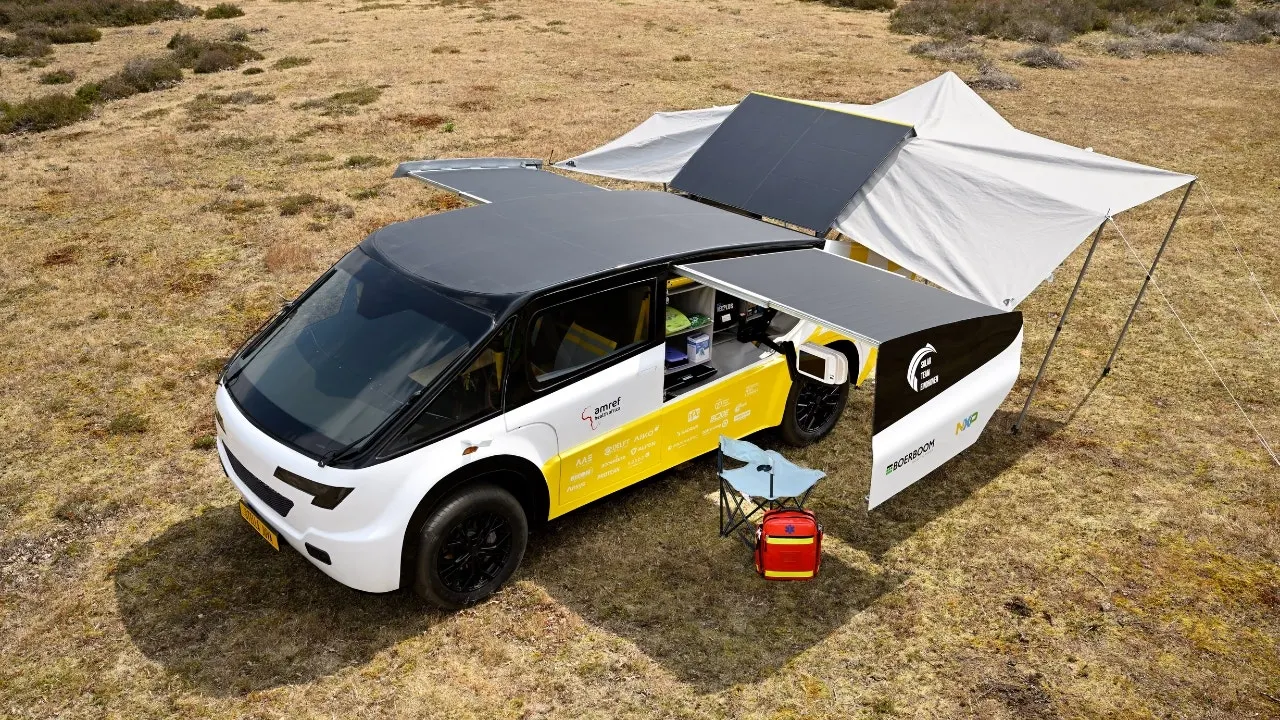

In an innovative move to enhance healthcare accessibility, a group of students from Eindhoven University of Technology in the Netherlands has introduced the world’s first solar-powered ambulance, named Stella Juva. This vehicle aims to revolutionize medical care delivery in remote areas by harnessing solar energy to power both its movement and medical equipment. Designed to tackle the challenges faced by healthcare facilities with unreliable electricity access, Stella Juva serves as a mobile clinic that can operate independently of existing infrastructures, making it a game-changer for underserved communities.
| Article Subheadings |
|---|
| 1) Introduction to Stella Juva and its Purpose |
| 2) Technical Specifications of the Solar-Powered Ambulance |
| 3) Applications and Services Offered by Stella Juva |
| 4) Future Implications and Testing in Kenya |
| 5) Potential Impact on Healthcare Accessibility |
Introduction to Stella Juva and its Purpose
Stella Juva, developed by a team of 23 students, stands as a testament to innovative thinking in the field of healthcare delivery. The vehicle was created to address a pressing issue: the lack of reliable medical access in remote areas, where traditional ambulances face numerous challenges such as poor road conditions, limited fuel availability, and inconsistent electricity sources. The team’s inspiration stemmed from the alarming statistic from the World Health Organization that highlights over one billion individuals relying on healthcare facilities with inadequate or no electricity at all. By creating an ambulance that utilizes solar energy, the team seeks to bridge the gap in medical services for people living far from urban centers.
Stella Juva is designed to deliver medical assistance directly to communities that often struggle to reach healthcare services due to various logistical barriers. Instead of merely transporting patients to hospitals, this solar-powered vehicle brings medical care closer to those in need, potentially saving lives through timely intervention. The vehicle’s ability to generate electricity onboard presents a fundamental shift in how we can provide aid, especially in underserved areas.
Technical Specifications of the Solar-Powered Ambulance
The engineering behind Stella Juva includes advanced features that cater to both transportation needs and medical equipment operation. The vehicle is outfitted with high-efficiency solar cells, specifically designed using AIKO’s All Back Contact technology. This innovative setup maximizes sunlight exposure by relocating electrical contacts to the back of the cells, a necessary adaptation given the vehicle’s limited roof space. This technology allows Stella Juva to generate sufficient power for both driving capabilities and the operation of essential medical equipment.
Equipped with a robust 50-kWh lithium-ion battery pack, the vehicle stores enough energy to function during periods of limited sunlight, ensuring that medical services remain uninterrupted even after dusk. The engineers expect Stella Juva to cover approximately 715 kilometers (about 444 miles) under optimal solar conditions. With a top speed approaching 75 miles per hour, the ambulance is both efficient and swift, tailored to navigate various terrains while providing necessary medical support.
Moreover, the design prioritizes lightweight materials without compromising durability—a crucial factor for vehicles meant to traverse rough terrains. The chassis and body are constructed of carbon-fiber composites, helping keep the vehicle’s total weight around 1,350 kilograms (approximately 3,000 pounds), significantly lighter than conventional ambulances, while its aerodynamic shape further enhances efficiency.
Applications and Services Offered by Stella Juva
Stella Juva is equipped to function as a mobile medical clinic, housing essential medical equipment capable of addressing various healthcare needs. The vehicle features a climate-controlled medical cabin where healthcare professionals can conduct crucial services such as tuberculosis screenings, pregnancy ultrasounds, and vaccinations. Equipped with an automated external defibrillator, Stella Juva is prepared to respond to emergencies swiftly and effectively. Furthermore, a refrigeration unit ensures that vaccines and temperature-sensitive medications remain viable, safeguarding their efficacy in challenging environments.
This mobile clinic model not only extends healthcare services but also alleviates the pressure on static medical facilities in urban areas. By allowing healthcare workers to navigate directly to underserved regions, Stella Juva represents a transformative approach to medical care. The design of the ambulance underscores a fundamental shift in thinking about healthcare access, emphasizing the importance of being proactive rather than reactive in medical service delivery.
Future Implications and Testing in Kenya
The next crucial phase for Stella Juva involves real-world testing in Kenya, scheduled for August. This mission aims to observe the vehicle’s performance in actual healthcare scenarios, particularly assessing its efficacy in addressing tuberculosis care. The students will engage in simulated healthcare situations, providing a practical evaluation of how the vehicle handles the demanding conditions it was designed for.
This field test may prove pivotal in understanding whether Stella Juva can maintain its performance under challenging conditions, including resource constraints and varied terrain. The team’s expectation of a 444-mile range is impressive; however, the critical question remains whether the vehicle can sustain operations once it arrives on-site and transitions from transport to medical service.
Potential Impact on Healthcare Accessibility
While Stella Juva is not intended for widespread deployment in urban healthcare systems, its underlying technology poses significant implications for future healthcare accessibility. Its design addresses the crucial need for reliable medical care delivery in isolated and rural regions, especially during disasters that disrupt electricity and access to facilities. The potential for mobile medical units like Stella Juva to bring essential healthcare services directly to patients cannot be overstated. This concept could redefine how care is administered in emergencies, ensuring that medical help is available regardless of infrastructure vulnerabilities.
As solar technology continues to improve, there is the potential for more efficient and capable vehicles to emerge, equipped to handle the demands of medical service provision in various contexts. Companies and healthcare organizations could leverage insights from the Stella Juva project to develop scalable solutions aimed at enhancing patient care on a global scale, particularly in underfunded regions.
| No. | Key Points |
|---|---|
| 1 | Stella Juva is the world’s first solar-powered ambulance, developed by a team of students to address healthcare accessibility in remote areas. |
| 2 | The vehicle features solar technology that allows it to generate electricity for both movement and medical emergencies. |
| 3 | Medical equipment onboard enables healthcare workers to perform vital services like screenings, ultrasounds, and vaccinations. |
| 4 | Field testing in Kenya will assess Stella Juva’s real-world performance in healthcare scenarios. |
| 5 | The project has implications for advancing mobile healthcare technology and improving access to services in underserved communities. |
Summary
The introduction of Stella Juva heralds a significant step forward in rethinking how medical care is delivered, particularly in areas where access to electricity and healthcare services is severely limited. As the vehicle embarks on field testing in Kenya, the opportunities to measure its effectiveness in real-world applications will provide vital insights. Through innovative engineering and a focus on social responsibility, the team from Eindhoven University of Technology illustrates how solar technology can be harnessed not only for transportation but also for enhancing global healthcare delivery. As the project progresses, its findings may inspire future advancements, further improving healthcare access where it is needed most.
Frequently Asked Questions
Question: What is the main purpose of the Stella Juva ambulance?
The Stella Juva ambulance is designed to bring healthcare services directly to remote communities, utilizing solar energy to power both its movement and medical equipment, providing essential medical support where access is typically limited.
Question: What makes the solar technology in Stella Juva unique?
Stella Juva utilizes high-efficiency solar cells designed with All Back Contact technology, maximizing sunlight absorption and enabling the vehicle to generate power for its operational needs while ensuring that solar energy is harnessed effectively.
Question: How will the vehicle’s effectiveness be tested?
The vehicle will undergo field testing in Kenya, where healthcare scenarios related to tuberculosis care will be simulated to evaluate its performance and reliability in actual conditions, assessing both its transportation capabilities and medical service provision.
