

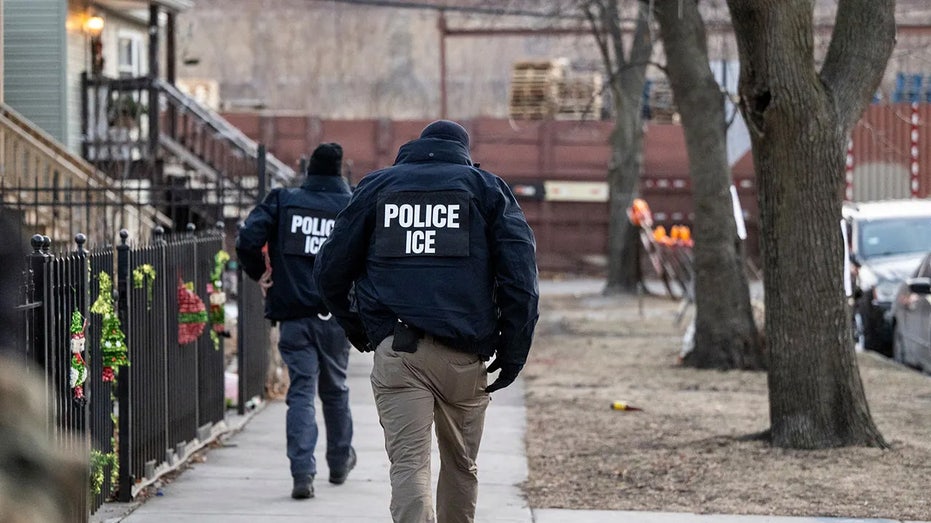

A Mexican national with prior domestic violence and assault convictions was arrested Wednesday after allegedly resisting an immigration enforcement operation outside Chicago. Federal officials said Jose Garnica-Naranjo dragged an Immigration and Customs Enforcement officer with his vehicle while fleeing an attempted arrest. The officer suffered leg injuries and was taken to a local hospital, but was later released. Authorities said the incident occurred Tuesday morning in Chicago Heights, Illinois.
The case has renewed federal criticism of what officials describe as rising violence against immigration officers. Homeland Security officials also directed criticism at Illinois Gov. J.B. Pritzker and other elected officials over rhetoric and policies related to immigration enforcement.
| 1) | Arrest follows a vehicle-related confrontation |
|---|---|
| 2) | Authorities describe the Chicago Heights operation |
| 3) | Officer treated for injuries after pursuit |
| 4) | Suspect’s criminal history cited by officials |
| 5) | Homeland Security condemns anti-ICE rhetoric |
Arrest follows a vehicle-related confrontation
Jose Garnica-Naranjo, 32, was taken into custody Wednesday, one day after federal officers attempted to arrest him during a targeted immigration enforcement operation. The Department of Homeland Security said he allegedly used his vehicle to resist the officers and flee. The circumstances described by authorities place the confrontation outside Chicago, where ICE officers were conducting enforcement activity involving a person with a prior criminal record.
Officials said the allegation centers on the interaction between Garnica-Naranjo and an Enforcement and Removal Operations officer. The case remains an allegation, and the available account does not provide details about the specific charges filed or an attorney representing Garnica-Naranjo.
Authorities describe the Chicago Heights operation
ICE officers reportedly saw Garnica-Naranjo leave a residence in Chicago Heights on Tuesday morning. According to DHS, officers followed his vehicle from a distance before attempting to conduct a traffic stop. When they approached, they instructed him to turn off the engine, but officials said he refused.
The department said officers then tried to remove him from the vehicle. Garnica-Naranjo allegedly accelerated and drove away while an officer was partially inside the vehicle through the driver-side window. Authorities said the vehicle crossed a raised, tree-planted center median as it fled.
Officer treated for injuries after pursuit
The officer was reportedly thrown from the vehicle after Garnica-Naranjo drove over the median. As the vehicle continued away, authorities said it struck the injured officer. The officer was transported to a local hospital for treatment.
The injuries included contusions, cuts and scrapes to the legs. Medical testing confirmed that the officer had no broken bones, and officials said the officer was later released from the hospital.
“This illegal alien used his vehicle to assault one of our ICE officers, hospitalizing the officer. Thankfully, the officer has since been released from the hospital.”
Homeland Security Secretary Markwayne Mullin made the statement while describing the incident as part of what he called a broader increase in assaults against immigration officers.
Suspect’s criminal history cited by officials
Federal officials said Garnica-Naranjo is a Mexican citizen and has prior convictions for domestic violence and assault. DHS cited that history as part of its explanation for why officers were conducting a targeted enforcement operation involving him.
The information released by authorities does not specify the dates, jurisdictions or sentences associated with those convictions. It also does not detail the legal process that led officers to locate him at the Chicago Heights residence before the attempted arrest.
Homeland Security condemns anti-ICE rhetoric
Mullin blamed what he described as anti-ICE rhetoric from Democratic elected officials for contributing to hostility toward immigration officers. He specifically criticized so-called sanctuary policies and mentioned Illinois Gov. J.B. Pritzker in his remarks.
Mullin called on Pritzker and other officials to stop what he characterized as violent rhetoric and to cooperate with ICE. He said federal officers had experienced a more than 1,600% increase in assaults, although the statement did not provide the underlying data or comparison period. The incident adds to ongoing disputes over federal immigration enforcement and the role of state and local authorities.
| Number | Key Point |
|---|---|
| 1 | Jose Garnica-Naranjo was arrested Wednesday after an attempted arrest in the Chicago area. |
| 2 | Authorities said he allegedly accelerated away while an ICE officer was partly inside his vehicle. |
| 3 | The officer suffered leg injuries but had no broken bones and was released from the hospital. |
| 4 | Federal officials cited Garnica-Naranjo’s prior domestic violence and assault convictions. |
Summary
Federal officials say an attempted immigration arrest in Chicago Heights escalated when the suspect allegedly drove away with an ICE officer partially inside the vehicle and later struck the officer. The officer was treated and released, while the suspect was arrested the following day. The case is also fueling a broader political dispute over immigration enforcement, officer safety and public statements about ICE operations.
Frequently Asked Questions
Who was arrested?
Jose Garnica-Naranjo, a 32-year-old Mexican citizen, was arrested Wednesday, according to federal officials.
What happened to the ICE officer?
Authorities said the officer was thrown from the vehicle and then struck as the suspect fled. The officer suffered leg contusions, cuts and scrapes, but no broken bones, and was released from the hospital.
Where did the incident occur?
The attempted arrest began after officers saw Garnica-Naranjo leave a residence in Chicago Heights, an Illinois suburb outside Chicago.
Why did the incident draw broader criticism?
Homeland Security officials used the case to criticize what they described as anti-ICE rhetoric and to call for greater cooperation from state and local officials.
