

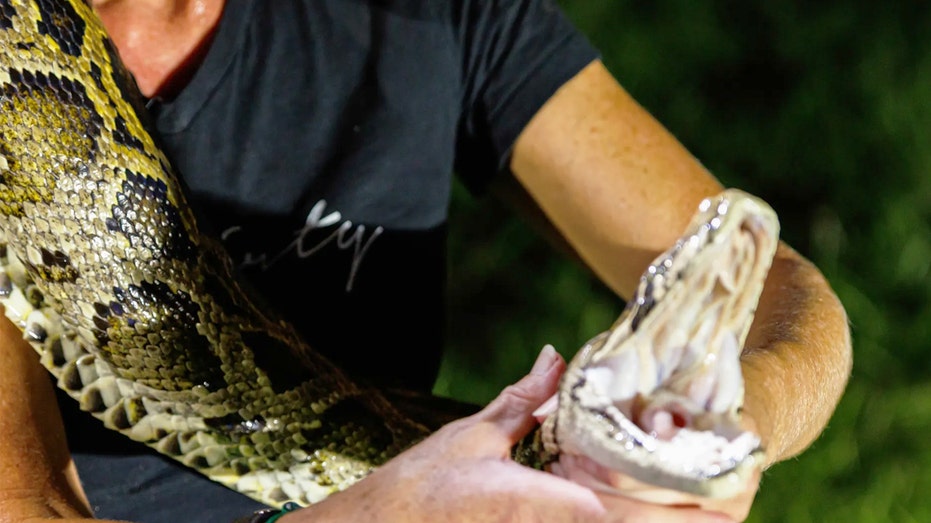

Invasive Burmese pythons are expanding beyond their long-established range in South Florida, raising concerns about new breeding populations. Researchers have found that the snakes can use gopher tortoise and armadillo burrows to shelter from colder temperatures. Hunters and wildlife officials are promoting early detection and removal to limit further ecological damage.
More than 23,000 Burmese pythons have been removed from Florida, but the total population in the Greater Everglades region is still estimated at tens of thousands. Because the snakes spend much of their time motionless and hidden, their numbers and distribution remain difficult to determine.
| 1) | Northern expansion raises new concerns |
| 2) | Burrows help pythons survive colder weather |
| 3) | Hunters use trained dogs and elevated platforms |
| 4) | Population estimates remain difficult |
| 5) | Early detection is central to containment |
Northern expansion raises new concerns
Burmese pythons have affected the Florida Everglades ecosystem for more than 25 years, primarily in the southern part of the state. Recent sightings farther north have prompted additional concern because established breeding populations are difficult to eradicate once they become widespread.
Two separate populations have recently been identified in Brevard County and Charlotte County, according to Amy Siewe, a professional python hunter and guide. Scientists believe these groups resulted from separate events rather than an expansion of the long-established Everglades population. The sightings show that the species can appear outside its best-known range and may require monitoring in new areas.
Burrows help pythons survive colder weather
Hard freezes were once considered a major factor limiting Burmese pythons to South Florida. Researchers have now documented the snakes sheltering, and sometimes breeding, in burrows that can protect them from cold temperatures.
“First of all, they’re following the food. But they are also stealing gopher tortoise burrows and armadillo burrows. And that’s how they’re staying warm during those colder nights in Florida that they typically wouldn’t be able to survive.”
The behavior creates a threat not only to native mammals that pythons consume, but also to species that depend on burrows for shelter. Siewe said pythons consume most mammals in some parts of the Everglades, increasing concerns about the long-term effects on native wildlife and the wider ecosystem.
Hunters use trained dogs and elevated platforms
Amy Siewe hunts pythons in the Everglades several times a week and also leads guided hunts. She began the work full time in 2019 after leaving a 13-year real estate career and turning her longstanding interest in snakes and reptiles toward invasive-species control.
During searches in Collier County, Siewe works with her husband and her trained dog, Dixie. The dog indicates when it detects a snake, after which Siewe verifies the location. A platform mounted on the hunting vehicle, known as a snake deck, gives her a higher view of grass and water where camouflaged pythons may be difficult to see.
“We are always happy catching one, like I always want to catch one more. There are a lot of times we go out and you don’t catch any. That’s just the nature of the python.”
Population estimates remain difficult
Conservative estimates place the Burmese python population in the Greater Everglades region in the tens of thousands. An exact count is unavailable because the snakes blend into their surroundings and often remain in locations that are hard for people to reach.
Siewe estimates that pythons are motionless for about 85% of their time. That makes routine searches challenging and means a single discovery may indicate the presence of many more snakes that have not been detected. The species can also reproduce rapidly, with females commonly laying 20 to 40 eggs and larger snakes sometimes laying more than 100, according to Siewe.
Early detection is central to containment
Florida has removed more than 23,000 Burmese pythons, but removal efforts must be paired with public awareness and rapid reporting. Researchers emphasize preventing additional releases of captive snakes and finding isolated populations before they can reproduce and spread.
The challenge is both geographic and biological. Pythons follow available food, use protected spaces to survive weather that once limited them, and remain hidden for long periods. Wildlife managers and hunters therefore rely on repeated searches, trained detection animals, public cooperation and continued research to identify where the snakes are present.
| Number | Key Point |
|---|---|
| 1 | Burmese pythons have been documented farther north in Florida, including Brevard and Charlotte counties. |
| 2 | Gopher tortoise and armadillo burrows can provide shelter from colder temperatures. |
| 3 | More than 23,000 pythons have been removed from Florida. |
| 4 | Experts say early detection and public education are essential to limiting new populations. |
Summary
Burmese pythons remain a major invasive-species challenge in Florida as sightings emerge beyond the established Everglades range. Their ability to hide in burrows and remain motionless makes detection difficult, while their reproduction and broad diet increase the potential threat to native wildlife. Continued removal, monitoring and public education are the principal tools identified for slowing further spread.
Frequently Asked Questions
Where are Burmese pythons expanding in Florida?
Separate populations have been reported in Brevard County and Charlotte County, north of the long-established population in the Everglades.
How do the snakes survive colder conditions?
They can shelter in gopher tortoise and armadillo burrows, which protect them from colder nights and may also provide locations for breeding.
Why are Burmese pythons difficult to count?
The snakes are highly camouflaged, spend about 85% of their time motionless and often remain in inaccessible areas, making many individuals difficult to detect.
What measures can limit their spread?
Experts emphasize early detection, removal, public education and preventing the release of captive invasive snakes before new breeding populations become established.
