

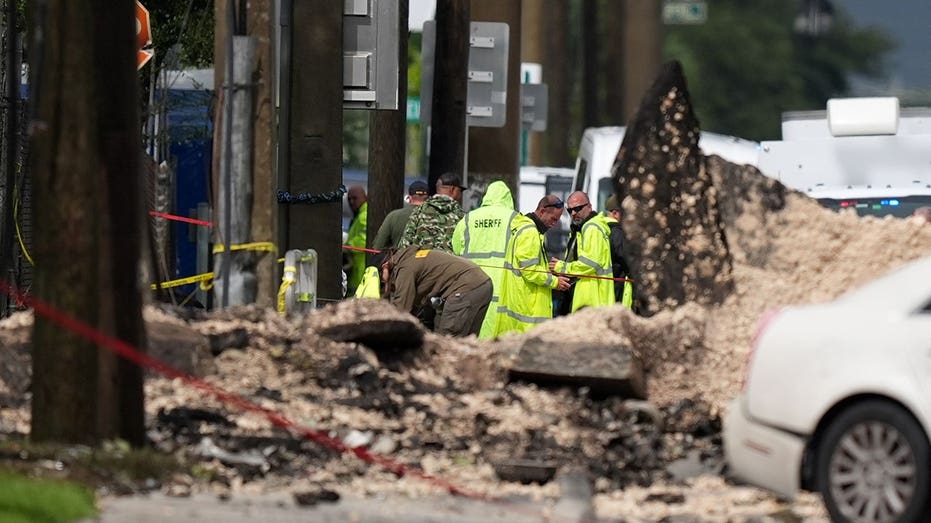

Federal investigators have recovered part of an engine from a Learjet 60 that crashed in Greenacres, Florida, killing all nine people aboard. Excavation began Wednesday after utility workers drained water and removed other hazards from the site. Investigators are also examining the aircraft’s left tail elevator, which was found in three pieces, including one nearly four miles from the main wreckage. Severe weather, icing, turbulence and the aircraft’s rapid descent are expected to be central to the investigation.
| 1) | Engine debris recovered during excavation |
| 2) | Tail elevator dispersal raises questions |
| 3) | Flight path and worsening weather |
| 4) | Nine people killed in the crash |
| 5) | Cockpit recorder remains unaccounted for |
Engine debris recovered during excavation
The National Transportation Safety Board said crews began digging at the Greenacres crash site on Wednesday, Nov. 4, after utility workers drained standing water and cleared hazards that had delayed recovery work. The excavation produced a portion of one engine from the Learjet, which struck the ground in Palm Beach County on Sunday, Nov. 1. Investigators also reported debris on the roofs of nearby homes and buildings, reflecting the wide distribution of aircraft parts.
The recovered engine section will be examined for evidence about the aircraft’s condition before impact. NTSB member Thomas B. Chapman described the recovered tail component as a “very important piece of evidence.” The agency has emphasized that even small wreckage fragments can help establish what happened during the flight’s final moments.
Tail elevator dispersal raises questions
Earlier in the investigation, crews found the Learjet’s left tail elevator in three pieces. The elevator controls the aircraft’s pitch, making its condition and separation important to investigators studying the jet’s rapid descent. One section was located nearly four miles from the main crash site, a distance that investigators will assess alongside the aircraft’s impact pattern and other wreckage locations.
The findings do not establish a cause. Investigators must determine whether the elevator broke apart before impact, during the crash, or as a result of the aircraft’s breakup. They will compare the component’s damage with the engine evidence, flight data and weather information as the examination continues.
Flight path and worsening weather
The Learjet 60 departed Austin-Bergstrom International Airport at about 10:37 a.m. Sunday, bound for North Eleuthera Airport in the Bahamas. At approximately 41,000 feet, an air traffic controller told the crew that moderate precipitation was about five miles away and offered a deviation to either side. The controller also warned that the turn toward Freeport “looks pretty bad.”
The crew was later directed toward a waypoint near Naples, Florida. After deviating toward Palm Beach County, the pilots reported deteriorating conditions, including icing and turbulence, and asked whether a “better ride” was available ahead. Heavy rain and thunderstorms were moving across South Florida when the aircraft descended into the Greenacres area shortly before 1 p.m. Weather conditions are expected to remain a major focus of the federal investigation.
Nine people killed in the crash
All nine people aboard died when the Learjet crashed and erupted into a fireball in a South Florida neighborhood, about nine miles from Mar-a-Lago. The passengers included Austin technology entrepreneur Adam Robinson, 45, his wife, Helen Sharp, 40, their children, Emma Robinson, 4, and Charlie Robinson, 2, and the children’s nanny, Anita Maria Cetina.
Also killed were Rachael Reed and Charmi Fehr. The flight crew consisted of captain Jeffrey Scott Gregory, 55, and copilot Nathalia Gadelha Filgueiras, 20. Investigators are reviewing the aircraft, its occupants, communications with air traffic control and the surrounding conditions to reconstruct the final phase of the flight.
Cockpit recorder remains unaccounted for
The Learjet was equipped with a cockpit voice recorder, but investigators have not located it. Officials also have not confirmed whether the recorder was aboard the aircraft when it crashed. Its recovery could provide information about cockpit communications, crew decisions and the response to the reported icing, turbulence and precipitation.
Until the recorder, additional wreckage and other records are analyzed, investigators cannot determine whether weather, a mechanical problem, structural failure or a combination of factors caused the crash. The engine and tail components recovered so far will be assessed as part of that broader process.
| Number | Key Point |
|---|---|
| 1 | An engine section was recovered after excavation began at the Greenacres crash site. |
| 2 | The left tail elevator was found in three pieces, with one section nearly four miles away. |
| 3 | The crew reported icing and turbulence after controllers warned about precipitation and difficult weather. |
| 4 | All nine occupants died, and the cockpit voice recorder has not been found. |
Summary
Investigators are combining wreckage recovery, air traffic control communications, weather data and crew information to determine why the Learjet 60 crashed in Greenacres. The engine fragment and separated tail elevator may help clarify whether the aircraft experienced a mechanical or structural problem before impact. The investigation remains open, with the missing cockpit voice recorder representing a significant unresolved source of evidence.
Frequently Asked Questions
What aircraft crashed in Florida?
A Learjet 60 crashed in Greenacres, Florida, on Sunday, Nov. 1, after departing Austin-Bergstrom International Airport for North Eleuthera Airport in the Bahamas.
What evidence have investigators recovered?
Investigators recovered part of an engine and the left tail elevator in three pieces. One elevator section was found nearly four miles from the main crash site.
What weather did the pilots report?
The pilots reported icing and turbulence and asked air traffic control whether a better ride was available. Heavy rain and thunderstorms were affecting South Florida at the time of the crash.
Have investigators found the cockpit voice recorder?
No. Investigators have not located the recorder and have not yet confirmed whether it was aboard the aircraft when it crashed.
