

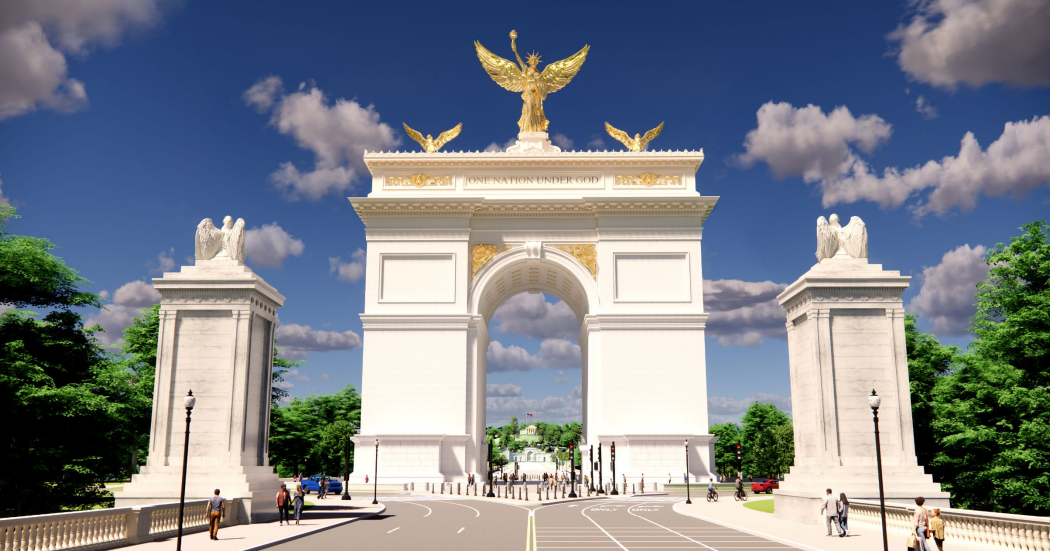

A federal judge has issued a temporary restraining order halting immediate construction on President Trump’s proposed triumphal arch, a move that aligns with a lawsuit led by Vietnam veterans and the governments of the District of Columbia and Virginia. U.S. District Judge Tanya Chutkan ruled that construction-related activities cannot commence for two weeks while further legal proceedings take place. This decision followed a significant vote by the National Capital Planning Commission (NCPC), which had earlier approved plans for the monument despite considerable public opposition.
| Article Subheadings |
|---|
| 1) Legal Block on Construction Activities |
| 2) NCPC Approval Sparks Public Outcry |
| 3) Concerns from Local Officials and Veterans |
| 4) The Arch’s Design and Purpose |
| 5) Potential Impacts of the Project |
Legal Block on Construction Activities
U.S. District Judge Tanya Chutkan ruled on Thursday that the Trump administration cannot begin construction on the proposed triumphal arch for at least 14 days, providing time for legal proceedings to unfold. The order specifically prohibits any “construction-related activity” during this period. Chutkan noted that the plaintiffs—comprised of Vietnam veterans, the District of Columbia, and Virginia—have a strong chance of success in demonstrating that the federal government failed to follow required legal procedures to construct the arch, which is planned to stand 250 feet tall between the Lincoln Memorial and Arlington National Cemetery. Furthermore, she pointed out that Virginia and D.C. are likely to have standing to sue, citing “tangible economic harms” stemming from anticipated traffic disruptions at the construction site.
NCPC Approval Sparks Public Outcry
Hours before the ruling, the NCPC voted 8-4 in favor of the triumphal arch’s construction, despite significant opposition expressed during almost nine hours of public comment. The commission is tasked with overseeing federal planning in the region and includes several members who are supportive of President Trump’s vision. During the commission meeting, critics, including lawmakers and local residents, voiced strong concerns that the arch would disrupt the historical significance and solemnity of the nearby memorial sites. Citing a feeling of disregard for veterans, critics claimed the arch’s construction prioritizes aesthetics over respect for those who have served in the military.
Concerns from Local Officials and Veterans
The responses from local officials and veteran representatives highlighted a deeper concern regarding the appropriateness of the monument’s intended location. Jared Huffman, a representative from California, labeled the arch as “illegal,” stating it would “disrupt the solemn connection” between crucial memorial sites. Veterans also voiced their objections; one Marine veteran, Jimi Shaughnessy, articulated strong feelings against the arch, describing it as “abhorrent and insulting” to military families. This negative sentiment encapsulates fears that the arch would commercialize an area dedicated to the memory of fallen soldiers, transforming it into a “carnival-like atmosphere” that prioritizes monument tourism over reverence.
The Arch’s Design and Purpose
The proposed triumphal arch is designed to stand 166 feet tall, topped with three gilded figures — a gold winged female figure flanked by two golden eagles — bringing its overall height to 250 feet. According to the documentation presented to the NCPC, the arch is intended to celebrate 250 years of American independence. Its location near the Ronald Reagan Washington National Airport required assessments from the FAA, which determined the arch would not pose any hazards to air navigation while requiring specific safety lighting measures. The project is expected to draw thousands of visitors daily, with estimates ranging from 2,000 to as high as 22,400, raising further questions about traffic and operational impacts in the region.
Potential Impacts of the Project
The arch’s construction could have significant ramifications for local traffic, environmental conditions, and emergency services response times. Both the District of Columbia and Virginia have entered legal suits, claiming the infrastructure surrounding the arch would suffer from increased congestion, pollution, and runoff issues potentially affecting the Potomac River. Throughout the legal proceedings, state attorneys general emphasized that any construction could inflict “irreparable harm.” They argue that the arch’s construction would hinder essential services, thereby fundamentally changing the area’s operational landscape. With concerns mounting over potential disruptions, local entities continue to push for a reevaluation of the arch project amidst the ongoing legal challenge.
| No. | Key Points |
|---|---|
| 1 | A judge has temporarily halted construction on the triumphal arch for two weeks. |
| 2 | The National Capital Planning Commission approved the project amid public criticism. |
| 3 | Local officials and veterans have voiced strong objections to the arch’s significance and location. |
| 4 | The arch is designed to celebrate 250 years of American independence. |
| 5 | Concerns exist regarding the potential environmental and traffic impacts of the project. |
Summary
The temporary injunction preventing construction of the triumphal arch underscores the complexities surrounding this ambitious project, as it faces legal challenges, public scrutiny, and concerns from local veterans and officials. As discussions continue regarding its implications, the project becomes a focal point in the debate over how best to honor military service and protect historical Integrity. The outcome of this legal dispute will likely set a precedent for how similar projects may be evaluated in the future, making it a significant moment for both local governance and national memorialization practices.
Frequently Asked Questions
Question: What is the purpose of the proposed triumphal arch?
The triumphal arch is intended to celebrate 250 years of American independence, according to project documentation.
Question: What legal challenges has the arch faced?
The arch has faced lawsuits from Vietnam veterans and local governments asserting that the Trump administration did not follow proper legal procedures before advancing the project.
Question: How tall will the triumphal arch be once completed?
The proposed structure is designed to be 250 feet tall, combining its height with the figures atop the arch.
