

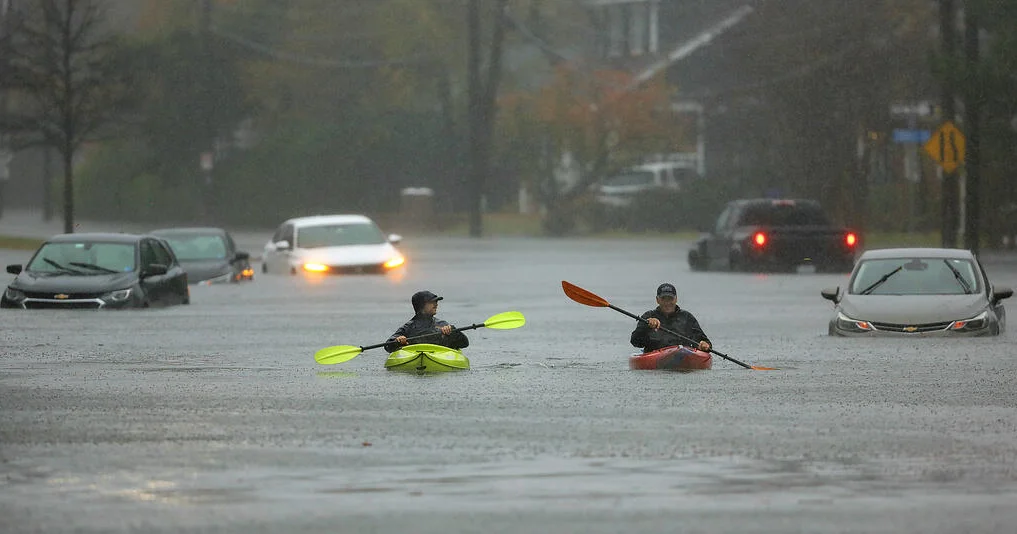

A powerful storm system has wreaked havoc across the East Coast and Midwest during the Thanksgiving holiday, causing widespread flooding, power outages, and travel disruptions. Over 800,000 customers lost electricity, with major flooding reported from New Jersey to North Carolina. Most notably, the storm forced the historic postponement of the Macy’s Thanksgiving Day Parade in New York City, prompting both safety concerns and logistical complications for thousands of visitors.
| Article Subheadings |
|---|
| 1) Storm’s Impact on Power and Travel |
| 2) New York City Faces Major Flooding |
| 3) Historic Postponement of the Macy’s Parade |
| 4) Roadways and Local Businesses Hit Hard |
| 5) State of Emergency Declared |
Storm’s Impact on Power and Travel
The Thanksgiving storm has had a severe impact on power supplies and transportation throughout the affected regions. By Thursday night, over 800,000 customers found themselves without power, with states like Pennsylvania and New Jersey reporting more than 170,000 outages each. The flight tracking service FlightAware documented over 2,500 flight delays and at least 460 cancellations as weather-related complications stranded travelers at various airports.
This chaos unfolded with numerous areas experiencing torrential rain, high winds, and severe flooding, prompting officials to take action. New Jersey was placed under a state of emergency declared by Governor Mikie Sherrill, while parts of New York received similar declarations from Governor Kathy Hochul. Wind advisories were issued from northern Georgia all the way to southern New England as meteorologists tracked the storm’s rapid progression.
New York City Faces Major Flooding
In New York City, the storm’s ferocity was felt acutely as emergency services responded to a host of flooding emergencies. Mayor Zohran Mamdani reported that two individuals had to be rescued after their vehicles became trapped in floodwaters. The mayor urged residents to avoid risky travel:
“We want to remind everyone to stay safe, and there is no destination worth your safety.”
The New York City Emergency Management agency indicated that the city received between 1.5 to 2 inches of rain, with certain areas experiencing as much as 3 inches. High tides added to the flooding, particularly affecting coastal locations like Staten Island and parts of Long Island. Central Park recorded wind gusts exceeding 30 mph, while LaGuardia Airport faced winds reaching 56 mph—notably strong enough to collapse scaffolding structures in the area, although no injuries have yet been reported.
Historic Postponement of the Macy’s Parade
Amidst the turmoil, the world-famous Macy’s Thanksgiving Day Parade was forced to postpone its festivities for the first time in history. Concerns arose regarding the safety of the parade’s large helium balloons, which are notoriously difficult to manage in high winds. As the organization announced the postponement, fans and participants alike faced disappointment and confusion, with many scrambling to adjust their plans.
One such participant, Ryan Demkovich, director of Pearland High School’s marching band from Texas, revealed that they raised a staggering $350,000 to extend their stay in New York City for the parade. As the band members navigated this unexpected change, they experienced a mix of emotions and community support:
“This was quite a challenge for us, and there was a very frantic and large call to action to our community to let the kids stay here and finish it out,”
he said, reflecting the spirit of resilience among those affected.
Visitors, such as Florida-based makeup artist Amanda Anderson, were also caught in the unexpected situation, stating,
“I was in Macy’s when I found out. There were like three girls crying already. People were sitting down, very somber. It was an experience.”
Roadways and Local Businesses Hit Hard
As the storm moved northward, coastal communities from North Carolina to New Jersey experienced significant flooding, leading to closures of major roadways and stranding motorists. Emergency workers were dispatched to assist individuals caught in rising floodwaters across several states. For instance, Avalon, New Jersey, reported some of the worst flooding on record, albeit not as severe as the infamous Hurricane Sandy.
In the community of Ocean City, resident Lance Miller described his surroundings as being about a foot deep in water, making it nearly impossible to navigate by car. As he prepared for his Thanksgiving dinner at home, he reflected on the broader impact of the flooding, stating, “So they’re dealing with cleanup, you know,” referring to friends in the area who suffered water damage in their homes.
State of Emergency Declared
In response to the escalating conditions, several states declared states of emergency, enabling more rapid coordination of resources and assistance. This included temporarily closing major travel routes in places like Virginia, where the Chesapeake Bay Bridge-Tunnel was shut down for several hours due to dangerous wind conditions. Additionally, in Maryland, a request for water conservation was placed on nearly 2 million residents, stemming from concerns over potential contamination at local filtration plants due to power outages.
The storm had broad-ranging effects, from steep snowfall in the Midwest, with areas in Missouri reporting upwards of 14 inches, to structural damage in populated areas. Onlookers remained vigilant as emergency services continued to provide support while navigating conditions that remained perilous for both residents and travelers throughout the impacted regions.
| No. | Key Points |
|---|---|
| 1 | Over 800,000 power outages reported across the East Coast and Midwest as the storm brought severe weather conditions. |
| 2 | New York City faced substantial flooding, with emergency rescues amid high tides and strong winds. |
| 3 | For the first time in history, Macy’s Thanksgiving Parade was postponed due to safety concerns regarding severe weather. |
| 4 | Coastal towns from North Carolina to New Jersey experienced significant flooding, causing emergency responses and road closures. |
| 5 | States declared emergencies to facilitate resource allocation amid the storm’s impact on essential services. |
Summary
The Thanksgiving storm played a major role in disrupting holiday celebrations while posing significant risks to public safety. With power outages affecting hundreds of thousands, major travel delays, and historic event cancellations, the storm’s impact will be felt for days to come. As emergency services continue to address the aftermath, it is a stark reminder of the unpredictable nature of weather during one of the busiest travel times of the year.
Frequently Asked Questions
Question: What measures are being taken to assist those affected by the storm?
Emergency services are responding to flooding incidents and providing resources to individuals stranded due to road closures. Several states have declared states of emergency to streamline aid and recovery efforts.
Question: Why was the Macy’s Thanksgiving Day Parade postponed?
The parade was postponed due to high winds that posed a safety risk to the large helium balloons and participants involved in the event. This decision was made to ensure the safety of everyone involved.
Question: What are the consequences of the storm on local businesses?
Local businesses have faced significant challenges due to flooding and power outages. Many were forced to remain closed during the storm, while others must contend with property damage and disrupted supply chains as a result of travel difficulties.
