

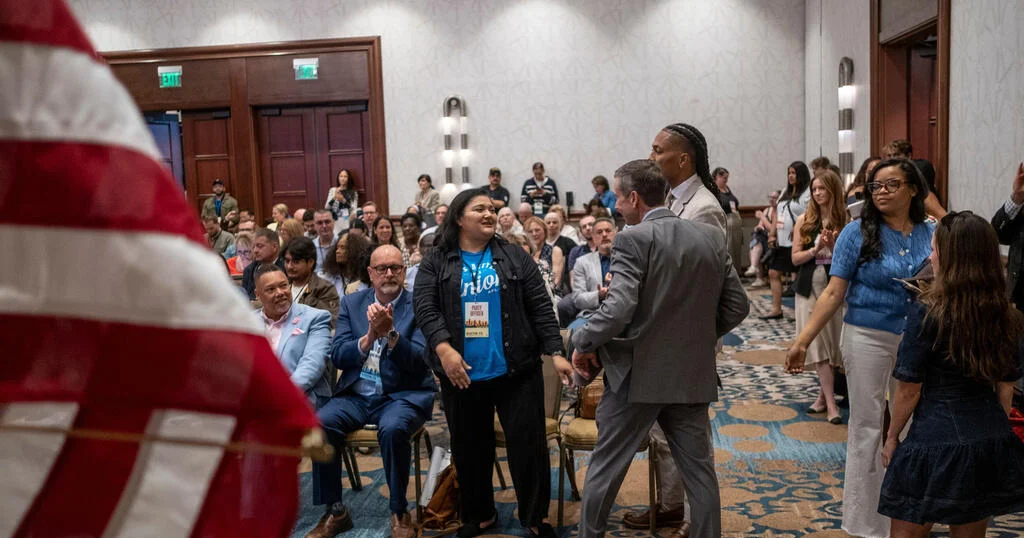

In a significant shift for the Democratic Party, officials approved a new presidential nominating calendar for 2028, positioning South Carolina as the first official primary state. This decision, made during the Democratic National Committee’s summer meeting in Austin, aims to elevate states that more accurately represent the party’s diverse electorate. The new schedule, set to begin in January 2028, introduces a sequence of early primary contests that challenges the traditional dominance of states like Iowa and New Hampshire, whose demographics do not fully reflect the party’s coalition of voters.
| Article Subheadings |
|---|
| 1) Overview of the New Nominating Calendar |
| 2) Reactions from Party Leaders |
| 3) The Historical Context of Primary States |
| 4) Implications for Candidates |
| 5) The Broader Impact on the Democratic Party |
Overview of the New Nominating Calendar
During its recent meeting in Austin, the Democratic National Committee (DNC) finalized a revolutionary decision regarding its presidential nominating calendar for 2028. South Carolina will now take precedence as the first state to hold a primary, scheduled for January 22, 2028. This change follows Nevada on February 1 and includes a lineup of other early states: New Hampshire, New Mexico, Michigan, and Virginia, all of which will hold primaries during February. The shift signals a departure from the party’s historical reliance on states with predominantly White electorates, like Iowa and New Hampshire, emphasizing the significance of demographic diversity within the Democratic coalition.
DNC Chair Ken Martin elaborated on the importance of the new calendar by stating,
“This is much bigger than a lineup of dates on a calendar. This is about our approach to winning back the presidency. It’s about the kind of Democratic Party and the kind of country we aspire to be.”
The resolution aims to empower Black and Latino voters, who have increasingly become crucial components of the Democratic base, ensuring their influence in shaping the presidential candidate of 2028.
Reactions from Party Leaders
The new calendar has met with mixed reactions from within the Democratic Party. While many officials applaud the decision as a progressive move to better reflect the diversity of the electorate, others, particularly those in Iowa and New Hampshire, have voiced strong opposition. Leaders in Iowa criticized the DNC for diminishing the influence of states that have historically played pivotal roles in the nomination process. Iowa Democratic Chair Rita Hart expressed concerns that the new calendar “fundamentally misses the mark,” arguing it could undermine the party’s goal of ensuring the strongest possible presidential candidate emerges from the primaries.
Democratic officials from New Hampshire reaffirmed their commitment to maintaining the state’s “First in the Nation” primary status. The U.S. congressional delegation from New Hampshire stated,
“As a state with highly engaged voters, we put candidates through their paces and thoroughly vet them.”
They argue that such rigorous processes produce better candidates and ultimately stronger presidents, posing questions about whether the change reflects the best interests of the party.
The Historical Context of Primary States
The decision to reposition South Carolina as the first primary state can be traced back to the events of the 2020 presidential election cycle. A key moment was former President Joe Biden’s comeback victory in South Carolina, which reignited his campaign after lackluster performances in Iowa and New Hampshire. This momentum shift ultimately shifted the focus of the DNC, leading them to prioritize states like South Carolina, which feature a more diverse electorate.
Notably, the DNC’s decision marks a potential end to the long-standing tradition where Iowa and New Hampshire, predominantly White states, kicked off the primary season. Previous resistance from New Hampshire when it sought to hold its primary before South Carolina has highlighted the tensions surrounding this calendar change. If New Hampshire attempts to defy the new schedule in 2028, the DNC has signaled that it may take further punitive action.
Implications for Candidates
The newly adopted calendar is expected to significantly shape the dynamics of the 2028 Democratic primaries. It introduces an environment where Black and Latino voters can exert greater influence over the selection of the party’s nominee. Currently, some early states, including South Carolina and Nevada, favor candidates who resonate with these demographics, holding the potential to elevate candidates who might not have previously gained traction.
Democratic strategists indicate that candidates aiming for the nomination will need to show strong appeal to these crucial voter segments if they hope to succeed in the early primaries. With no clear front-runner emerging for the 2028 election, early victories in South Carolina and Nevada could set candidates on paths to success or derail their campaigns if they fail to resonate with the electorate.
The Broader Impact on the Democratic Party
As the Democratic Party continues to grapple with divisions between its establishment moderate and progressive factions, the new nominating calendar could exacerbate these tensions. The calendar positions South Carolina and Nevada as early bellwethers, potentially granting them notable sway over which ideological factions can build momentum within the party.
Historically, states like Nevada have shown support for progressive candidates, while South Carolina features a larger base of voters who tend to align with more moderate positions. This divergence could make it challenging for progressives to gain the necessary traction to secure the nomination, raising questions about the ultimate shape and direction of the Democratic Party in the upcoming years. Furthermore, the Democratic Party is also under pressure to retain support from Hispanic voters, as recent data highlighted a shifting tide of support toward the Republican Party among these demographics in recent elections.
| No. | Key Points |
|---|---|
| 1 | South Carolina will become the first official primary state for the Democratic Party in 2028. |
| 2 | This new schedule aims to elevate underrepresented voter groups, particularly Black and Latino populations. |
| 3 | The decision has sparked backlash from leaders in Iowa and New Hampshire, historically significant primary states. |
| 4 | The change reflects a broader ideological struggle within the Democratic Party, impacting candidate strategies. |
| 5 | The decision may influence voter turnout and party cohesion as Democrats aim to reclaim and strengthen their support among key demographics. |
Summary
The Democratic National Committee’s recent approval of a new presidential nominating calendar for 2028 underscores a transformative moment for the party. By placing South Carolina as the lead primary state, the DNC seeks to reflect the increasingly diverse makeup of its voter base. While this change offers opportunities for broader representation, it also sets the stage for ideological battles and heightened competition among candidates, potentially reshaping the Democratic Party’s future. As candidates prepare for the upcoming primaries, they must navigate an evolving political landscape where demographic factors will weigh heavily on their chances for nomination and success in the general election.
Frequently Asked Questions
Question: Why did the DNC change the primary calendar?
The DNC altered the primary calendar to better reflect the party’s diverse voter base, elevating states like South Carolina with larger Black and Latino populations, which are vital for the party’s electoral success.
Question: What states are now included in the early presidential primary lineup?
The early primary lineup includes South Carolina, Nevada, New Hampshire, New Mexico, Michigan, and Virginia, all scheduled to vote before Super Tuesday in February 2028.
Question: How does this new calendar impact candidates in the Democratic primaries?
Candidates will need to demonstrate strong appeal to Black and Latino voters in key states like South Carolina and Nevada to build momentum, as these demographics will significantly influence the nomination process.
