

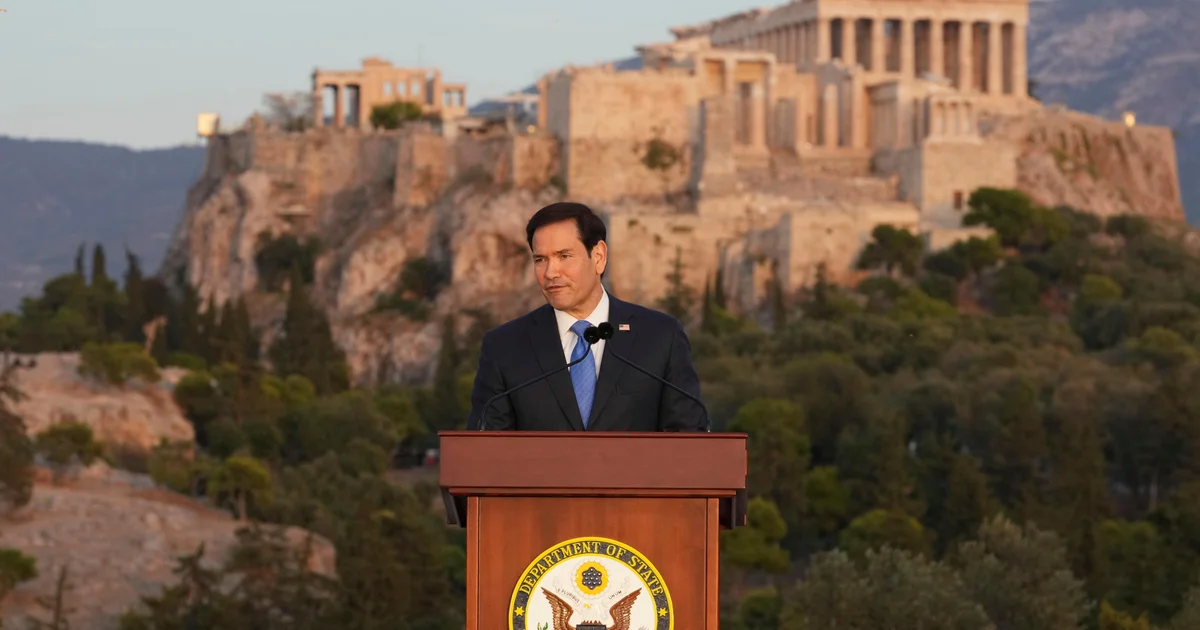

In a recent address in Athens, Secretary of State Marco Rubio emphasized the importance of ancient Greek principles in shaping Western identity amid ongoing global challenges, including the U.S. war with Iran and Russia’s conflict in Ukraine. Addressing a gathering on Pnyx hill, he lamented the erosion of key Western traits such as ambition and individuality. His remarks come at a time of heightened scrutiny of U.S. foreign policy and were combined with discussions on regional security and military cooperation with Greece during his European tour.
| Article Subheadings |
|---|
| 1) Rubio’s Address and Its Historical Context |
| 2) Contemporary Western Challenges |
| 3) Strategic Importance of Greece |
| 4) The U.S. Position on Iran |
| 5) Future Implications for U.S. Policy |
Rubio’s Address and Its Historical Context
In his recent speech, Secretary of State Marco Rubio drew on the legacy of ancient Greece to highlight the foundations of Western civilization, notably democracy, philosophy, and the concept of individual ambition. Speaking from the Pnyx hill, a historical site where citizens of Athens assembled for democratic discussions, he articulated that the essence of Western culture emerged from the unique character and aspirations of ancient Greeks. He stated, “Here, in Athens, we found the first full realization of all the essential traits that would come to define the West,” underscoring the notion of individuality and a thirst for discovery.
Rubio framed this historical significance as critical for understanding modern challenges faced by Western societies. He suggested that the ideals that propelled Western advancement have become diluted over time, with societal focus shifting towards seeking ‘perfect safety’ instead of embracing risk and competition. This shift, he asserts, is a crucial factor in the current civilizational struggles faced by countries across the West.
Contemporary Western Challenges
The backdrop of Rubio’s address includes ongoing geopolitical tensions, primarily the military engagement with Iran and the conflict in Ukraine. This situation was further accentuated by his remarks about the consequences of losing the unique qualities that, according to him, have historically driven progress within Western civilization. Rubio expressed concern that contemporary ideologies promote safety over excellence and that this trend needs to be reversed to safeguard the Western way of life.
The Secretary raised alarms about the future of Western societies, describing them as being at a critical juncture. He stated that decisions made in the coming decade would determine whether the West can maintain its global leadership or succumb to decline. Such rhetoric resonated with audiences accustomed to political discourse focused on pitfalls rather than the ambitious ideals that once marked progress.
Strategic Importance of Greece
During his visit, Rubio engaged in dialogues with Greek officials, reinforcing the significance of Greece as a steadfast NATO ally. His discussions with Greek Foreign Minister George Gerapetritis centered around defense, energy, and regional security, emphasizing the collaborative nature of U.S.-Greece relations. Rubio noted the strategic relevance of Greece in countering threats posed by Iran and in stabilizing the Eastern Mediterranean region, linking this to broader NATO objectives.
Mentioning the possibility of increased military cooperation, Rubio conveyed a commitment to deepening defense ties. He remarked on Greece’s willingness to assist in maritime operations, particularly in strategic waterways like the Strait of Hormuz, if conditions prompt a viable peace process in the region. This focus not only strengthens U.S.-Greece relations but also positions Greece as a pivotal player in the evolving security landscape.
The U.S. Position on Iran
Rubio also addressed the ongoing conflict with Iran, emphasizing the U.S. stance against the nation obtaining nuclear capabilities. He drew stark contrasts between Western values and what he termed a “cult of death” among Iran’s leadership, invoking historical references to emphasize the differences in ideologies. “Our heroes may be willing to die for their cause, but they do not worship death,” Rubio pointedly remarked, framing the U.S. position as one of moral clarity amidst swirling complexities of international relations.
Pressing further, he reiterated that any doubts regarding the U.S. resolve on nuclear issues were misplaced, insisting that Iran must not develop nuclear weapons. However, he opted not to specify what levels of uranium enrichment the U.S. might find acceptable, a strategic position possibly intended to maintain flexibility in negotiations while unequivocally emphasizing the U.S. commitment to preventing a nuclear-capable Iran.
Future Implications for U.S. Policy
The implications of Rubio’s statements extend beyond immediate foreign policy concerns; they reflect his vision for a future centered on U.S. power and leadership. The Secretary’s speech connects the historical narratives of the West with current strategic priorities, asserting that the U.S. must pursue an aggressive approach in reclaiming control over its supply chains and reindustrializing the economy. This aligns with broader goals within the Trump administration to reassert American dominance, especially concerning emerging technologies and defense.
As he wrapped up his address and discussed ongoing challenges, Rubio made it clear that the U.S. is prepared to take decisive action, reaffirming a commitment to national interests and emphasizing the collaborative spirit among NATO allies. He lauded recent achievements that could reshape the geopolitical landscape, such as the Greenland deal he helped negotiate, which he believes will enhance the security of NATO as a whole.
| No. | Key Points |
|---|---|
| 1 | Rubio emphasized the historical significance of ancient Greece in shaping Western democracy and individuality. |
| 2 | The speech highlighted concerns over contemporary challenges, including the U.S. war with Iran and the conflict in Ukraine. |
| 3 | Rubio reinforced the strategic importance of Greece as a key NATO ally and a partner in regional security efforts. |
| 4 | The U.S. remains firmly opposed to Iran acquiring nuclear weapons, framing the issue as a moral imperative. |
| 5 | Rubio’s address suggests a future focus on assertive U.S. policies aimed at reclaiming global influence and leadership. |
Summary
Secretary of State Marco Rubio‘s address in Athens highlighted the importance of ancient Greek principles in contemporary discussions surrounding Western identity and democracy. While connecting historical narratives to present challenges posed by geopolitical tensions, Rubio made a call for renewed ambition among Western societies. His remarks reflect a vision of strong U.S. engagement worldwide, emphasizing strategic partnerships and a robust stance against adversaries, particularly in the context of Iranian nuclear ambitions and broader national security priorities.
Frequently Asked Questions
Question: What were the main themes of Rubio’s speech in Athens?
Rubio focused on the historical significance of ancient Greece and its impact on Western identity, addressing themes of ambition, individuality, and the need for modern societies to recover these essential traits.
Question: How does Rubio view the current geopolitical situation related to Iran?
He expresses a firm stance against Iran obtaining nuclear weapons and emphasizes the necessity for the U.S. to maintain a decisive position to prevent this development.
Question: What is the importance of Greece in U.S. foreign policy?
Greece is viewed as a crucial NATO ally that plays a significant role in regional security efforts, particularly in confronting threats from Iran and stabilizing the Eastern Mediterranean.
