

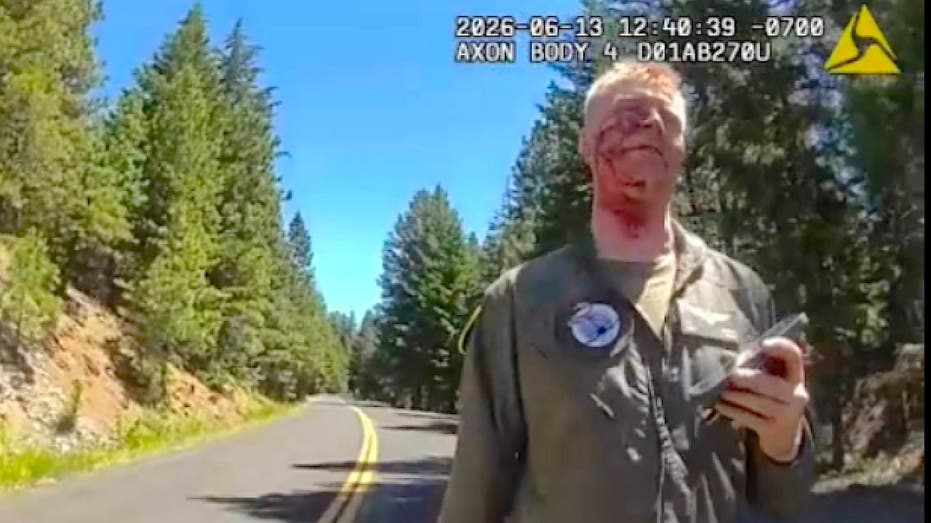

Bodycam footage shows Marine Corps Maj. Jackson Simon walking toward a Yakima County sheriff’s deputy after ejecting from an F-18 fighter jet in Washington state. The aircraft crashed into a mountainside near Rimrock Lake during a low-level training flight on June 13, 2026. Simon had facial lacerations and blood on his face but appeared composed as he described the crash and contacted his superiors. The aircraft was destroyed and valued by a military spokesperson at approximately $67 million.
The incident occurred at about noon Pacific time, roughly 55 miles southeast of Seattle. Witnesses reported seeing the aircraft circle near the lake before the pilot ejected and the jet struck the wooded mountainside, starting a fire. The cause of the non-fatal aviation mishap remains under investigation.
| 1) | Pilot’s condition after ejection |
| 2) | Low-level training flight and crash |
| 3) | Emergency response and witness reports |
| 4) | Aircraft assignment and investigation |
| 5) | Recovery of gear and immediate aftermath |
Pilot’s condition after ejection
After ejecting from the F-18, Jackson Simon came down through trees and approached a responding Yakima County sheriff’s deputy. Bodycam footage showed blood covering parts of his face, consistent with facial lacerations, while he carried a phone and appeared able to walk and communicate. When asked how he was doing, Simon acknowledged that he was somewhat unsettled.
“I’m a little frazzled,” Simon told the deputy.
He also said he was experiencing an adrenaline response. The deputy performed a “buddy check” for injuries after reaching him on the hillside. The available account does not describe further medical details, but the Marine Corps said the pilot survived and was recovered by local authorities.
Low-level training flight and crash
The flight was a routine Marine Corps training mission conducted near Rimrock Lake in central Washington on June 13. Simon told responders that he and the aircraft had been making circles over the lake before he moved into a tucked-in position and encountered a problem he could not immediately explain.
“We were doing some circles over the lake. I tucked in, and I’m not sure exactly. Honestly, I’m a little frazzled,” Simon said.
The pilot ejected before the fighter jet slammed into a mountainside. The impact produced flames and a thick column of black smoke above the surrounding trees, and the burning wreckage also ignited a fire in the wooded area. Simon later described the event as extremely close to a fatal outcome.
Emergency response and witness reports
People near Rimrock Lake saw the aircraft circling and then observed the ejection and crash. The first emergency report was logged at 12:18 p.m. local time, according to the incident report. Within less than a minute, dispatch records identified a “JET CRASH” and stated that the “PILOT PARACHUTED OUT.”
Several callers reported the fire and the pilot’s parachute. One dispatch entry recorded that a witness was crying after seeing the crash. Local sheriff’s personnel subsequently located Simon on a hillside and helped him move away from the parachute lines and other equipment in the trees.
Aircraft assignment and investigation
The Marine Corps identified the aircraft as an F-18 assigned to Marine Aircraft Group 11, part of the 3rd Marine Aircraft Wing. The training area was approximately 55 miles southeast of Seattle. A military spokesperson placed the value of the destroyed aircraft at close to $67 million.
The service classified the event as a non-fatal aviation mishap. No cause has been announced. The 3rd Marine Aircraft Wing, headquartered at Marine Corps Air Station Miramar in San Diego, California, said it was withholding additional details while the investigation proceeds. Military aviation mishap investigations can take several months to complete.
Recovery of gear and immediate aftermath
The responding deputy’s report said Simon was standing on a hillside, removing his flight harness and placing his equipment in a pile. He then slid down an embankment to meet the deputy. Bodycam footage also showed Simon making calls, including one in which he notified others that he had ejected and was safe.
“Hey, buddy, this is Maj. Simon, I just crashed,” he said during one call.
Later, the deputy helped collect Simon’s gear and cut the parachute free from ropes tangled in the trees. Simon told responders that he had gone through the trees during the descent. Despite the visible injuries and the violent crash, he remained sufficiently alert to explain what happened and assist with the initial recovery effort.
| Number | Key Point |
|---|---|
| 1 | Maj. Jackson Simon ejected safely before the F-18 crashed. |
| 2 | The crash occurred near Rimrock Lake during training on June 13, 2026. |
| 3 | The aircraft was destroyed and valued at about $67 million. |
| 4 | Witnesses reported the ejection, impact and resulting fire. |
| 5 | The cause remains under investigation. |
Summary
The Washington crash ended with the loss of a Marine Corps F-18 but no reported fatality. Simon’s ejection, survival and ability to communicate with responders allowed local authorities to recover him quickly. Investigators are continuing to examine the circumstances of the training mishap, and additional details are expected only after the military review advances.
Frequently Asked Questions
When did the F-18 crash?
The crash occurred at approximately noon Pacific time on June 13, 2026.
Where did the crash happen?
The fighter jet crashed into a mountainside near Rimrock Lake in Washington state, about 55 miles southeast of Seattle.
What happened to the pilot?
Maj. Jackson Simon ejected before impact, survived the descent through the trees and was recovered by the local sheriff’s department.
What is known about the cause?
The cause remains under investigation. The 3rd Marine Aircraft Wing said aviation mishap investigations can take several months.
