

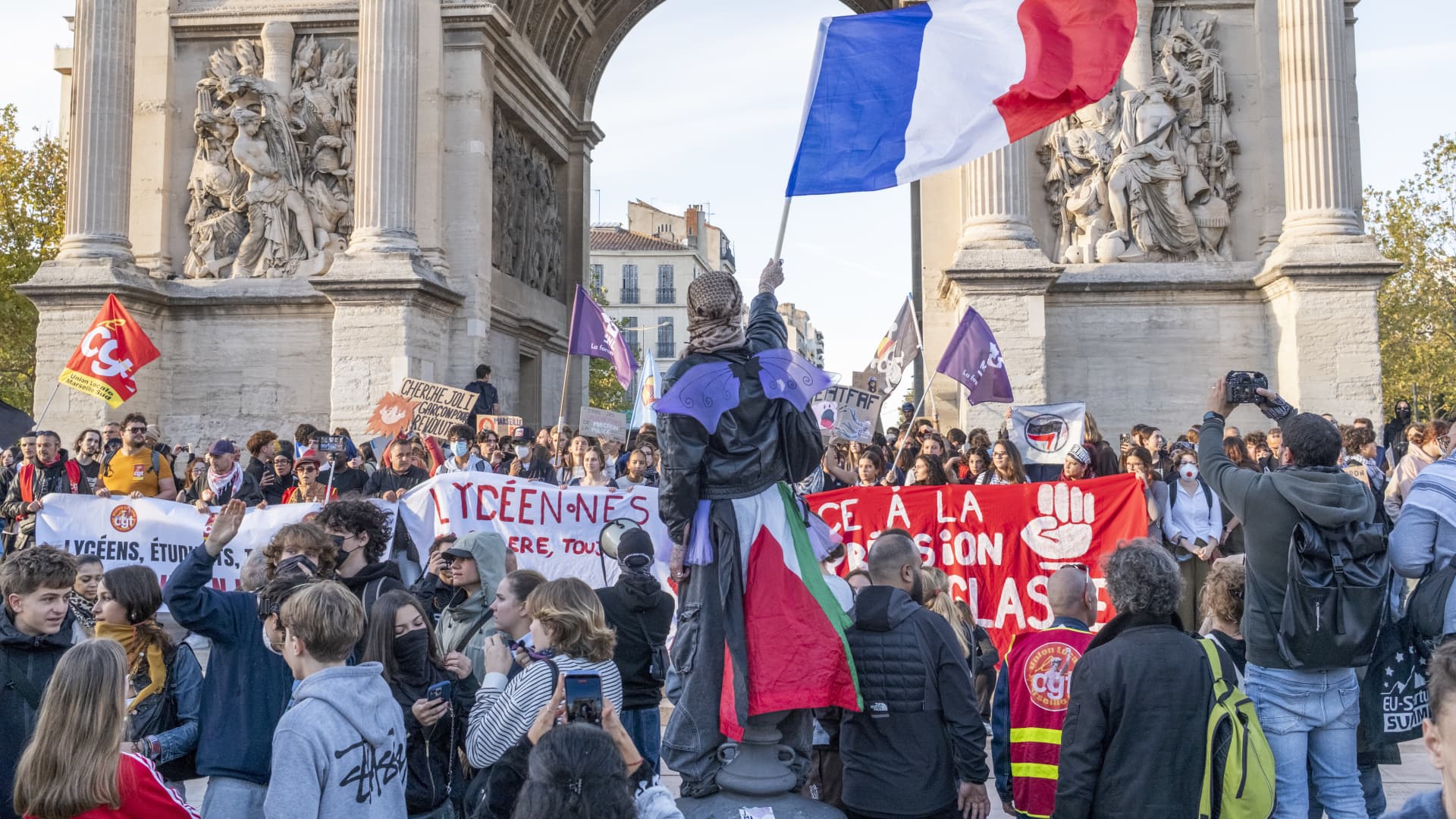

Tensions continue to rise in France as protests against deteriorating public services and the escalating cost of living persist, marking the fourth consecutive weekend of demonstrations. These events, initially ignited by students voicing concerns over the education system, have evolved into broader criticisms of government policy, accompanied by mounting frustrations regarding economic conditions as the nation approaches a critical presidential election in April 2027. This instability has not only affected public sentiment but also created warnings of recession, with businesses expressing heightened concerns over economic performance.
| Article Subheadings |
|---|
| 1) Background of Ongoing Protests in France |
| 2) Current Economic Conditions and Recession Warnings |
| 3) Election Concerns and Political Landscape |
| 4) Impacts of Civil Unrest on Economic Confidence |
| 5) Path Forward: Potential Economic Reforms |
Background of Ongoing Protests in France
On November 7, 2026, large crowds assembled at Porte D’Aix following a rally at Reformes Square in Marseille as part of a nationwide protest movement addressing the plunging state of public services and the rising cost of living. Originally sparked by student demonstrations that began over frustrations with the French education system, these protests resonate profoundly across society, reflecting widespread discontent with governmental policies.
The recent surge in activism has seen a notable participation of various demographic groups, united by their grievances regarding economic hardships, specifically the effects of inflation and budget cuts in essential services. These protests have gained momentum over the course of several weekends, leading to thousands of arrests and instigating a tense atmosphere characterized by protests that sometimes escalate into violence.
This discontentment draws upon a backdrop of rising national concerns about governmental efficacy and decision-making capacity, especially as voters prepare for the upcoming elections, which will determine not only the future political leadership but also the strategic direction of national policies regarding economic stability and public welfare.
Current Economic Conditions and Recession Warnings
As protests evolve, so, too, does the landscape of the French economy. Current data indicates significant strain, with the S&P Global Purchasing Managers’ Index reflecting a reduction in business activity to its lowest level in six months. This downturn, particularly evident in manufacturing sectors, suggests a pervasive sense of pessimism concerning future economic prospects. Many analysts indicate that the outlook for 2027 remains bleak, as businesses hesitate to make long-term decisions amidst a volatile political atmosphere.
Job losses have been reported for seven consecutive months, with companies citing economic uncertainty as a primary concern. Reports detail that fragile domestic demand suppresses sales, illustrating the extent of the economic malaise gripping the nation. With consumers tightening their belts due to rising costs, businesses are struggling to maintain profitability, and that further endangers economic growth over the near term.
Joe Hayes, a senior principal economist at S&P Global Market Intelligence, highlights that the likelihood of France entering a technical recession is increasing, with signs indicating a continuation of negative GDP growth. Following a modest contraction of 0.1% in the third quarter, the forthcoming economic data will be closely monitored for signs of recovery or further decline.
Election Concerns and Political Landscape
France is on the brink of a pivotal presidential election in April 2027, with the political environment charged by a growing desire for systemic change. Polling trends suggest a possible shift towards candidates who promise a departure from the collective policies of incumbent President Emmanuel Macron, with far-right candidate **Marine Le Pen** emerging as a frontrunner.
Analysts emphasize that the electoral landscape is being shaped not just by popular sentiments but also by candidates’ ability to provide assurance regarding fiscal sustainability and economic stability. Despite attempts by **Le Pen** to reassure financial markets with her fiscal proposals, doubts linger among experts about her ability to stabilize France’s debt trajectory.
Concerns are also heightened by the emergence of another popular candidate, **Jean-Luc Mélenchon** of the far-left, who advocates for progressive reforms that further complicate the political scene. With both economic and political pressures mounting, the upcoming election is poised to have a lasting impact on the course of France’s economy.
Impacts of Civil Unrest on Economic Confidence
The civil unrest and protests are having significant negative repercussions on economic confidence among both consumers and investors. Many companies cite the current state of uncertainty surrounding government stability as a major deterrent in their decision-making processes, leading to postponed projects and diminished investment commitments. Analysts observe a trend of hesitancy permeating through sectors essential for economic growth.
Banks and financial institutions report challenges in accessing favorable borrowing conditions, particularly as the widening spread between French and German bond yields intensifies. These higher borrowing costs limit companies’ abilities to finance new projects, with some housing sectors showing marked declines in sales due to skyrocketing borrowing costs.
In an environment where trust continues to diminish, economic forecasts remain fraught with uncertainty. The prevailing financial situation has resulted in calls from financial experts for concrete governmental measures aimed at restoring confidence in the French economy. Notably, new fiscal policies and budgetary reform discussions have emerged as critical focal points of dialogue among economic leaders.
Path Forward: Potential Economic Reforms
Despite the challenges facing France, there are discussions regarding potential reforms aimed at curbing the deficit and promoting stability. Recently, **French Finance Minister Roland Lescure** indicated that the government’s proposed economic growth forecast for 2027 might be subject to downgrade if significant fiscal actions are not taken. Calls for the implementation of a “golden rule” emphasizing strict controls on public spending are gaining traction among political candidates.
This concept, which aims to rejuvenate fiscal discipline, has been supported by various political candidates, including **Edouard Philippe** and **Marine Le Pen**. Such reforms are seen as essential to restoring credibility among financial markets. **Bank of France Governor Emmanuel Moulin** reassured that while confidence and political uncertainty remain critical issues, there are signs of resilience within certain sectors, such as electricity and defense, which might weather broader economic challenges.
The path to fiscal reform may involve contentious discussions within the fragmented parliament, but economic analysts maintain that effective management of public finance will be vital to ensure France navigates its economic tumult successfully. These reforms could potentially mitigate the adverse effects of dwindling public confidence and ultimately lead to a more stable economic atmosphere as the country heads into a crucial election cycle.
| No. | Key Points |
|---|---|
| 1 | Protests against public service cuts and rising living costs continue across France. |
| 2 | Current economic indicators suggest a heightened risk of recession in France. |
| 3 | Political uncertainty ahead of the 2027 presidential election significantly impacts economic confidence. |
| 4 | Civil unrest has led to increased borrowing costs and hesitancy among investors. |
| 5 | Discussions about fiscal reforms highlight the need for immediate governmental action to restore economic stability. |
Summary
The ongoing protests in France illustrate deep-seated frustrations stemming from economic decline and public service issues, all compounded by uncertainty ahead of the upcoming presidential election. With recession warnings looming and confidence wavering in both the public and corporate sectors, the need for effective government action becomes paramount. As the political landscape evolves, the potential implementation of economic reforms could play a crucial role in navigating the country through its current challenges while simultaneously fostering a more stable future.
Frequently Asked Questions
Question: What are the main reasons behind the protests in France?
The protests are primarily due to dissatisfaction with deteriorating public services, rising living costs, and frustrations with the education system, which have prompted widespread demonstrations across various demographic groups.
Question: How are economic conditions impacting the protests?
Economic conditions are contributing to the protests as businesses report job losses and decreased growth. The declining economic outlook has intensified public frustrations, with many calling for governmental reform.
Question: What is the significance of the 2027 presidential election in France?
The 2027 presidential election is critical as it may lead to significant shifts in government policy aimed at addressing economic issues, including fiscal management and public service funding, amidst growing discontent among the populace.
