

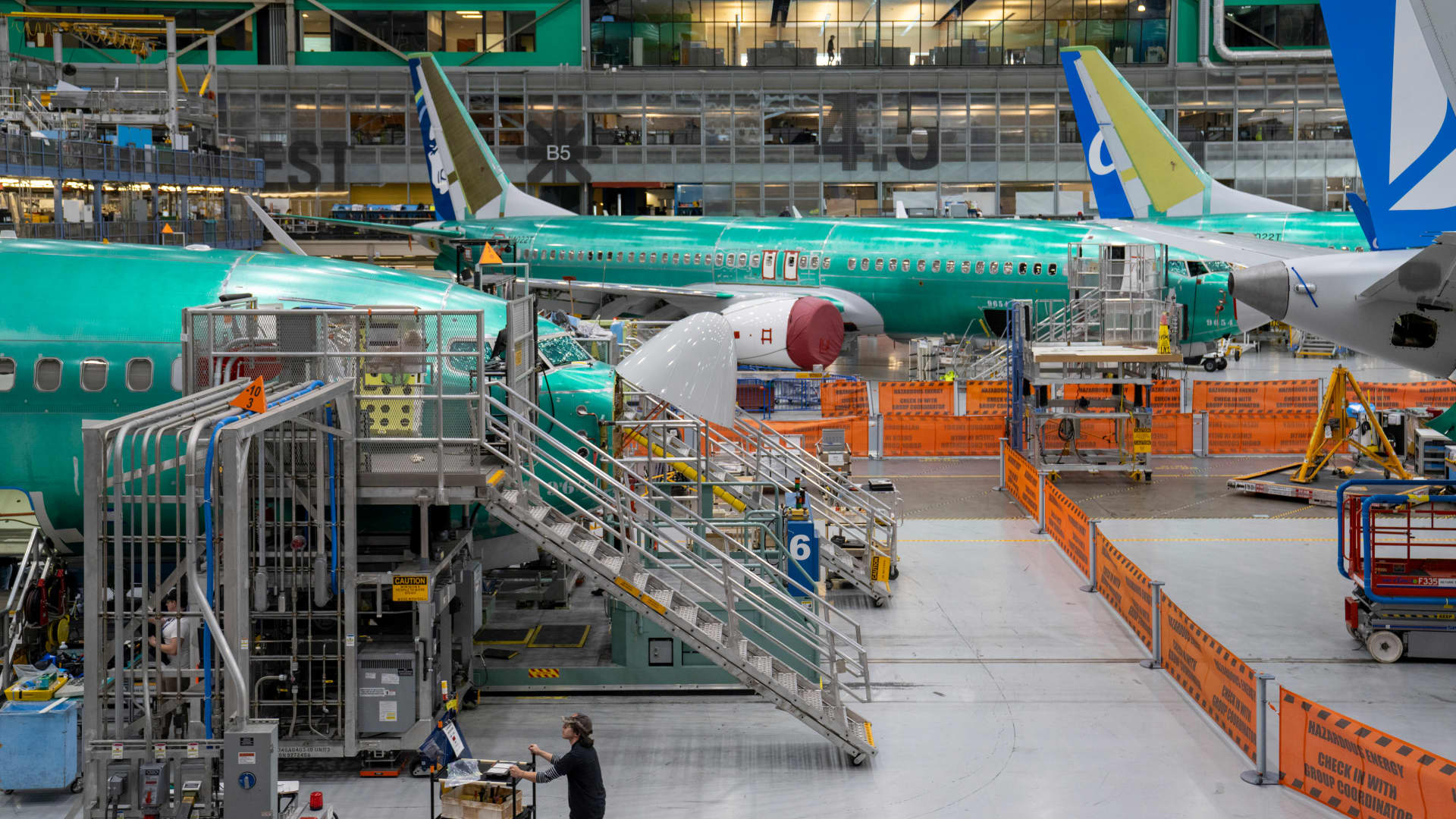

Boeing is facing an extended timeline for ramping up production of its 737 Max aircraft, as the company grapples with slow wing production. CEO Kelly Ortberg announced in a quarterly earnings call that the company does not anticipate reaching a production target of 52 aircraft per month until the second half of 2027. This announcement led to a subsequent drop in Boeing’s stock by 10%. Additionally, the company’s third-quarter earnings report revealed narrowed losses, largely supported by its defense unit, yet challenges remain in commercial aircraft revenue.
| Article Subheadings |
|---|
| 1) Production Challenges for Boeing’s 737 Max |
| 2) Financial Overview and Third-Quarter Earnings |
| 3) Recent Certification Achievements |
| 4) Future Prospects for Boeing’s Commercial Aircraft |
| 5) Industry Context and Competitive Landscape |
Production Challenges for Boeing’s 737 Max
Boeing’s production strategy for the 737 Max has recently encountered unexpected challenges, particularly due to a lag in wing production. According to CEO Kelly Ortberg, the company plans to reach a target production rate of 52 aircraft per month, but this goal is not expected to materialize until the latter part of 2027. Currently, production is at approximately 47 aircraft per month. The delays have raised concerns among investors and industry watchers, emphasizing the complexity of manufacturing processes and supply chain dependencies in the aerospace sector.
The announcement came during a quarterly earnings call where Ortberg indicated that while there is significant pressure to increase production rates, the focus must remain on safety and quality. He stated,
“I know everybody wants us to go faster, but we’re going to do it right.”
This sentiment illustrates Boeing’s commitment to maintaining high standards, despite the potential ramifications for deliveries and financial performance.
As wing production continues to be a bottleneck, analysts speculate about the impacts on Boeing’s broader operational performance and its ability to meet rising demand. The company’s efforts to stabilize production processes will be scrutinized as employees are urged to improve productivity and efficiency while adhering to stringent safety protocols. The slower-than-anticipated ramp-up could hinder Boeing’s competitive edge in the commercial jet market, as rivals seek to capitalize on any weaknesses.
Financial Overview and Third-Quarter Earnings
In tandem with production challenges, Boeing’s financial health is also a topic of discussion among investors and analysts. The company recently released its third-quarter earnings report, revealing a narrowed net loss of $116 million, or 26 cents per share, compared to a significant loss of $5.34 billion, or $7.14 per share, during the same period in the previous year. The major improvement is attributed to operational adjustments and a notable contribution from Boeing’s defense unit, which saw revenue grow 15% to $7.94 billion.
Despite this encouraging trend, deeper dives into the numbers reveal areas of concern. Boeing’s revenue climbed 4% year-over-year to $24.19 billion, largely boosted by defense contracts. However, after adjusting for one-time items, including a loss of 34 cents per share, the numbers suggest underlying issues in the commercial aircraft sector remain unaddressed. Analysts had projected a lesser loss of 21 cents per adjusted share.
Furthermore, Boeing’s commercial aircraft revenue fell by 3% to $10.72 billion, indicating challenges in the segment crucial to its recovery strategy. A negative operating margin of 6.5% resulted from delivery challenges and anticipated production adjustments, adding pressure to the company’s financial outlook. Ortberg echoed these concerns, indicating in a memo that while steps have been taken to improve efficiencies, there is still much work to be done to enhance the overall profitability of the business.
Recent Certification Achievements
Amid the challenges, there are also bright spots for Boeing. Recently, the U.S. Navy awarded Boeing a contract to develop its next-generation fighter jet, signaling ongoing confidence in Boeing’s capabilities in the defense sector. Additionally, the Federal Aviation Administration (FAA) recently granted full certification for the 737 Max 10, the largest variant in the Max family, following prior approvals for the Max 7. These certifications reflect the company’s advancements in regulatory compliance, a critical element in re-establishing trust with airlines and passengers alike.
Certification by the FAA is paramount for ensuring safety standards are met before aircraft can be delivered to customers, underscoring Boeing’s efforts to reassure stakeholders of its commitment to quality. The achievement of the Max model certifications marks a significant milestone for Boeing, as it looks to recover from previous setbacks associated with the 737 Max’s grounding. This progress will enable the company to begin deliveries of these aircraft, which is key to improving cash flows and meeting outstanding orders.
Future Prospects for Boeing’s Commercial Aircraft
Looking ahead, Boeing’s leadership recognizes the importance of adapting to a changing market landscape and addressing the production slowdown. Analysts suggest that Boeing must prioritize innovation and operational excellence to regain its competitive edge. Given the current dynamics, the focus will be on increasing the pace of deliveries, which is critical to cash flow since payment is often processed at the time of delivery.
As air travel continues to enhance globally, demand for aircraft is expected to rise. In this context, Boeing aims to enhance productivity through continuous improvement initiatives and lean manufacturing techniques. The pursuit of higher efficiency is essential as the company navigates the challenges presented by supply chain disruptions and labor shortages that have characterized the industry’s recovery post-pandemic.
Moreover, as airlines retire older fleets and seek more fuel-efficient aircraft, Boeing must align its offerings with market needs. Completing the production ramp-up will not only fulfill the commitments to existing customers but also enhance Boeing’s market position for future orders. Analysts predict that achieving this balance will be vital for Boeing’s long-term success and stability in the aerospace sector.
Industry Context and Competitive Landscape
The aerospace industry is witnessing heightened competition, particularly in the commercial aircraft sector where both Boeing and its rival, Airbus, are vying for market dominance. Airbus has recently showcased its ability to ramp up production rates effectively, capitalizing on Boeing’s challenges. As a result, Boeing’s slower production forecast is likely to allow competitors to capture a greater share of the market.
The geopolitical climate and economic uncertainties further contribute to a complex landscape for aerospace firms. Rising input costs and supply chain disruptions are persistent challenges that companies must navigate in their bid for profitability and growth. Within this context, Boeing’s efforts to stabilize its production and regain its footing will be crucial in maintaining confidence among investors, suppliers, and customers.
In conclusion, as Boeing works to overcome current obstacles, the company’s strategic response will determine its trajectory in a rapidly evolving market. The interplay of regulatory achievements, production capacity, and financial performance will shape how Boeing positions itself against competitors and responds to the expectations of stakeholders in the coming years.
| No. | Key Points |
|---|---|
| 1 | Boeing does not anticipate significantly increasing production of the 737 Max until the second half of 2027. |
| 2 | The company’s third-quarter earnings revealed a narrowed loss of $116 million, attributed to defense unit performance. |
| 3 | Boeing achieved recent certification milestones for the 737 Max, allowing it to build consumer confidence. |
| 4 | Future prospects for Boeing are focused on improving production efficiency to meet rising demand in the airline industry. |
| 5 | The competitive landscape sees Boeing and Airbus competing for market share, influencing Boeing’s strategic decisions. |
Summary
Boeing is navigating a period of significant challenges and opportunities as it looks to stabilize production and improve its financial performance. Although production ramp-up for the 737 Max is delayed until at least 2027, the company is focused on achieving greater efficiency and bolstering its defense sector to offset commercial setbacks. Recent certification achievements further illustrate Boeing’s commitment to enhancing safety and quality, crucial elements for bolstering trust in their aircraft. Moving forward, Boeing must adapt to a competitive landscape that presents both risks and growth potential for the future.
Frequently Asked Questions
Question: What are the main challenges Boeing is currently facing?
Boeing is encountering production delays primarily due to a slower-than-expected pace of wing manufacturing, which has hindered its ability to ramp up the output of its best-selling 737 Max aircraft.
Question: How did Boeing’s third-quarter earnings perform compared to previous years?
Boeing reported a narrowed net loss of $116 million, a significant improvement from a $5.34 billion loss in the same quarter the previous year, thanks mainly to gains in its defense unit.
Question: What certifications has Boeing recently achieved?
Boeing recently received FAA certification for the 737 Max 10, following prior approvals for the 737 Max 7, marking a crucial step in the recovery of its commercial aircraft business.
