

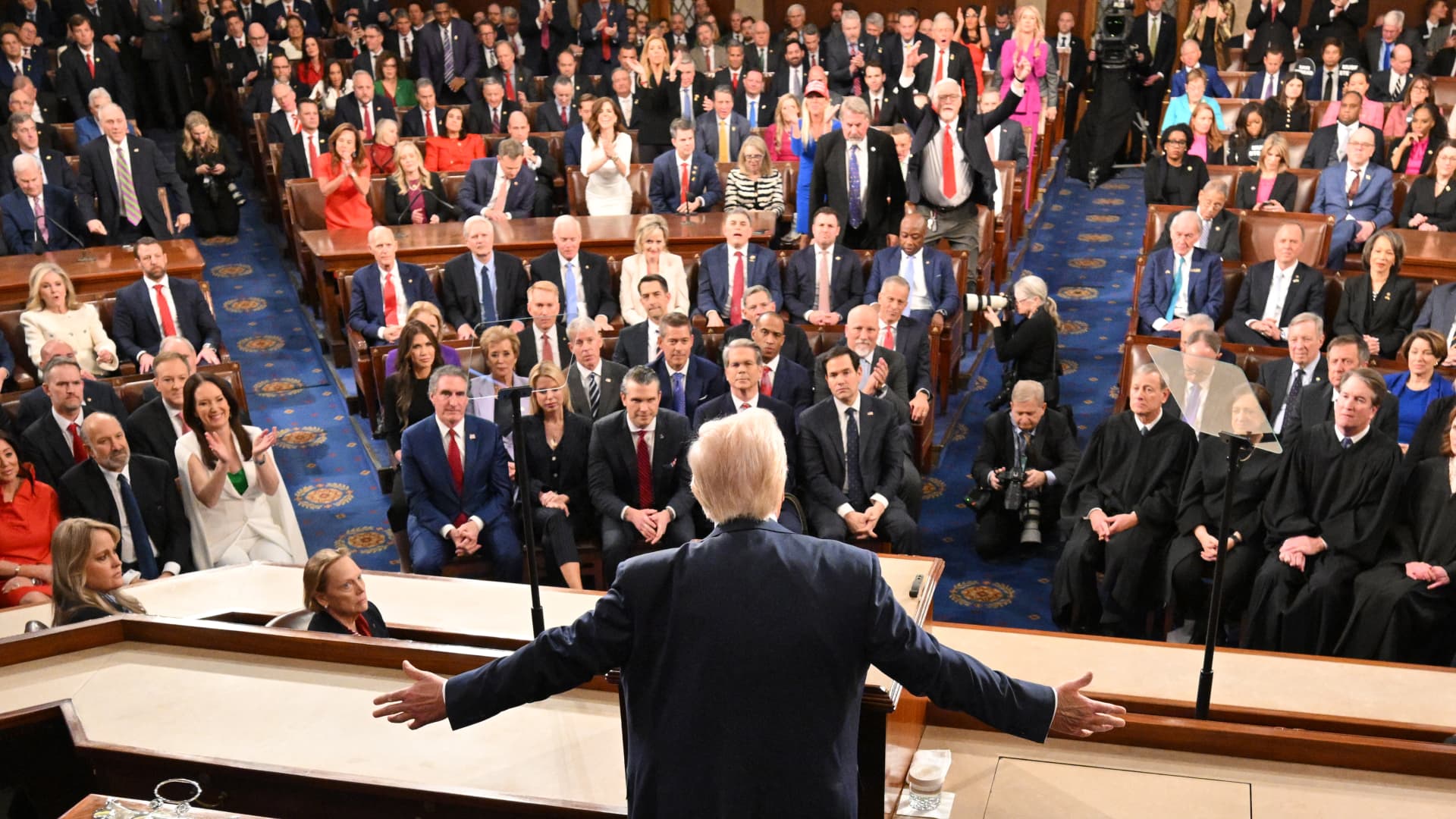

In a recent address before Congress, President Donald Trump championed tariffs as a crucial element for job creation in the U.S., asserting they would generate unprecedented employment opportunities. However, economists have expressed skepticism regarding these claims, suggesting the current tariff policies may actually hinder job growth. Analysis indicates that while some domestic industries might temporarily benefit, the broader economic repercussions could lead to an overall loss of employment in other sectors.
| Article Subheadings |
|---|
| 1) A barrage of tariffs |
| 2) Tariffs have ‘collateral damage’ |
| 3) Why tariffs are a ‘tax on exports’ |
| 4) ‘Disappointing results’ of Trump-era tariff policies |
| 5) Historical lessons from tariff policies |
A barrage of tariffs
Since the start of his presidency, President Trump has implemented an aggressive approach regarding tariffs on imports, particularly from key trading partners like China, Canada, and Mexico. Notably, he imposed a 20% duty on all imports from China, alongside a 25% tariff on both Canadian and Mexican goods, which are the United States’ two largest trade partners. These measures represent a significant shift in U.S. trade policy and are part of a broader initiative to bolster domestic manufacturing and reduce reliance on foreign products.
Scheduled for implementation are substantial tariffs on other materials, including steel and aluminum, set to rise by 25%. Additionally, duties on copper, lumber, and reciprocal tariffs on all trading partners are anticipated to follow shortly. The rationale behind such tariffs is to make foreign-produced goods more expensive, thereby promoting American-made products. This strategic economic policy is designed to protect domestic industries and their workforce from foreign competition.
Tariffs have ‘collateral damage’
While the introduction of tariffs might provide short-term relief to certain sectors, the broader economic implications reveal a more complex reality. Lydia Cox, an assistant economics professor at the University of Wisconsin-Madison, has researched the collateral effects of tariffs, noting that increased costs of imported materials can negatively impact other industries. For instance, the steel tariffs not only assist steel producers but simultaneously inflate production costs for manufacturers who depend on steel for their products.
Cox’s research highlights that tariffs can have unintended adverse effects on vulnerable sectors, resulting in job losses that outnumber gains in protected industries. For example, studies of past steel tariffs indicate that they led to a considerable reduction in employment in industries using steel, such as automotive and machinery manufacturing. Economists argue that this “collateral damage” is a critical consideration when evaluating the efficacy of tariff policies.
Why tariffs are a ‘tax on exports’
The repercussions of tariffs extend beyond domestic boundaries, resulting in retaliatory measures from other nations. Economists have cautioned that U.S. tariffs can effectively turn into a ‘tax on exports,’ making it more expensive for American producers to sell goods internationally. The early tariffs imposed by the Trump administration involved an average of 24% on $290 billion in U.S. imports, and the resultant retaliatory tariffs from affected countries went on to create a broader average tariff of 2% on U.S. exports.
This phenomenon highlights a critical downside of tariff policies: while they may aim to protect local industries, they can inadvertently diminish international competitiveness for exporters. Erica York, an economist, pointed out that the costs incurred by domestic producers from foreign retaliation ultimately outstrip the benefits of jobs created from tariffs. Executives and policymakers are faced with a dilemma; while the intention behind tariffs is to generate immediate job growth, the long-term economic impacts suggest otherwise.
‘Disappointing results’ of Trump-era tariff policies
A retrospective evaluation of the tariffs implemented during Trump’s presidency offers a sobering conclusion: the policies have not achieved their intended outcomes. Historical analysis, comparing recent tariffs to the Smoot-Hawley Tariff of 1930, indicates that protectionist strategies may have resulted in an overall reduction in economic health, contrary to their objectives. Evidence suggests that tariffs have notably reduced total manufacturing employment by 2.7%, even as they provided marginal protection to specific sectors.
Research conducted by economists further confirms that despite the temporary economic positioning of tariffs, the net outcome reveals a lack of revival in domestic manufacturing. Instead of fostering growth, this protectionist approach has seen a decline in overall employment figures in the manufacturing sector, validating claims made by several analysts that tariffs primarily hurt the very workers they are intended to help.
Historical lessons from tariff policies
Reflecting on historical precedents may shed light on the current economic landscape impacted by tariffs. The Smoot-Hawley Tariff is often cited as an example of a misguided but popular economic strategy, exacerbating the Great Depression rather than alleviating it. Similar patterns can be observed with the current administration’s tariffs, which have resulted in reduced exports and failed to yield significant benefits to the agricultural sector. Michael Strain, director of economic policy studies, noted that today’s protectionist policies yield “disappointing results,” echoing sentiments from the past.
As the global economy evolves, these protective measures may disrupt industries, leading to unintended consequences that extend beyond manufacturing. Strain encourages leaders to consider alternative policies that would better connect workers to future job opportunities rather than resorting to antiquated protective measures.
| No. | Key Points |
|---|---|
| 1 | President Trump asserts that tariffs will create significant job growth in the U.S. |
| 2 | Economists argue that tariffs could lead to job losses in other sectors of the economy. |
| 3 | Recent tariffs impose substantial costs on domestic manufacturers and lead to retaliatory measures from foreign nations. |
| 4 | Historical evidence suggests protectionist policies often result in negative economic outcomes. |
| 5 | Experts recommend connecting workers to more future-oriented job opportunities rather than reverting to past protectionist strategies. |
Summary
The ongoing debate surrounding the effectiveness of tariffs under President Trump‘s administration reflects a profound split between political rhetoric and economic realities. While the president promotes tariffs as a catalyst for job creation, economic analysis suggests a different picture, wherein these policies may result in a net loss of employment across various sectors. The insights drawn from this discourse underscore the importance of crafting policies that foster sustainable economic growth while mitigating adverse side effects, drawing lessons from both historical precedents and contemporary economic research.
Frequently Asked Questions
Question: What is the purpose of imposing tariffs?
The primary purpose of imposing tariffs is to protect domestic industries from foreign competition by making imported goods more expensive, thereby encouraging consumers to purchase locally produced products.
Question: How can tariffs negatively impact the economy?
While tariffs may protect specific industries, they can lead to increased production costs for other sectors, resulting in job losses and higher prices for consumers nationwide due to reduced competition.
Question: What historical examples are relevant to current tariff discussions?
The Smoot-Hawley Tariff of 1930 serves as a historical example, illustrating how high tariffs can lead to economic downturns, reduced exports, and negative impacts on domestic markets, a concern echoed by many economists today.
