

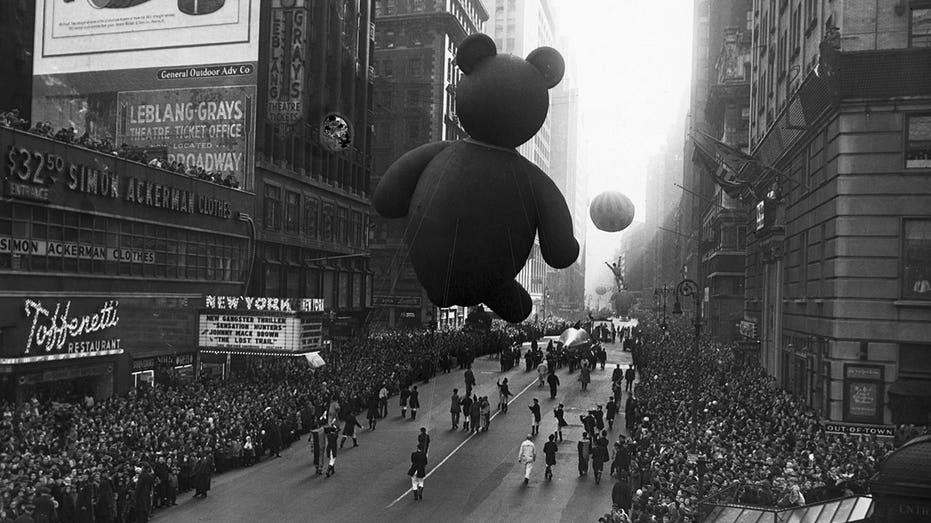

Severe weather has postponed the 100th Macy’s Thanksgiving Day Parade until Saturday, Nov. 28, marking the first delay of the holiday event. New York City officials moved the parade because forecast winds exceeded the safety limits for its giant balloons. Despite previous national crises and dangerous weather, the parade has been canceled outright only three times, in 1942, 1943 and 1944, during World War II. The event returned in 1945 to enormous crowds and renewed public excitement.
The 2026 decision followed forecasts of heavy rain and damaging winds across the Northeast and New England. Thursday morning gusts were projected at 35 mph to 45 mph, above the limits required for balloon operations.
| 1) | Storm conditions force the 2026 parade delay |
| 2) | Why balloon safety rules shaped the decision |
| 3) | World War II caused the only full cancellations |
| 4) | The parade returned as a postwar celebration |
| 5) | How the tradition continued through later crises |
Storm conditions force the 2026 parade delay
The 100th Macy’s Thanksgiving Day Parade was rescheduled from Thursday, Nov. 26, to 8:30 a.m. Saturday, Nov. 28. New York City officials announced the change as a powerful coastal storm threatened the city and surrounding areas with heavy rain and strong winds. The postponement was intended to protect balloon handlers, performers, spectators and others working along the Manhattan route.
The change is notable because the parade had continued on Thanksgiving Day through earlier periods of national difficulty. Officials characterized the 2026 action as a weather-related postponement rather than a cancellation, preserving the event while moving it beyond the most dangerous conditions.
Why balloon safety rules shaped the decision
The parade’s giant balloons require controlled wind conditions to be flown safely. Current rules call for sustained winds below 23 mph and gusts under 34 mph. Forecast Thursday gusts of 35 mph to 45 mph exceeded those limits, while broader storm forecasts called for gusts between 60 mph and 70 mph in parts of the Northeast and New England.
The limits were strengthened after the 1997 parade, when 40 mph gusts pushed the “Cat in the Hat” balloon into a lamppost and injured spectators. Severe weather has affected the parade before. In 1971, heavy rain and high winds kept the balloons grounded, but floats and marching bands still traveled the route.
World War II caused the only full cancellations
The only complete interruption in the parade’s century-long history came during World War II. After the attack on Pearl Harbor on Dec. 7, 1941, American manufacturing shifted toward military production. Rubber, helium, metal cylinders, tires and gasoline became strategically important, making the parade’s elaborate balloons and operations difficult to justify.
The parade was canceled in 1942, 1943 and 1944. During that period, Jack Strauss donated the giant balloons to New York City Mayor Fiorello La Guardia and the city’s Salvage Committee in a Nov. 13, 1942, ceremony. A 60-foot dragon balloon was symbolically cut apart, helping convert about 650 pounds of rubber into material for military uses such as tires, life rafts or dirigibles.
“But now we’ve a war to win and we’ve enlisted, to help make the world safe for future parades full of merriment and good will.”
Even without a street procession, the department store maintained a holiday attraction through mechanical window displays. The 1942 presentation, titled “The Funny Page Parade,” featured 26 floats.
The parade returned as a postwar celebration
The parade returned on Nov. 22, 1945, after the three-year wartime hiatus. An estimated 2 million spectators gathered along the route, including more than 30,000 people in Times Square. Contemporary accounts described the return as resembling a second victory parade, reflecting the public’s relief and enthusiasm after the war.
Seven bands and 20 floats took part, and the event was televised nationally for the first time. Balloons again filled the Manhattan skyline, including a 45-foot Bobo Clown, a 40-foot teddy bear and a triple-scoop ice cream cone. Aerial attractions required occasional helium top-offs when their shapes began to sag during the march.
How the tradition continued through later crises
The parade continued through other major disruptions after its 1945 return. Following the Sept. 11, 2001, terrorist attacks, organizers did not consider canceling the event. Ronnie Taffet, then a Macy’s public relations vice president, said officials believed holding the parade was important.
The 2020 parade also went ahead during the COVID-19 pandemic, but organizers removed the public audience from the route and shortened the procession from two blocks to one. Those adjustments, like the 1971 decision to ground the balloons, allowed parts of the tradition to continue. The 2026 storm therefore represents the first full postponement, rather than cancellation, of the parade.
| Number | Key Point |
|---|---|
| 1 | The 2026 parade was moved to Saturday, Nov. 28, because of dangerous storm conditions. |
| 2 | Balloon operations require sustained winds below 23 mph and gusts under 34 mph. |
| 3 | The only outright cancellations occurred from 1942 through 1944 during World War II. |
| 4 | The parade returned in 1945 to crowds estimated at 2 million people. |
Summary
The 2026 storm delay is an unusual disruption for the Macy’s Thanksgiving Day Parade, but it is not an outright cancellation. Only the three-year World War II suspension stopped the event entirely. Across later crises, organizers have generally adapted the route, balloons or audience arrangements to preserve the tradition while addressing safety and national circumstances.
Frequently Asked Questions
Why was the 2026 parade postponed?
A coastal storm brought forecasts of heavy rain and winds above the safety limits for the parade’s giant balloons, prompting officials to move the event to Saturday, Nov. 28.
Has the parade ever been canceled before?
Yes. It was canceled in 1942, 1943 and 1944 because World War II redirected rubber, helium and other resources to the military effort.
What happened during the 2020 parade?
The parade proceeded during the COVID-19 pandemic without spectators along the route, and organizers shortened the march from two blocks to one.
