

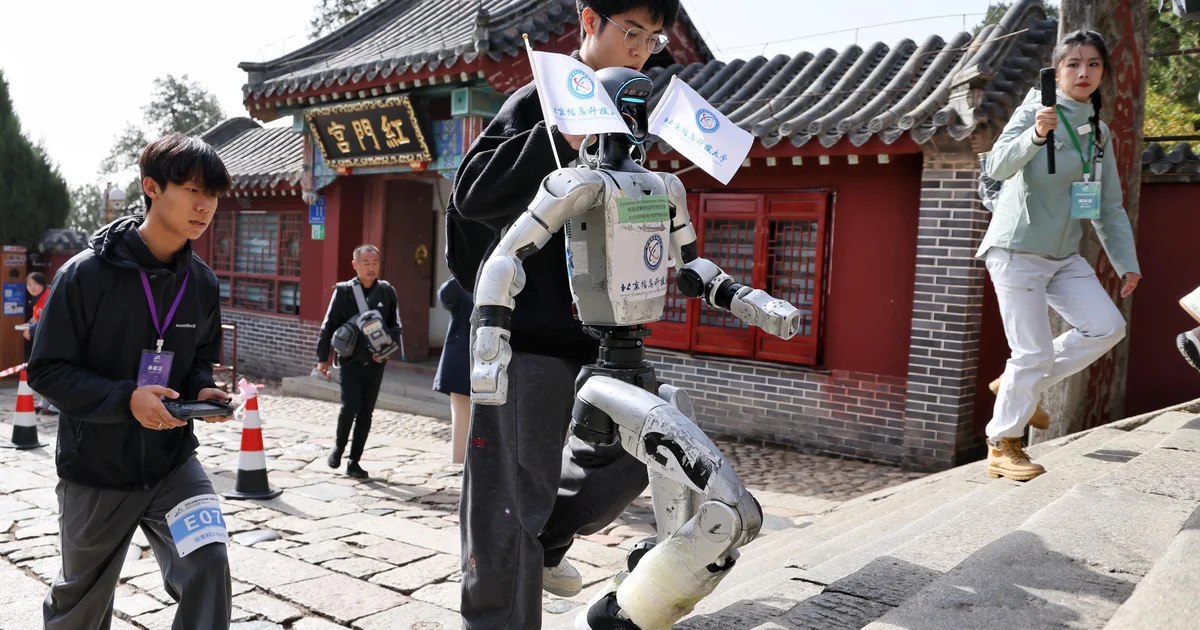

In a groundbreaking event showcasing advancements in robotics, dozens of robots undertook a significant challenge on Mount Tai in China. Over 3,000 steps and a demanding course were set to evaluate their endurance and capabilities, with some tasked to transport delicate items like eggs and watermelons. Organized by the China Media Group, this competition took place in a setting that is both a cultural icon and a natural testing ground, illustrating the juxtaposition of ancient heritage and modern technology.
| Article Subheadings |
|---|
| 1) The Historic Significance of Mount Tai |
| 2) The Competition’s Layout and Structure |
| 3) Highlights and Performances in the Race |
| 4) Technical Challenges Faced by Participants |
| 5) Future Implications of the Event |
The Historic Significance of Mount Tai
Mount Tai, a UNESCO World Heritage site, holds immense spiritual and cultural significance in China. Historically, this peak has attracted emperors and pilgrims alike for centuries, symbolizing a connection between heaven and earth. With an height of over 4,000 feet, it has inspired poets, artists, and travelers, making it one of China’s most revered landscapes. The peak’s mystical qualities form the backdrop of various myths and legends, which are entwined with Chinese traditions.
Aside from its cultural narratives, Mount Tai serves as a popular destination for both locals and tourists. The hiking trails, dotted with ancient inscriptions and temples, provide a historical journey alongside physical challenge. By hosting a technology event amidst such ancient surroundings, the organizers of the World Mountain Robot Challenge are bridging the past with futuristic innovations, demonstrating how modern robotics can thrive in environments steeped in history.
The Competition’s Layout and Structure
The inaugural World Mountain Robot Challenge featured a challenging course spanning 2.4 miles with an ascent of over 1,970 feet. This layout was designed to push participants to their limits, whether that meant completing the route as quickly as possible or focusing on the delicate transportation of goods. Contestants hailed from approximately 90 teams, each bringing their own design and technical approach to the task at hand.
The design of the race was not only about speed but also tested the robots’ agility and coordination. For instance, while some robots were built for brute force to haul heavy loads, others incorporated sophisticated balance mechanisms to navigate the uneven terrain of Mount Tai. The competition’s structure combined various elements, including speed trials and load-bearing tests, allowing for a comprehensive evaluation of each robot’s capabilities.
Highlights and Performances in the Race
Among the most impressive performances was a canine robot developed by Beijing Lingyi Technology, a subsidiary of industry giant Unitree, which completed the demanding course in a remarkable 43 minutes and 41 seconds, clinching victory in the four-legged speed category. The achievement not only showcased the engineering prowess behind the robot but also set a high standard for future robotic competitions.
In comparison, the top humanoid robot from Beijing-based team Zhishen Lingyue finished a shorter course in 27 minutes and 26 seconds. These performances highlighted both the advances in robotic technology and the rigorous testing afforded by the challenging environment of Mount Tai. The contrast in the robots’ designs displayed the diversity in robotics, emphasizing that different constructions can lead to varied outcomes depending upon the nature of the task.
Technical Challenges Faced by Participants
Despite the high-level achievements, several robots encountered significant technical challenges. One humanoid robot suffered a collapse while navigating the cobbled paths of Mount Tai, illustrating the difficulties engineers face in replicating human-like endurance in robotic designs. Another robot took a tumble down a flight of stairs, landing beside a rubbish bin, an incident that underscores the inherent risks present in such a demanding environment.
These challenges served as valuable learning experiences for the teams involved. Every setback indicated areas for improvement, especially in terms of navigation, stability, and robustness in design. Engineers quickly mobilized to troubleshoot issues during the competition, reflecting the collaborative nature of robotic challenges and the necessity for quick thinking in real-world applications.
Future Implications of the Event
The World Mountain Robot Challenge not only served as a testbed for technologies but also raised questions about the future implications of robotics in various industries. As robots become increasingly adept at traversing complex terrains, they could play pivotal roles in agriculture, search and rescue missions, and logistics. The rugged conditions of Mount Tai provided an ideal backdrop for understanding how robots might perform in challenging situations similar to real-world applications.
Organizers have indicated that the event aims to inspire innovation in robotics, fostering collaboration amongst teams to address the real challenges faced by robots in outdoor settings. As technology advances, competitions like this may pave the way for smarter machines capable of assisting humans in their endeavors, fostering advancements that could reshape various sectors.
| No. | Key Points |
|---|---|
| 1 | Dozens of robots participated in the World Mountain Robot Challenge on Mount Tai. |
| 2 | The competition featured a 2.4-mile course with a significant elevation gain. |
| 3 | A canine robot won the speed category, completing the course in 43 minutes. |
| 4 | Technical challenges highlighted the difficulties in robot endurance on rugged terrains. |
| 5 | The event aims to inspire innovation and improve real-world robotic applications. |
Summary
The World Mountain Robot Challenge on Mount Tai exemplified the intersection of robotics and real-world challenges. As competitors navigated the symbolic yet demanding terrain, both the triumphs and tribulations of robotic engineering were laid bare. This event not only showcased current technological capabilities but also positioned itself as a catalyst for future advancements, fostering a spirit of innovation bound to influence industries far beyond the realm of competitions.
Frequently Asked Questions
Question: What was the goal of the World Mountain Robot Challenge?
The World Mountain Robot Challenge aimed to test the endurance and capabilities of robots in a real-world environment, focusing on speed and load transportation across a rugged course.
Question: Who organized the World Mountain Robot Challenge?
The challenge was organized by the state-run China Media Group, reflecting a governmental interest in advancing robotics and technology.
Question: How do robots perform in comparison to humans on the Mount Tai routes?
While the fastest robotic competitors completed the course in under an hour, most human tourists traditionally take about two hours to finish the same route, indicating a significant advantage in specific robotic capabilities.
