

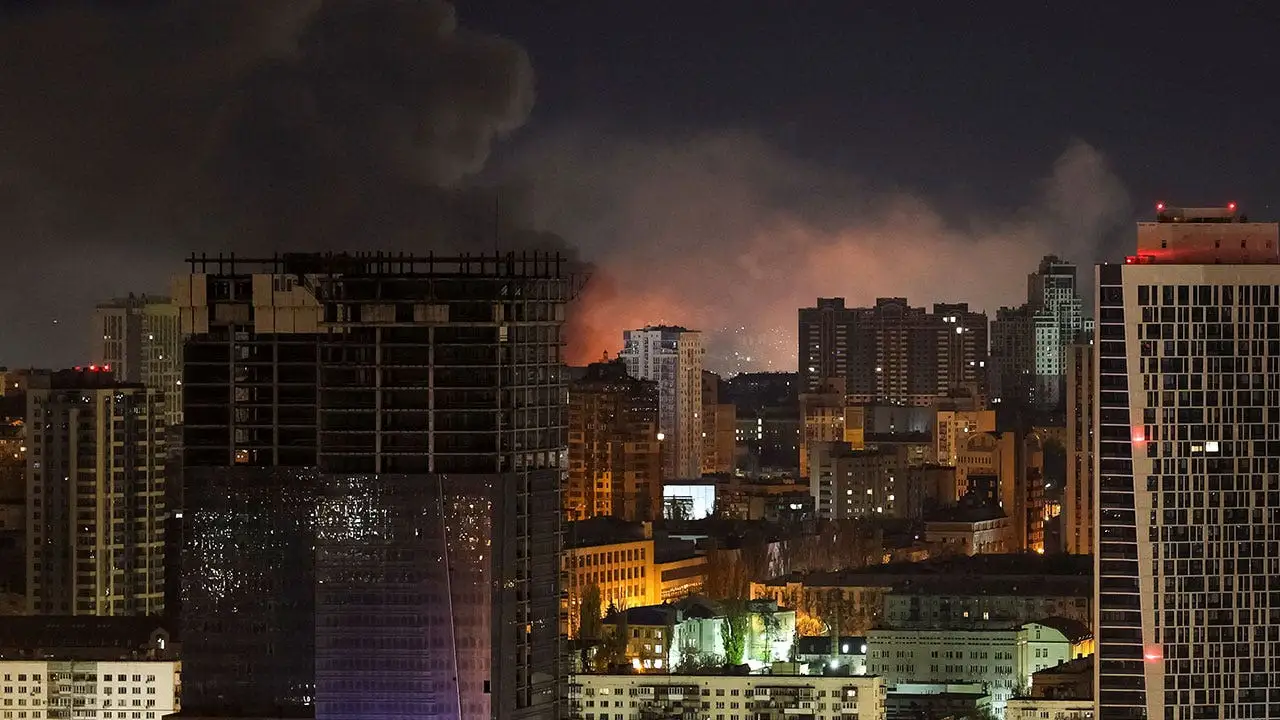

In a dramatic escalation of the ongoing conflict, Russian President Vladimir Putin ordered one of the largest attacks on Ukraine since the start of the war, resulting in significant casualties. The overnight assault, which coincided with a historic summit between world leaders in China, raises serious concerns not only for Ukraine but also for NATO allies, with missiles reportedly breaching Polish airspace. As tensions mount, military experts suggest that Putin is intent on applying sustained pressure on Ukraine while navigating diplomatic channels aimed at altering the battlefield dynamics.
| Article Subheadings |
|---|
| 1) Russia launches massive attack on Ukrainian cities |
| 2) Russian missiles enter NATO-member Poland |
| 3) Putin’s strategy as peace talks advance |
| 4) The Kyiv response and the international reaction |
| 5) Implications for NATO and regional security |
Russia launches massive attack on Ukrainian cities
Ukrainian President Volodymyr Zelenskyy confirmed that Russia executed a relentless attack involving over 400 drones and more than 110 missiles, targeting crucial infrastructure across the nation. The assault resulted in the deaths of at least eight individuals—six in the capital of Kyiv and two in the western city of Lviv—while injuring dozens more. The strikes specifically targeted energy facilities, transportation hubs, and logistical infrastructure, causing widespread disruptions as Ukraine braces for the harsh winter ahead.
Major bridges spanning the Dnipro River in Kyiv—namely the Podilsko-Voskresenskyi, Darnytskyi, and Pivdennyi bridges—sustained significant damage, impeding transit between eastern and western sectors of the capital. Russian forces also compromised railway infrastructure and energy installations, which triggered emergency power outages amid falling temperatures. Zelenskyy characterized the assault as one of the largest since the escalation of hostilities began, framing it as a desperate attempt by Moscow to regain control over the narrative after recent military setbacks.
“They are trying to compensate for losses in the military and diplomatic arenas,” Zelenskyy remarked, providing insight into the Kremlin’s current tactics. The Russian Defense Ministry further substantiated the operation’s scale and purpose, claiming it targeted sites tied to the Ukrainian military-industrial complex.
Russian missiles enter NATO-member Poland
The Russian assault extended concerns beyond Ukraine’s borders when Polish officials reported multiple incursions into their airspace, with at least one projectile identified as a Russian Kh-101 cruise missile. Polish Defense Minister Władysław Kosiniak-Kamysz confirmed the findings and noted that debris was discovered in southern Poland, inducing a heightened sense of urgency regarding the territorial integrity of NATO allies.
Kosiniak-Kamysz was explicit about the violations, stating, “There has been a violation of Polish airspace and an incursion by objects from the Russian Federation.” This prompted Poland to seek enhanced NATO support to bolster defense initiatives along its eastern flank, revealing the precariousness of regional security amid escalating tensions. Military experts, including retired General Philip Breedlove, argued that such incursions were tests of NATO’s resolve and demonstrated a calculated risk from the Russian leadership.
Breedlove articulated that if there is no cost associated with these provocations, Russia will continue to push boundaries. “Mr. Putin will push further and further when there is no cost to him; he will continue,” he cautioned.
Putin’s strategy as peace talks advance
The attacks coincided with diplomatic developments, as the Trump administration announced progress toward expanding peace negotiations involving Russia, Ukraine, and European governments. U.S. envoy Jared Kushner relayed that Moscow had tentatively agreed to include European representatives in multilateral peace talks, although skepticism about Russia’s intentions persists. The rapid succession of military aggression following diplomatic moves underscores a complex and fraught negotiation landscape.
Still, Russia’s Deputy Foreign Minister Sergei Ryabkov indicated mixed signals, suggesting that the invitation extended to Europeans did not inherently signify acceptance into the existing U.S.-brokered framework. This ambivalence hints at Moscow’s strategic calculations—that engaging in talks can bolster their leverage while simultaneously maintaining operational military pressure on Ukraine.
An intelligence source indicated that Russia is adopting a twofold approach: to prolong military operations while shifting the focus of negotiations toward broader European security questions. This tactic aims to obfuscate the direct territorial negotiations with Ukraine, which could compel Ukraine to make concessions as winter looms. Additionally, reports of targeted mobilization, particularly among individuals facing economic difficulties, shed light on how Russia seeks to maintain troop strength without formal announcements of wide-scale mobilization.
The Kyiv response and the international reaction
In response to the attacks, the Ukrainian government has reiterated its commitment to defend its sovereignty, calling for immediate international assistance to counteract the escalating threat from Russia. Ukrainian leadership reached out to Western allies for support, emphasizing the need for advanced military systems capable of neutralizing drone and missile threats. Discussions surrounding the provision of enhanced air defense systems have been re-energized, focusing on fulfilling urgent operational requirements as winter conditions add another layer of complexity to military operations.
Internationally, reactions have emerged denouncing Russia’s latest wave of aggression. Various governments across Europe have signaled solidarity with Ukraine, emphasizing the need for continued comprehensive sanctions targeting Russian assets and economic interests. Furthermore, NATO officials have convened to assess the implications of the airspace violations and to reaffirm the alliance’s collective defense guarantees—reinforcing the principle that an attack on one member is considered an attack on all.
Implications for NATO and regional security
The recent developments not only underscore the immediate threat posed by Russian military actions but also reveal the broader ramifications for NATO and global security architecture. The ongoing assault highlights the necessity for entities like NATO to adapt to evolving geopolitical realities and demonstrates the urgent need for a coordinated response to uphold the principle of collective defense against aggression from nation-states like Russia.
As tensions persist, NATO is expected to conduct comprehensive evaluations of its defensive posture in light of these escalations. Member states may consider bolstering the presence of troops and military assets on the eastern flank to deter further incursions and provide reassurance to front-line members like Poland and the Baltic states. Putin’s strategy appears to capitalize on perceived fractures within the alliance, seeking to exploit any hesitation among NATO member states regarding their collective response capabilities.
| No. | Key Points |
|---|---|
| 1 | Russia’s recent military assault on Ukraine resulted in significant civilian casualties and the destruction of vital infrastructure. |
| 2 | Multiple missiles from Russia violated NATO-member Poland’s airspace, raising alarms about regional security. |
| 3 | Diplomatic efforts are ongoing between the U.S., Russia, and European governments, though skepticism persists regarding Moscow’s intentions. |
| 4 | Ukrainian leadership has called for enhanced support and defense capabilities from Western allies to counter the escalating threat. |
| 5 | NATO is reevaluating its defense strategies in light of the recent aggressions, emphasizing the importance of collective defense. |
Summary
The unprecedented military assault by Russia on Ukraine marks a significant intensification of hostilities, contrasting sharply with diplomatic overtures aimed at easing tensions. As casualties mount and missile threats extend beyond Ukrainian borders, it is evident that the challenges facing Ukraine are likely to escalate amid a harsh winter. The situation underlines the imperative for NATO to reassess its defense mechanisms in response to Russia’s provocative maneuvers, while also reaffirming the importance of international unity and resolve in the face of aggression. The coming months will be crucial in determining both Ukraine’s fate and the broader geopolitical landscape of European security.
Frequently Asked Questions
Question: What triggered Russia’s latest attack on Ukraine?
The timing of the latest assault, which coincided with high-level diplomatic engagements involving world leaders, suggests a strategic decision by Russia to apply pressure on Ukraine amidst ongoing peace talks.
Question: How are NATO members responding to Russia’s incursions into Polish airspace?
Poland is seeking increased support from NATO to secure its eastern borders and confront potential threats posed by Russian military actions.
Question: What are the implications of Russia’s military strategy for Ukraine and NATO?
Russia’s military strategy is designed to intensify pressure on Ukraine, compelling it to consider territorial concessions while testing the resolve of NATO and its collective defense commitments.
